High Valyrian in House of the Dragon Season 3 Episode 1 — Breakdown and Analysis
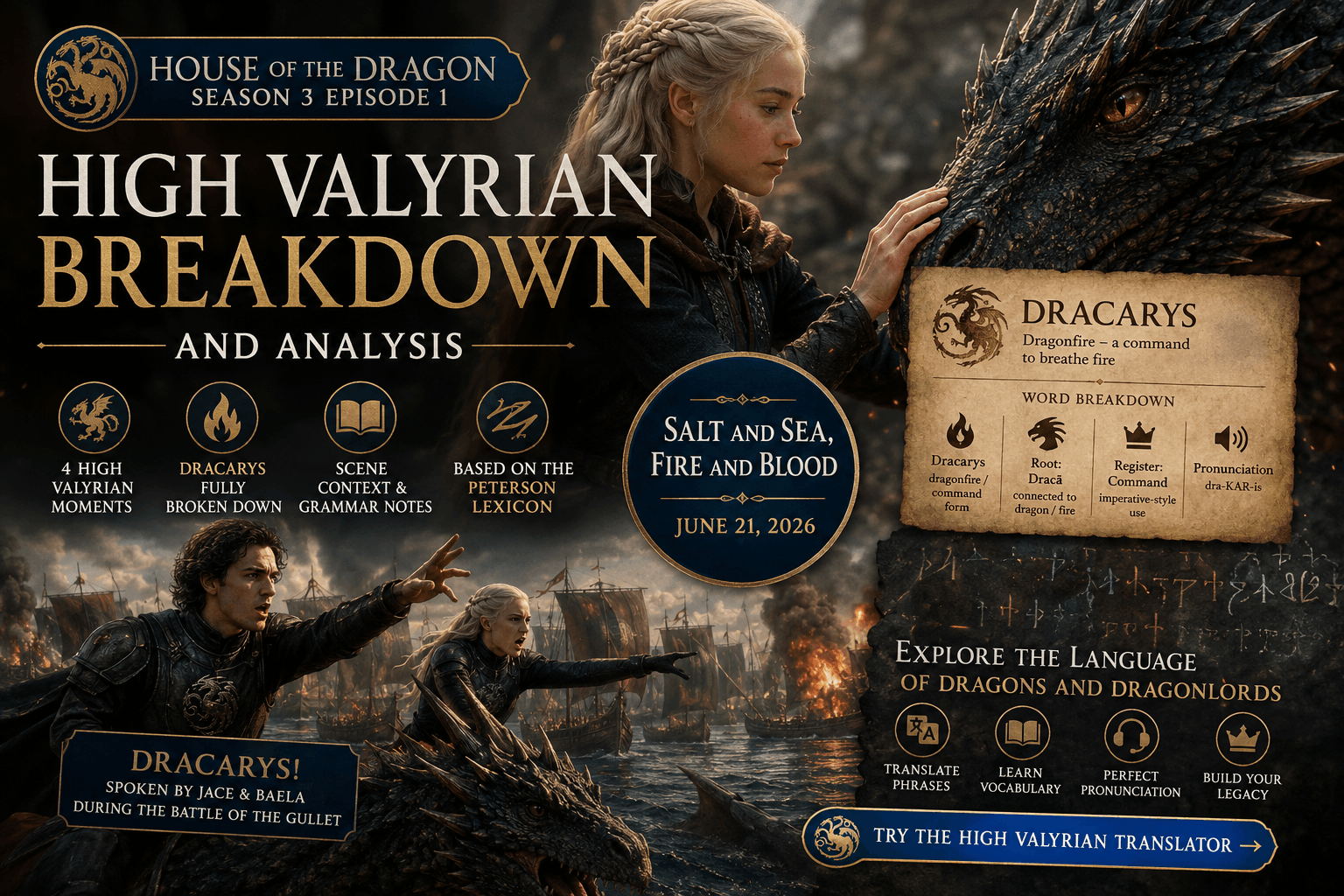
Salt and Sea, Fire and Blood aired June 21, 2026. Episode 1 contains four High Valyrian moments. Dracarys is fully confirmed and broken down here with grammar notes and scene context. Rhaena’s bonding scene lines are analysed in detail.
Quick Answer
Episode 1 of House of the Dragon Season 3 contains three High Valyrian moments from Rhaena Targaryen during her bonding scene with Sheepstealer, plus the command Dracarys spoken by Jace and Baela during the Battle of the Gullet. Dracarys is fully broken down here. Rhaena’s exact lines will be added once official subtitles are confirmed.
About This Episode
Title: Salt and Sea, Fire and Blood
Season: 3 — Episode: 1
Air date: June 21, 2026 — HBO and HBO Max
High Valyrian moments: 4
Season 3 was confirmed by Matt Smith to feature significantly more High Valyrian than previous seasons. He described the language as “such a hard language to learn” at CCXP Mexico, calling it a blend of around ten different languages. Episode 1 delivers on that promise early — placing the most emotionally significant Valyrian lines in the hands of Rhaena during her long-awaited dragon bond.
This guide covers every High Valyrian moment in the episode, with a full breakdown where vocabulary is confirmed in the documented Peterson lexicon, and honest scene analysis where exact subtitle wording has not yet been officially released.
A Note on Sourcing — Why Accuracy Matters Here
Honesty builds authority. The official subtitle file for Episode 1 had not been released in full at time of writing. Some lines spoken by Rhaena during the Sheepstealer bonding scene appear in the transcript as [speaks High Valyrian] and [singing in High Valyrian] without the exact words printed. Where we have confirmed on-screen words, we break them down fully. Where we do not, we say so clearly and explain what the scene context tells us linguistically. We will never invent Valyrian dialogue and pass it off as canon.
High Valyrian was constructed by linguist David J. Peterson for HBO. All analysis on this site draws from the documented High Valyrian lexicon and grammar as developed by Peterson. For lines not yet fully confirmed, we provide scene analysis and will update this post once official subtitles are available.
The High Valyrian Moments — Episode 1
Moment 1 — Rhaena Speaks to Sheepstealer (Opening Scene)
Moment 2 — Rhaena Sings to Sheepstealer
Moment 3 — Rhaena Speaks Again During the Bond
Moment 4 — Dracarys (Battle of the Gullet) — Fully Confirmed
High Valyrian Vocabulary in This Episode — Reference Table
Every confirmed High Valyrian word and phrase used or directly relevant to Episode 1, with meanings, pronunciation, and grammar notes.
| High Valyrian | English Meaning | Pronunciation | Grammar Note |
|---|---|---|---|
| Dracarys | Dragonfire / breathe fire | dra-KAR-is | Command form. Spoken by Jace and Baela at the Gullet. The r is always a trill in High Valyrian. |
| Zaldrīzes | Dragon | zal-DREE-zes | Base noun form. Long ī requires a held vowel. Form changes in sentences depending on case. |
| Ñuha zaldrīzes | My dragon | NYOO-hah zal-DREE-zes | Possessive phrase. A common rider-to-dragon address pattern across the series. |
| Rytsas | Hello / greetings | RIT-sahs | Standard greeting. Relevant to Rhaena’s careful, non-aggressive approach to Sheepstealer. |
| Kirimvose | Thank you | kee-rim-VOH-seh | Polite fixed phrase. Relevant to Rhaena’s third moment after the bond is accepted. |
| Perzys | Fire | PER-zis | Core vocabulary word. Central to Targaryen and dragonlord identity throughout the show. |
| Ānogar | Blood | AH-no-gar | Long ā at the start. Part of the fire-and-blood vocabulary — appears in the episode title theme. |
| Dārys | King | DAH-ris | Relevant to the episode’s political theme of contested kingship between Aegon and Rhaenyra. |
| Dāria | Queen | DAH-ree-ah | Rhaenyra is referenced as queen throughout the episode, including by her own sons. |
| Valar morghulis | All men must die | VAH-lar mor-GHOO-lis | Fixed phrase. Deeply relevant to an episode in which Jace — a prince and dragonrider — is killed. |
| Valar dohaeris | All men must serve | VAH-lar doh-HAE-ris | The paired response. Characters across both factions serve causes that cost them everything. |
Why Rhaena Speaks Valyrian to Sheepstealer — The Linguistics
The scene where Rhaena bonds with Sheepstealer is built around a belief that runs through the entire ASOIAF world: dragons do not simply obey riders. They respond to Valyrian blood and the Valyrian language itself.
High Valyrian is not just communication for Targaryens. It is identity. Speaking it to a dragon is an act of claiming kinship — not commanding, but declaring.
Sheepstealer has rejected every previous rider. Rhaena’s approach is patient and quiet — the Valyrian she speaks reflects that register. Song, not command.
Daemon sang to Vermithor in Season 1. Rhaena sings to Sheepstealer in Season 3. The parallel is deliberate. Song is the highest form of Valyrian address to a dragon.
This is why the Valyrian in the bonding scene matters beyond a simple subtitle. It is the moment where Rhaena — who has spent two seasons without a dragon of her own — finally claims her inheritance in her family’s ancestral tongue. The language is the proof of the bond, not just its expression.
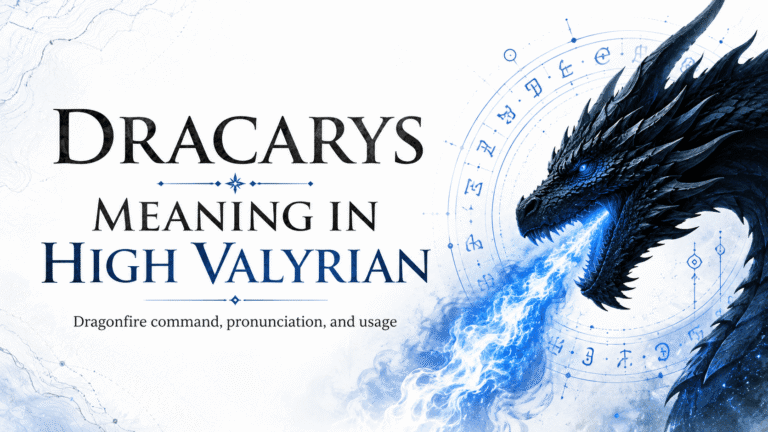
Dracarys — The Most Important Word in the Episode
Dracarys appears twice in Episode 1 — once from Jace on Vermax, once from Baela on Moondancer. Both commands come during the Battle of the Gullet, the largest naval battle of the Dance of the Dragons.
The word’s weight in this episode comes from what follows it. Jace shouts Dracarys in what becomes his final act as a dragonrider. Within minutes, Vermax is hit by a scorpion bolt, drowns, and Jace — swimming free of the saddle — is shot and killed by Triarchy archers.
The irony is precise. Dracarys is a word of power — the command that sets the world on fire. In this episode, the boy who speaks it dies moments later in the water, surrounded by burning ships, with no dragon to save him.
dra-KAR-is — Stress on the second syllable. The r in High Valyrian is always a trill, not the soft English approximant. The final s is pronounced clearly.
What Changes in Season 3 — The Valyrian Register Shifts
Matt Smith’s confirmation that Season 3 features significantly more High Valyrian is not just a quantity change. The register of the language appears to shift as the war deepens.
- Season 1: High Valyrian used primarily in formal settings — court, titles, dragonkeeper commands
- Season 2: Valyrian used in emotional, private scenes — Daemon’s visions, battlefield commands
- Season 3: Based on Episode 1, Valyrian appears in bonding, song, and battle — the full emotional range of the language
This progression mirrors what the language represents in-world. At the start of the show, High Valyrian is a marker of status. By Season 3, it is a marker of survival — characters reaching for their deepest identity as everything around them falls apart.
Try These Phrases Yourself
Episode 1 features dragon commands, bonding language, and the vocabulary of fire and blood. Here are the phrases most directly connected to this episode that you can explore using the High Valyrian Translator.
| English Phrase | High Valyrian | Episode Connection |
|---|---|---|
| My dragon | Ñuha zaldrīzes | The possessive form Rhaena would use when addressing Sheepstealer |
| Fire and blood | Perzys ānogar | The Targaryen words — central to the episode title and theme |
| All men must die | Valar morghulis | The phrase that defines Jace’s death at the end of the episode |
| Dragonfire | Dracarys | Spoken by Jace and Baela during the Battle of the Gullet |
| Salt and sea | Explore in translator | The episode title — try translating each word into High Valyrian |
Frequently Asked Questions
What High Valyrian is spoken in HotD Season 3 Episode 1?
Episode 1 contains three High Valyrian moments from Rhaena Targaryen during her bonding scene with Sheepstealer, including a sung passage. It also includes Dracarys spoken by Jace and Baela during the Battle of the Gullet. The exact wording of Rhaena’s lines will be added here once the official subtitle file is released.
What does Dracarys mean in High Valyrian?
Dracarys means dragonfire and functions as a command. Riders use it to instruct their dragons to breathe fire. It is the most widely recognized word in the High Valyrian lexicon. In Episode 1 it is spoken by Jacaerys on Vermax and Baela on Moondancer during the Battle of the Gullet.
Why does Rhaena sing to Sheepstealer in High Valyrian?
In the world of ASOIAF, dragons respond to Valyrian blood and the Valyrian language. Song represents the highest and most intimate form of Valyrian address to a dragon — Daemon used it with Vermithor in Season 1. Rhaena’s song mirrors that moment and marks her bond as genuine rather than forced.
Will you update this with Rhaena’s exact Valyrian lines?
Yes. Once the official subtitle file or David Peterson’s translation notes are released, we will update this post with the exact High Valyrian text, word-by-word breakdown, and grammar notes for every line Rhaena speaks and sings. Bookmark this page or check back after Episode 2 airs.
How do you pronounce Dracarys correctly?
The correct pronunciation is dra-KAR-is, with stress on the second syllable. The r in High Valyrian is always a trill, similar to Spanish or Italian, not the soft English r. The final s is pronounced clearly, not dropped.
Is there more High Valyrian in Season 3?
Yes. Actor Matt Smith confirmed at CCXP Mexico 2026 that Season 3 features significantly more High Valyrian than previous seasons, describing the language as challenging because it draws on elements of multiple languages. Episode 1 sets that up with Rhaena’s bonding scene and the Gullet battle commands.
Can I translate the episode title into High Valyrian?
Yes. The title Salt and Sea, Fire and Blood maps directly onto High Valyrian vocabulary. Fire is Perzys and blood is Ānogar. You can explore the full title using the High Valyrian Translator.
Related Guides
Explore the High Valyrian from This Episode
Try translating the phrases from Salt and Sea, Fire and Blood — Dracarys, fire and blood, my dragon — using the free High Valyrian Translator with word-by-word breakdowns.
Try the High Valyrian Translator →