Why Word Order Matters in High Valyrian Grammar and Meaning
Introduction
Word order in High Valyrian is flexible, but it is not random. Learners often hear that the language allows freedom in sentence structure, then assume they can place words anywhere. That assumption leads to confusion, unnatural sentences, and misunderstandings.
High Valyrian uses a rich case system, something you can observe directly when testing sentences inside a High Valyrian translator tool. Because nouns change form depending on their role, the language does not depend on strict Subject Verb Object order like English does. However, word order still carries meaning. It shows emphasis, focus, contrast, and tone. It can subtly shift what feels important in a sentence.
In long-term learner forums and structured study groups built around the grammar created by David J. Peterson, I have seen the same pattern repeatedly. Students memorize declensions and conjugations but ignore sentence flow. Their grammar is technically correct, yet their sentences feel strange to experienced readers.
Short summary: High Valyrian allows flexible word order because of its case system, but different word arrangements affect emphasis, clarity, and naturalness. Understanding these patterns is essential for writing and speaking convincingly.
This guide explains why word order matters, how it works in real usage, and what serious learners should pay attention to.
The Role of Case Endings in Sentence Structure
High Valyrian, developed by linguist David J. Peterson for the television series Game of Thrones, has a fascinating origin story explored in our guide on who created the High Valyrian language. Nouns change form depending on whether they are the subject, object, or part of another grammatical function.
For example, in a simple sentence such as “The dragon sees the man,” English depends on order. If we reverse the nouns, the meaning changes. In High Valyrian, case endings indicate who is doing the action and who is receiving it. That allows more freedom.
However, freedom does not mean lack of structure. In beginner classes and online learning communities, I have noticed that students often overcorrect. After learning that case endings carry meaning, they begin experimenting with extreme word orders. Technically, some of these constructions remain grammatically valid. Yet they feel heavy or unnatural.
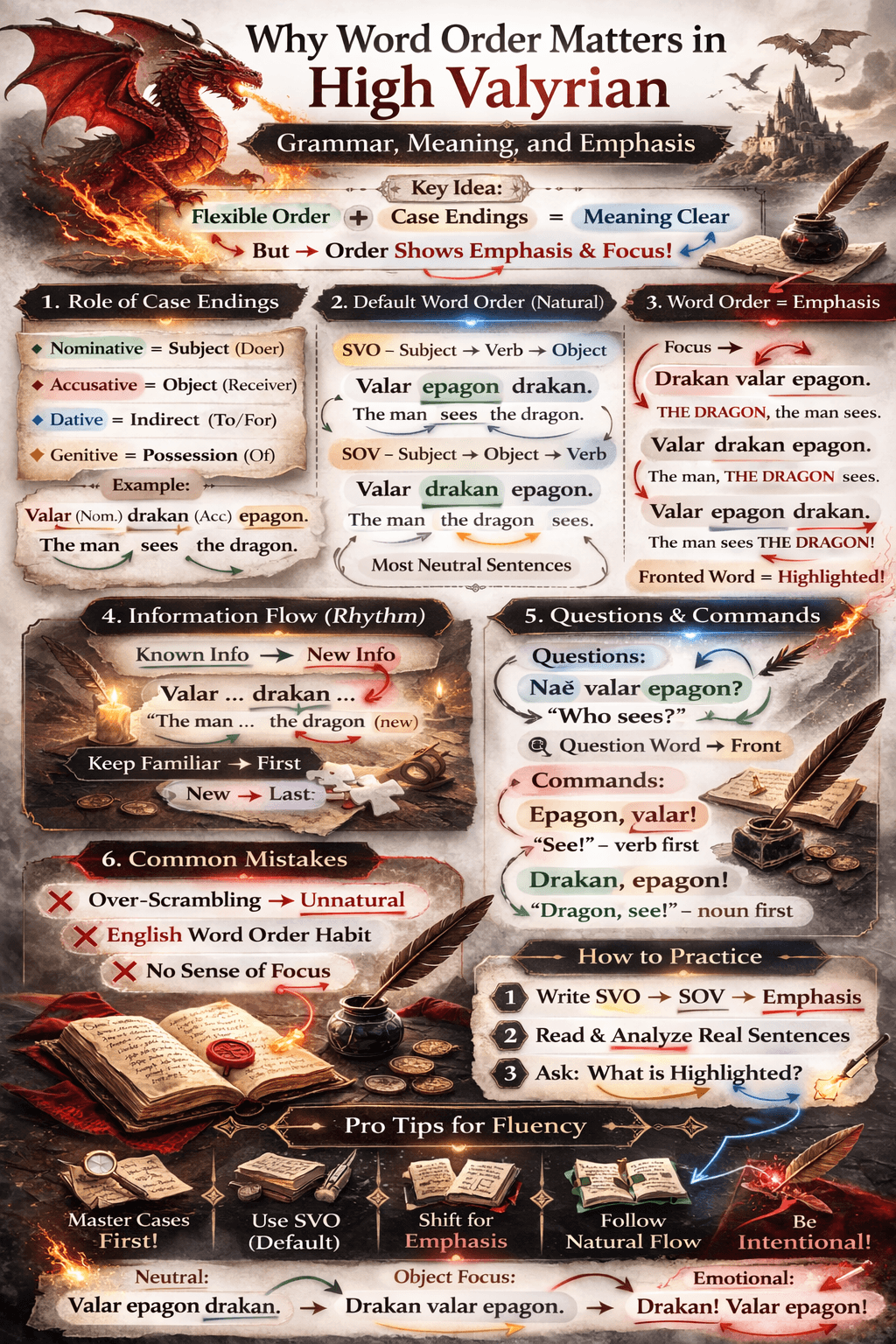
The case system gives flexibility, but natural High Valyrian still follows patterns. Subject Verb Object and Subject Object Verb are both common. Completely scrambled sentences are rare outside of poetry or stylized speech.
A common learner mistake is assuming that because endings show function, word order becomes irrelevant. In reality, word order works together with case endings. Case tells us what role a noun plays. Word order tells us what information the speaker wants to highlight.
Understanding this cooperation is the foundation for advanced fluency.
Default Word Order Patterns in High Valyrian
Although High Valyrian allows variation, there are default tendencies. In most neutral declarative sentences, Subject Verb Object appears frequently. You will see this in many examples from the Game of Thrones dialogue and in structured grammar examples.
This does not mean High Valyrian copies English. Instead, it reflects natural processing. Speakers often introduce the subject first, then the action, then the object.
In study groups that analyze canonical sentences, learners quickly notice that the most natural sounding examples follow predictable rhythms. When beginners try Object Subject Verb patterns in simple statements without context, the result feels marked or dramatic.
For example, placing the object first can create emphasis. It can imply contrast. It can suggest emotional weight. But if every sentence uses that pattern, the speech becomes unnatural.
One realistic issue I observed in peer correction sessions involved translation exercises. Learners translating from English sometimes rearranged words purely to sound “more foreign.” They believed deviation from English structure automatically made the sentence better. Experienced learners consistently corrected this approach.
Naturalness in High Valyrian comes from balance. Use common word orders for neutral statements. Shift order deliberately when you want to emphasize something specific.
Word Order as a Tool for Emphasis and Focus
When a speaker moves a word to the beginning of a sentence, that word gains prominence. This is true in many languages, and High Valyrian is no exception.
Suppose you want to emphasize the object. Placing it earlier in the sentence can signal importance. This is especially common in emotional or dramatic contexts.
In community reading sessions where participants reenacted scenes, we compared neutral sentences with rearranged versions. The difference was subtle but powerful. Fronted elements felt charged. They carried weight.
Learners often misunderstand this feature. They think moving words around simply adds stylistic variety. In practice, it changes interpretation.
For example, if a sentence begins with the object, it may imply contrast. It may answer an implicit question. It may suggest correction of a previous statement.
One pattern I observed in advanced learner writing is overemphasis. When every sentence begins with a dramatic element, the text loses coherence. Emphasis only works when it contrasts with normal order.
The key insight is intentionality. Ask yourself why you are changing the order. If you cannot explain the communicative purpose, the shift is probably unnecessary.
Information Flow and Natural Rhythm
Languages organize information in predictable ways. Often, known information appears earlier, and new information appears later. This principle helps listeners process meaning smoothly.
High Valyrian follows similar information flow patterns. In narrative contexts, speakers often start with familiar elements before introducing new details.
In long translation workshops, learners who ignored information flow produced sentences that were grammatically accurate but difficult to process. Readers had to mentally reorganize the structure to understand it.
Consider a scenario where the subject has already been discussed. Placing that known subject first creates continuity. Introducing entirely new objects at the end allows the sentence to build naturally.
When learners reverse this flow without reason, sentences feel abrupt. The language becomes harder to follow.
Word order, therefore, is not only about grammar. It is about cognitive processing. Good High Valyrian sentences guide the reader step by step. Poorly ordered sentences force unnecessary mental effort.
Understanding rhythm is part of mastering advanced syntax.
Questions, Commands, and Stylistic Variations
Interrogative and imperative sentences often display distinct patterns. Question words frequently appear early in the sentence, guiding the listener toward the missing information.
In structured exercises focused on question formation, I noticed that beginners sometimes kept English order while only translating vocabulary. This often resulted in unnatural phrasing.
High Valyrian allows flexibility, but question words typically lead the sentence. This signals clearly what is being asked.
Commands also reveal how word order interacts with tone. A direct command may start with the verb, emphasizing action. In contrast, placing a noun first can soften or reframe the command.
Advanced learners experimenting with stylistic speech sometimes mimic poetic inversions found in dramatic dialogue. While this can be effective, it requires strong control of grammar. Without that control, inversion produces confusion rather than artistry.
Word order shifts in questions and commands are purposeful. They serve clarity, urgency, or stylistic impact. They are not decorative rearrangements.
Common Learner Mistakes with Word Order
Across multiple learning communities, certain patterns appear repeatedly.
First, learners overestimate flexibility. They believe any arrangement is equally natural. In practice, some structures sound marked or literary.
Second, learners transfer English emphasis patterns directly. English uses stress and intonation heavily. High Valyrian can use word placement instead. Ignoring this leads to flat or misleading sentences.
Third, learners forget context. Word order depends on what has already been said. A sentence that works in isolation may feel strange within a paragraph.
In peer review sessions, sentences were often corrected not because they were grammatically wrong, but because they disrupted narrative flow. This distinction is important. High Valyrian fluency goes beyond correct endings.
The solution is exposure and reflection. Analyze authentic examples. Compare different arrangements of the same sentence. Ask how meaning shifts.
Treat word order as part of communication strategy, not as a puzzle of moving pieces.
What Advanced Fluency Looks Like
Advanced High Valyrian learners do not rely on rigid formulas. They internalize common patterns, then adjust them consciously.
In extended writing projects, I observed that strong learners varied structure sparingly. They maintained clear default order in most sentences. When they shifted structure, the reason was obvious.
Their sentences felt deliberate. Information flowed logically. Emphasis aligned with narrative intent.
Fluency in word order is not about memorizing rules. It is about developing sensitivity. That sensitivity comes from reading, rewriting, and receiving feedback.
One effective exercise involves writing a short paragraph in neutral order. Then rewrite it, shifting emphasis intentionally. Compare the effects. This builds awareness of nuance.
At higher levels, word order becomes a stylistic instrument, especially when learners start to think in High Valyrian without translating from English first. But it only works when grounded in solid grammatical understanding.
FAQs
Summary and Action Plan
Word order in High Valyrian works together with case endings to shape meaning, emphasis, and clarity. Flexibility exists, but it is guided by patterns.
To strengthen your understanding:
First, master neutral Subject Verb Object structures.
Second, analyze authentic dialogue and observe how emphasis is created.
Third, practice rewriting sentences with intentional shifts.
Fourth, pay attention to information flow within paragraphs.
Finally, seek feedback. Many word order issues become clear only when others read your work.
Treat word order as part of communication strategy, not decoration. When used deliberately, it adds precision and power to your High Valyrian.