
Sword Name Generator
The fires of Valyria await your command.
Your past generations will appear here.
Saved favourites appear here across sessions.
Every legendary blade begins with a name. When Ned Stark swung Ice, when Jon Snow drew Longclaw, when Arya whispered to Needle, the names carried weight. They turned steel into legend, weapon into character, tool into destiny.
This sword name generator creates names worthy of the greatest fantasy epics. Whether you’re crafting a Valyrian sword for your Game of Thrones campaign, naming a cursed blade for your novel, or building a legendary weapon for your RPG character, you’ll find names that resonate with the same power as Excalibur, Stormbringer, and Widow’s Wail.
Our fantasy sword name generator draws from authentic linguistic patterns, Valyrian phonetics, mythological naming traditions, and the metallic poetry that makes a blade unforgettable. No random gibberish. No meaningless combinations. Just names that sound like they’ve already carved their place in history.
Try the Sword Name Generator
Generate multiple legendary sword names instantly, each crafted with deliberate phonetic architecture. Choose your style, from noble Valyrian steel worthy of a Targaryen to dark, cursed blades whispering doom. Customize by tone (heroic, villainous, ancient), origin (Valyrian, Nordic, Eastern), and purpose (execution blade, dragon-slayer, throne-breaker).
The generator produces 3 variations per use, complete with suggested meanings and contexts. Unlike generic randomizers, each name follows recognizable linguistic rules that make them feel authentic rather than thrown together. You’ll know instantly which names belong to heroes and which belong to the swords that kill them.
What Makes a Sword Name Truly Legendary
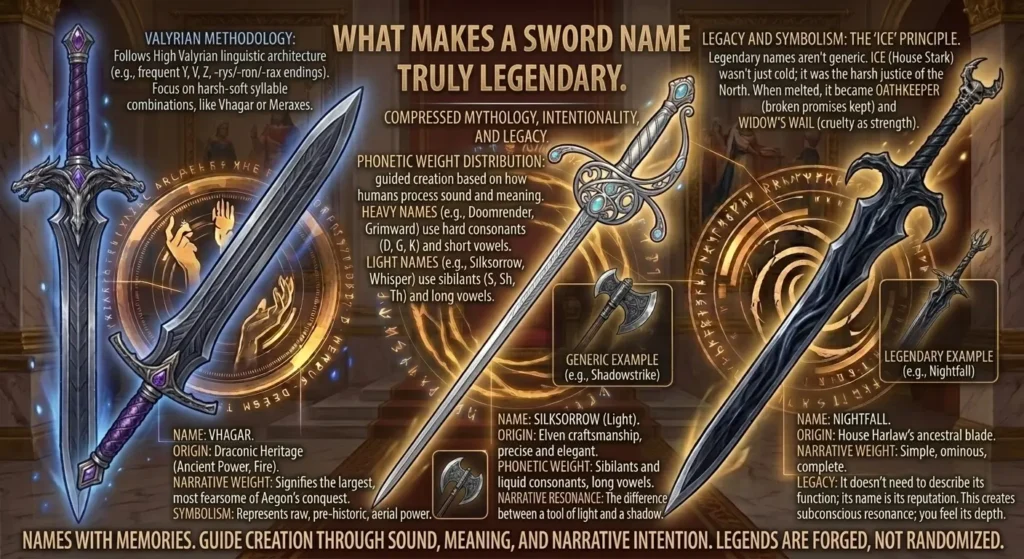
A legendary blade name isn’t just pretty syllables. It’s compressed mythology.
Ice wasn’t named for being cold, it was named for the North, for harsh justice, for the austere honor of House Stark. When Tywin Lannister melted it down, he didn’t just destroy a sword; he shattered a symbol. The reforged blades, Oathkeeper and Widow’s Wail, told new stories: one of broken promises kept, one of cruelty masquerading as strength.
Compare “Shadowstrike” (generic, videogame, forgettable) with “Nightfall” (House Harlaw’s ancestral blade, simple, ominous, complete). The difference is intentionality. Great sword names operate on multiple levels:
• Sound: Hard consonants for war blades (Blackfyre, Heartsbane). Sibilants for assassin’s steel (Whisper, Silksorrow).
• Meaning: Literal and metaphorical. “Longclaw” describes the weapon and the bear-to-wolf transformation of House Mormont’s honor.
• Legacy: The name should suggest history. Even invented names benefit from sounding old, weathered, witnessed.
When you name a sword, you’re not labeling it, you’re giving it memory before it creates new memories.
Types of Sword Names You Can Generate
Fantasy Sword Names
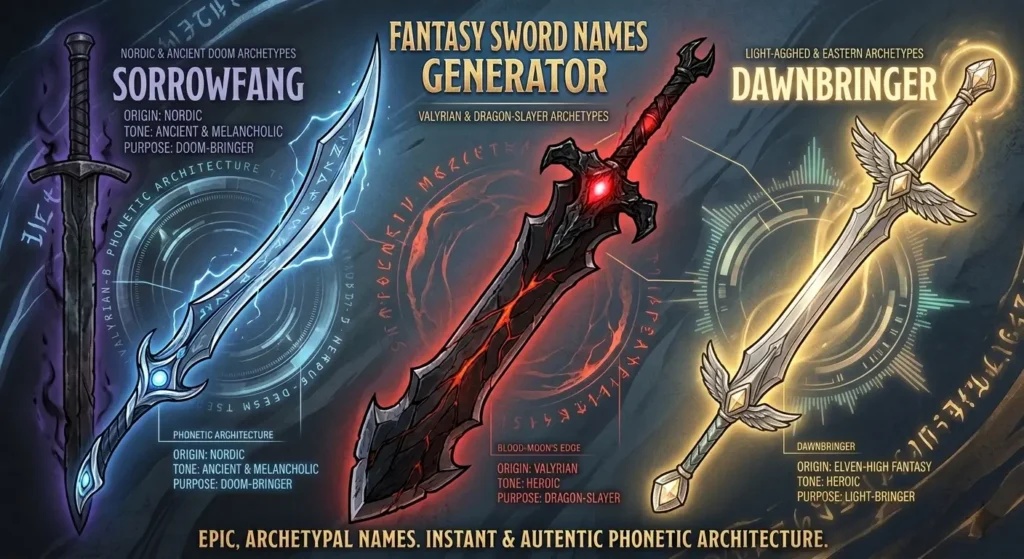
Epic, archetypal, built for heroes and villains alike. These names evoke classic fantasy, they sound equally at home in Tolkien’s Middle-earth or Jordan’s Wheel of Time. Think: Stormbreaker, Dawnbringer, Sorrowfang. They combine elemental forces, times of day, or emotional weights with sharp, weapon-evoking syllables.
Best for: High fantasy settings, noble heroes, classic good-vs-evil narratives, weapons with clear moral alignments.
Valyrian Sword Names (Game of Thrones Style)
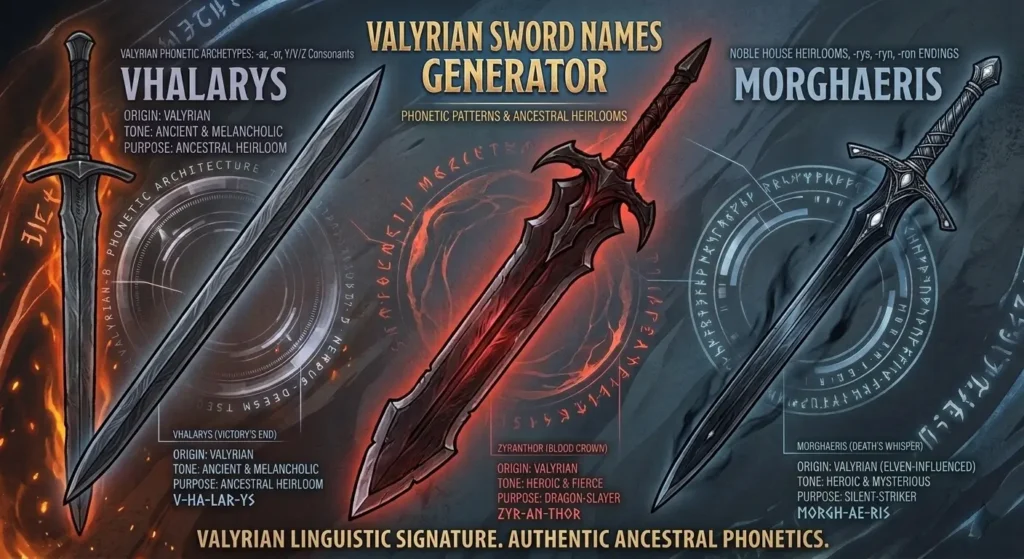
The linguistic signature of Valyrian steel runs deeper than spelling. These names use specific phonetic patterns: the -ar and -or endings (Brightroar), the emphasis on hard stops and liquid consonants (Blackfyre, Lady Forlorn), the tendency toward compound meanings that sound ancient rather than invented.
Authentic Valyrian phonology favors: Y/V/Z consonants, -rys/-ryn/-ron endings, harsh-then-soft syllable pairings. Think Vhagar (the dragon) applied to steel: Vhalarys (Victory’s End), Zyranthor (Blood Crown), Morghaeris (Death’s Whisper).
Best for: Game of Thrones campaigns, noble houses, ancestral heirlooms, blades forged in dragonfire.
Legendary Sword Names
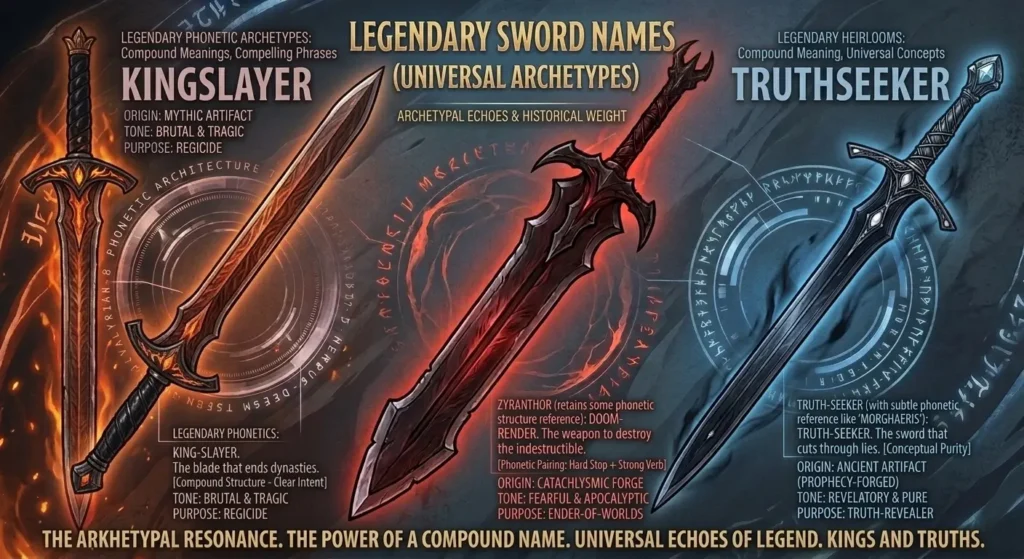
These carry the weight of mythology without being tied to specific fictional universes. Names like Kingslayer, Truthseeker, Doomrender work across settings because they tap into universal archetypes. The blade that ends dynasties. The weapon that cuts through lies. The sword forged to destroy what cannot be destroyed.
Best for: Artifacts with game-changing power, weapons central to prophecy, blades that have changed the course of history.
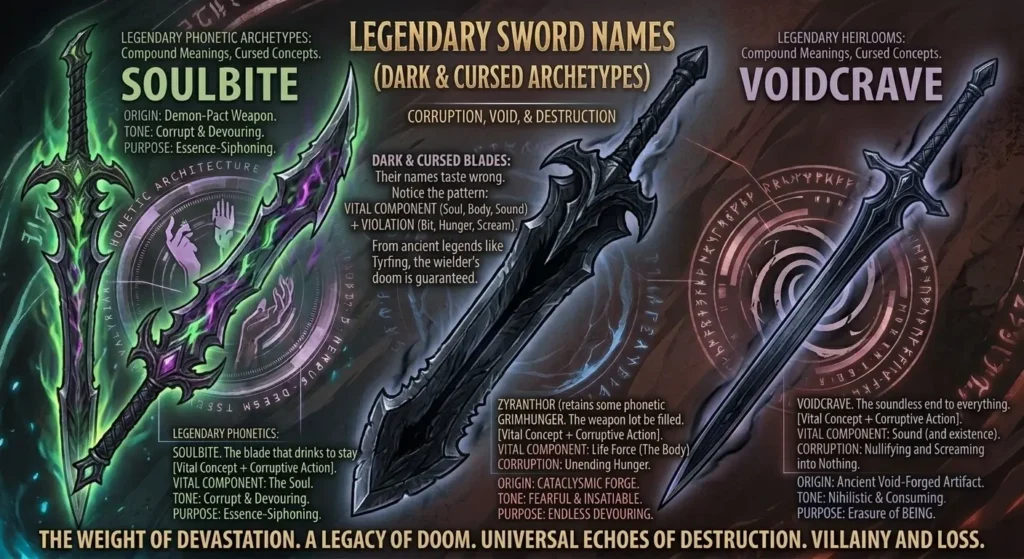
Dark & Cursed Blades
Cursed swords don’t just kill, they corrupt, devour, transform. Their names should taste wrong in the mouth: Soulbite, Grimhunger, Voidscream. Notice the pattern: something vital (soul, the body itself, sound) + something that violates it (biting, hungering, screaming into nothing).
Tyrfing from Norse mythology never missed its target but guaranteed its wielder’s doom. Modern dark blades inherit this duality, immense power, terrible cost. Name them accordingly.
Best for: Villains who don’t know they’re doomed, berserkers, demon-pact weapons, swords that drink blood to stay satisfied.
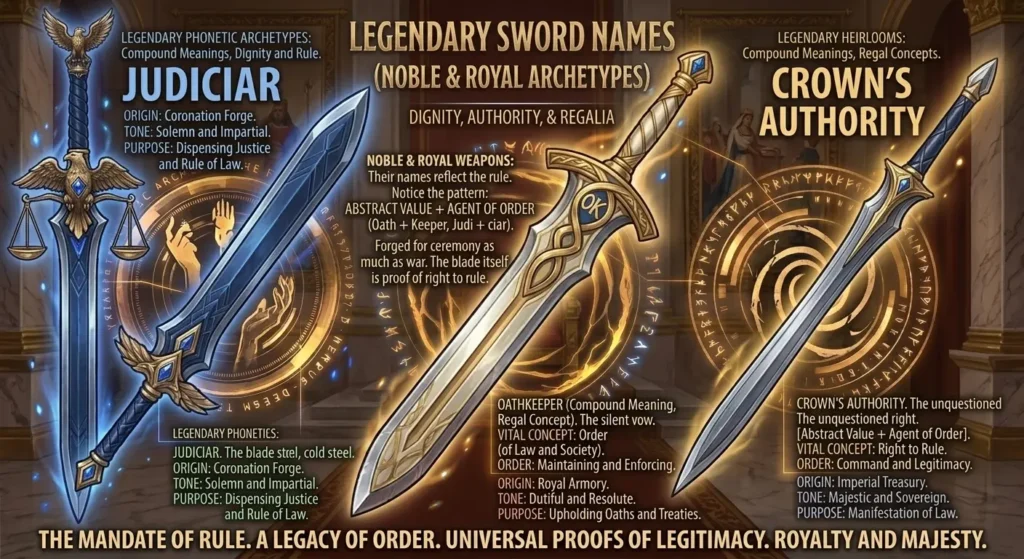
Noble & Royal Weapons
These swords were forged for ceremony as much as war. They sit in throne rooms, get passed in coronations, embody the legitimacy of rule. Their names reflect this dignity: Oathkeeper, Judiciar, Royal Warrant, Crown’s Authority.
Notice what these avoid: aggression. A king’s blade doesn’t need to threaten because the king himself is the threat. The sword simply exists as proof of right to rule.
Best for: Kings, queens, judges, symbols of office, execution blades, swords that hang on walls more than they swing.
50+ Sword Name Ideas With Meaning
Valyrian-Style Blades
Vhaenyx , Shadow Victory | For blades that win through cunning rather than strength
Zaldrīzes , Dragon’s Fang | Forged in dragonfire, naturally
Morghaes , Death’s Promise | Every swing is an oath being kept
Perzyrax , Flame Devourer | Absorbs heat, chills the blood
Qēlossys , Star Iron | Forged from meteorite, older than kingdoms
Valonqar , Little Brother | Smaller blade that killed a king
Rhaelyx , Winter’s Edge | Northern Valyrian steel, impossibly sharp
Zoklaeon , Wolf’s Tear | Named for the first blood it drew
Thyrian , Storm Crown | Won in battle during a lightning strike
Vēzyrax , Honor’s Price | The cost of keeping oaths
Legendary & Mythic Names
Truthcleaver , Justice Incarnate | Separates lies from reality with each cut
Dawnbreaker , Hope’s Edge | Drawn at first light, ends sieges
Sorrow’s End , Mercy Blade | Grants death to those suffering beyond healing
Kingfall , Dynasty Ender | Has killed three monarchs across five centuries
Voidseeker , Oblivion’s Compass | Points toward death, finds the dying
Ruinmarker , Herald of Collapse | Kingdoms fall within a generation of its appearance
Oathsunder , Promise Breaker | Cursed to betray whoever wields it
Grimward , Guardian Against Dark | Glows near undead, demons, corruption
Fatesever , Prophecy Breaker | Cuts threads of destiny, alters futures
Lastlight , Twilight Blade | The final thing dying enemies see
Dark & Cursed Weapons
Soulrend , Spirit Thief | Traps the essence of those it kills
Bloodprice , Hungry Edge | Must taste blood weekly or harm its wielder
Voidwhisper , Nihil’s Voice | Murmurs doubt to anyone holding it
Wraithbind , Ghost Shackle | Enslaves the dead to serve the killer
Corpsegrin , Death’s Smile | Black blade that spreads necrosis
Doomscrawl , Ruin Written | Names of future victims appear on the blade
Ashenmaw , Flame Eater | Extinguishes life force like snuffing candles
Fellmark , Corruption Sigil | Wounds never heal, turn gangrenous
Nighthunger , Darkness Fed | Stronger in shadow, weakens in sunlight
Grimreaping , Harvest Blade | Kills crops, livestock, fertility where it’s drawn
Noble & Ceremonial Blades
Sovereign’s Word , Royal Decree | Executes sentences, finalizes judgments
Justicebrand , Law’s Forge | Used to knight heroes, execute traitors
Crownguard , Throne Protector | Ceremonial but deadly when needed
Honorbound , Oath Keeper | Glows when wielder breaks their word
Lineagerender , Dynasty Blade | Passed parent to child for eight generations
Throneright , Legitimacy Proof | Whoever holds it claims the crown
Peacewarden , Treaty Seal | Drawn only when peace fails
Elderlight , Ancient Authority | So old, its origin is forgotten myth
Lawbringer , Order’s Edge | Symbolizes civilization against chaos
Gracemark , Mercy’s Sign | Quick death for condemned nobility
Elemental & Nature-Forged
Stormfang , Thunder’s Bite | Crackling with electricity, carved from lightning-struck oak
Frostborne , Winter’s Gift | Never warms, freezes blood in wounds
Emberheart , Living Flame | Forged inside a volcano, eternally warm
Tidecaller , Ocean’s Fury | Ebbs and flows with moon phases
Stonedrinker , Mountain Blood | Carves rock like flesh
Windshear , Gale’s Razor | Impossibly light, makes no sound cutting air
Rootwrath , Forest’s Vengeance | Wooden core, grows vines when dormant
Ashfall , Extinction Memory | Forged from a fallen star
Icethorn , Frozen Cruelty | Beautiful, crystalline, absolutely merciless
Scorchwind , Desert Breath | Found buried in sand for a thousand years
Unique & Evocative
Silksorrow , Beautiful Death | Elegant, whisper-thin, impossibly sharp
Ravenwatch , Omen Keeper | Ravens gather when it’s drawn
Bonegnaw , Skeletal Hunger | Hilt made from dragon bone
Mirrorcut , Reflection Splitter | Polished to impossible sheen
Echofang , Memory Blade | Rings with the voices of those it’s killed
How This Sword Name Generator Works
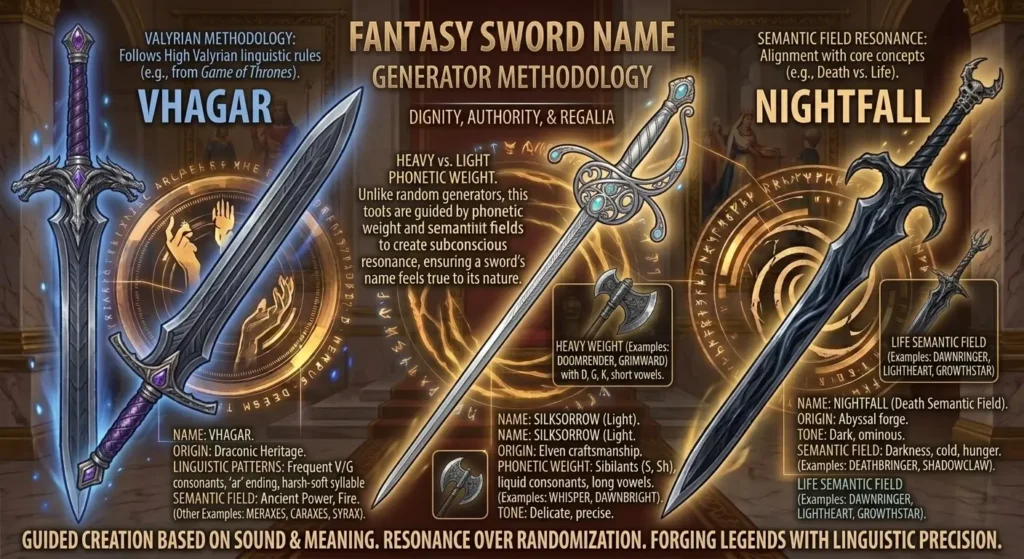
Unlike random generators that smash syllables together, this tool follows structured phonetic patterns inspired by High Valyrian. Names use recognizable elements like Y/V/Z consonants, -rys/-ron/-rax endings, and balanced harsh-soft syllable flow (similar to Vhagar or Meraxes).
Fantasy sword names are shaped by sound and tone. Heavier names (Doomrender, Grimward) lean on hard consonants like D, G, and K, while lighter names (Silksorrow, Whisper) use softer, flowing sounds like S, Sh, and Th.
The generator also assigns meanings based on the feel of the name—associating harsher sounds with power, war, or destruction, and softer sounds with grace, mystery, or elegance.
This creates names that feel intentional, cohesive, and true to fantasy naming traditions—not random combinations.
How to Choose the Perfect Sword Name
Match the Wielder
A berserker shouldn’t carry Gracemark. A paladin shouldn’t swing Soulrend. The weapon and warrior must align, not in obvious ways (barbarian gets ANGRY SWORD) but in meaningful ones.
Consider: Jon Snow’s Longclaw. It wasn’t named for him, but it fit perfectly—the outsider wielding the blade of a disgraced house, both redeemed through service to something greater than themselves.
Consider the Blade’s Role
Execution swords need gravity: Royal Warrant, Justicebrand, Sovereign’s Word.
War blades need aggression: Bonegnaw, Stormbringer, Ruinmarker.
Ancestral heirlooms need history: Elderlight, Lineagerender, Throneright.
Cursed blades need wrongness: Doomscrawl, Voidwhisper, Oathsunder.
Choose Your Tone
Epic/Heroic: Two-part compound words, elemental imagery, rising cadence (ends with strong syllables). Examples: Dawnbreaker, Stormfang, Truthcleaver
Dark/Villainous: Decay words, consumption imagery, falling cadence (ends with weak syllables). Examples: Soulrend, Grimhunger, Ashenmaw
Noble/Royal: Abstract concepts, single words or formal compounds, balanced rhythm. Examples: Oathkeeper, Justicebrand, Sovereign’s Word
Ancient/Mythic: Archaic-sounding phonetics, unusual letter combinations, mysterious meanings. Examples: Vhaenyx, Zaldrīzes, Qēlossys
Test the Sound
Say it out loud. Does it feel right in your mouth? Does it sound better shouted in battle or whispered in fear?
Longclaw is a single breath, quick, decisive, done. Widow’s Wail is two beats of cruelty, you have to pause between them, savor the malice.
Great sword names pass the sound test. Bad ones feel awkward, clumsy, forgettable.
Why Use This Sword Name Generator
Most generators produce random syllable combinations that mean nothing and sound like nothing. You get Xylothrak and Zephyndor, technically fantasy words, practically meaningless.
This tool generates names with:
Linguistic consistency: Valyrian names follow High Valyrian phonology. Fantasy names follow established genre patterns.
Semantic weight: Every name suggests a story, even if you haven’t written it yet.
Variety without randomness: You get 3 options that all work but feel different from each other.
Practical utility: Perfect for writers avoiding placeholder names, game masters creating loot drops, roleplayers naming signature weapons, worldbuilders establishing mythology.
You’re not just getting words, you’re getting instant backstory hooks.
Sword Naming Traditions in Fantasy & Valyrian Lore
The Valyrian Way
Valyrian steel wasn’t just forged, it was sung into existence with dragonfire and blood magic. The names reflect this. They’re not descriptive labels but compressed history.
Ice: Named for the region it defended, not its temperature.
Blackfyre: Named for the black dragon Balerion whose fire reforged it, became the symbol of legitimacy so powerful a rebellion took its name.
Heartsbane: House Tarly’s greatsword, a name that promises exactly what it
delivers, the end of courage, the shattering of will.
Notice what Valyrian tradition avoids: cute names, clever puns, anything that diminishes the weapon. These are tools of legacy, not personality. The sword outlives you, will outlive your grandchildren, might outlive your house. Its name must carry that weight.
The Fantasy Tradition
Broader fantasy draws from medieval European practice where swords rarely had individual names, except the legendary ones. Excalibur. Durendal. Joyeuse. These weren’t named by committee. They earned names through deed and myth.
Modern fantasy inherited this: great blades get named, common swords don’t. The naming is an acknowledgment of significance. Your sword has a name the way your house has words, it means you matter enough for history to remember.
Tolkien’s Glamdring (Foe-hammer) and Sting (for the spiders it slew) established the pattern: names reflect purpose, echo deeds, compress character into syllables.
The Psychology of Weapon Naming
We name things we love or fear. Cars, boats, guitars, storms. Swords get names when they transcend utility and become relationship.
A soldier with a standard-issue blade calls it “my sword.” A warrior with a legendary blade calls it by name and thinks of it as a companion. The difference isn’t the steel, it’s the bond.
This matters for worldbuilding. In your setting, who names swords? The smith? The first wielder? The third wielder after it’s proven itself? Is naming ceremonial or organic? Do some cultures forbid weapon names as arrogant? Do others require them?
These questions make worlds feel lived-in. The answers tell you what a culture values, fears, and remembers.
Related Valyrian Tools
Below are some other Valyrian tools we offer, all worth exploring.
High Valyrian Translator
Our high valyrian translator Convert English phrases into authentic High Valyrian, the ancient language of dragonlords. Perfect for creating sword inscriptions, house words, or magical incantations to accompany your legendary blade. When your sword needs an etched motto like Joyeuse’s scripture, this gives you the linguistic tools.
Valyrian Name Generator
Create your character valyrian names following authentic Valyrian phonology and structure, Daenerys, Rhaenyra, Viserys patterns. Essential if your sword’s wielder needs a name as legendary as the blade itself. A Valyrian sword deserves a Valyrian bloodline.
FAQs
Generate legendary blades worthy of legend. Create names that will echo through ages. Learn about author