
Valyrian Name Generator
The fires of Valyria await your command.
Your past generations will appear here.
Saved favourites appear here across sessions.
Get the perfect name for your Targaryen heir, dragonlord OC, or Valyrian-blooded character instantly using this lore-accurate valyrian name generator. Whether you’re writing fanfiction, building a D&D campaign set in Westeros, creating a Targaryen roleplay character, or just obsessed with the linguistic beauty of George R.R. Martin’s world, this tool delivers names that feel genuinely Valyrian.
Each generated name follows the phonetic rules, suffix conventions, and noble cadence that make Targaryen names like “Daenerys” and “Aegon” instantly recognizable. You’ll get names with that distinctive flowing sound—those lyrical vowel combinations, the regal consonant patterns, and the weight of ancient prestige. No generic fantasy output here, just names worthy of dragonfire.
How High Valyrian Names Work in Lore
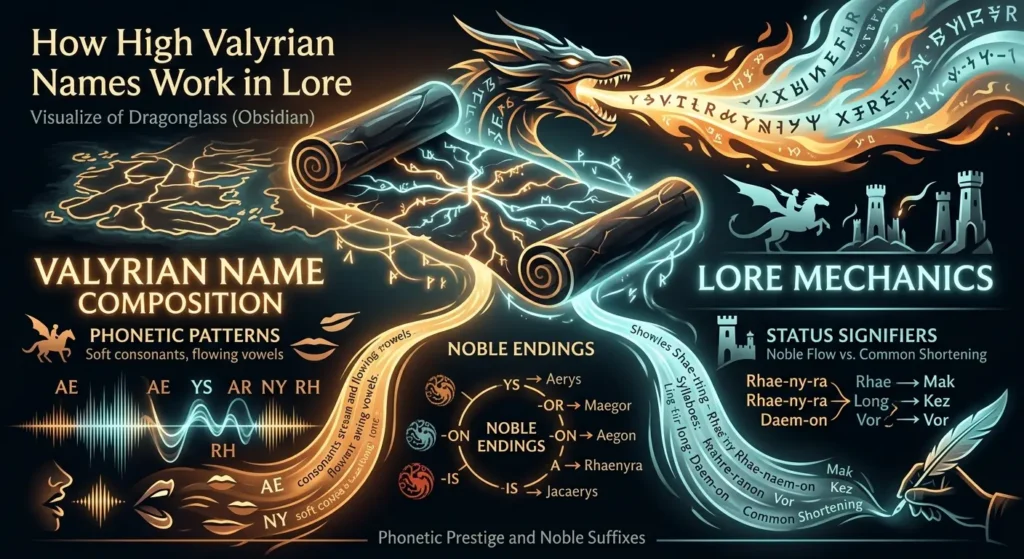
High Valyrian names carry a distinct musical quality that sets them apart from Westerosi Common Tongue. The Valyrian Freehold’s naming conventions evolved over thousands of years, creating patterns you can hear immediately: names often feature soft consonants paired with flowing vowels (ae, ys, ar), melodic double-vowel combinations that give them that signature lilt, and specific endings that signal nobility versus common birth.
Noble Valyrian names frequently end in -ys, -or, -on, -a, or -is—think Aerys, Viserys, Daemon, Rhaenyra, Aegon. These endings weren’t arbitrary; they marked bloodline prestige and often indicated gender, though High Valyrian itself is notably less gendered than Westerosi naming conventions. The dragonlord families favored multi-syllabic names with internal rhythm: Mae-gor, Rhae-ny-ra, Vis-er-ys. Each syllable flows into the next, creating names that sound almost song-like when spoken aloud.
In fan communities and roleplay circles, shorter or simplified variants are often used to represent lower-status or less formal Valyrian naming styles. Where a noble might be “Maekar,” a commoner could be “Mak.” The linguistic prestige gap was deliberate—your name announced your status before you opened your mouth. Even phonetically, certain consonant clusters (rh-, ae-, ny-) were associated with the highest bloodlines, particularly those who could claim dragonriding heritage.
Generate Authentic High Valyrian Names Instantly
This generator doesn’t just slap random syllables together and call it Valyrian. It analyzes the phonetic patterns from every canonical Targaryen, Velaryon, and Blackfyre name, then constructs new names following those exact linguistic rules. The algorithm accounts for vowel harmony, appropriate consonant pairing, gender-typical endings, and the syllabic rhythm that makes Valyrian names sound genuinely period-authentic.
Each name comes with context—whether it suits a dragonlord, a noble lady, a seafaring Velaryon, or an ancient pre-Doom ancestor. You’re not just getting “Vaelara” with no explanation; you’re understanding why that particular name feels right for a proud noblewoman versus a battle-hardened dragon rider. The generator also provides pronunciation guidance for trickier combinations, because “Daenerys” stumped readers for years until the show gave us clarity.
Want multiple options? Generate freely. Sometimes the perfect name reveals itself on the fifth try when you see it in context with your character concept. The tool remembers nothing between generations, every click gives you fresh possibilities without recycling the same outputs.
Customize Your High Valyrian Name
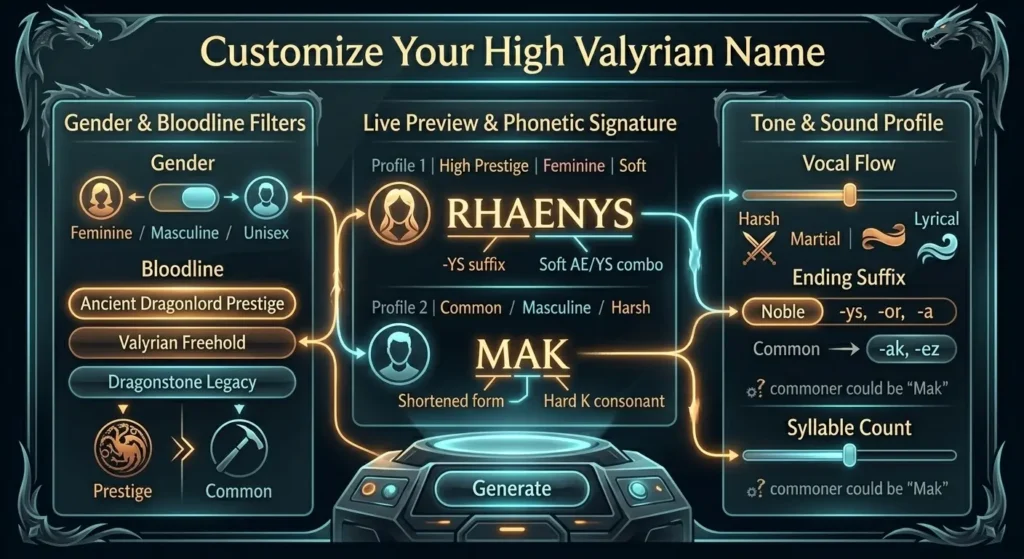
The generator offers filters that let you narrow results to match your exact vision. Looking for a feminine name with ancient dragonlord gravitas? Select those parameters. Need a masculine name that sounds common-born rather than lordly? Adjust accordingly. The customization options respect the lore’s internal logic, you won’t get a “common” name ending in -aelon, because that ending screams nobility.
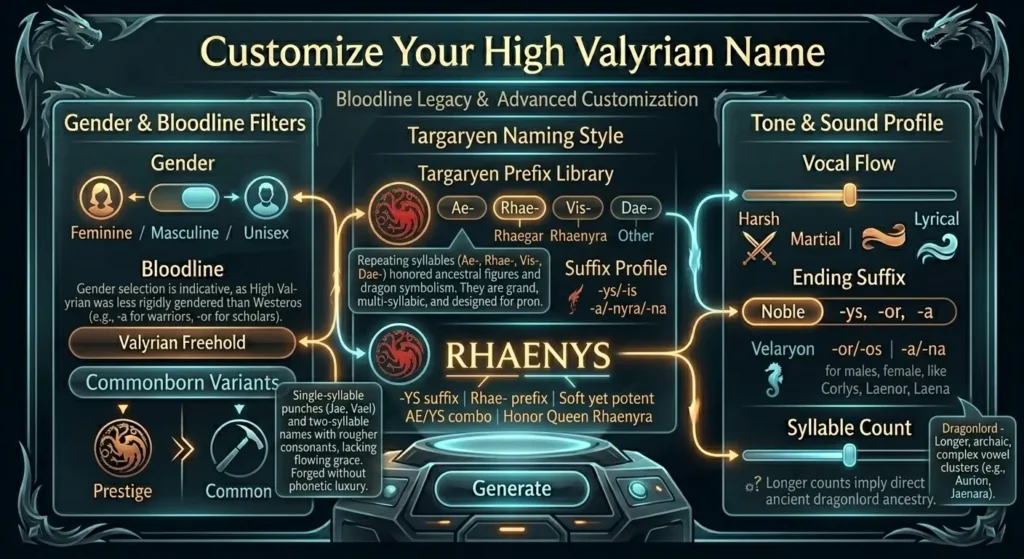
Gender selection helps when your character concept requires it, though remember High Valyrian culture was less rigidly gendered than Westeros. A name ending in -a could suit a fierce warrior; one ending in -or might fit a scholarly woman. The bloodline filter distinguishes between the ancient prestige of pre-Doom names versus the Westerosi-influenced variants that evolved after the Targaryens settled Dragonstone.
Tone settings let you choose between harsh/martial sounds (lots of k, g, hard consonants) versus softer, more lyrical options (flowing with s, l, r). A dragonrider preparing for war needs a different name energy than a diplomat or maester. These aren’t superficial changes—the tool adjusts its phonetic algorithm to match your selection, ensuring every generated name fits the vibe you specified.
High Valyrian House and Family Naming Traditions
Valyrian bloodlines developed distinct naming flavors over centuries of isolated breeding and cultural pride. Each dragonlord family cultivated its own phonetic signature, a way to announce lineage without needing to recite your entire pedigree. These patterns persisted even after the Doom scattered survivors across the known world.
Targaryen Naming Style
The Targaryens favor names with royal weight and dragon symbolism. You’ll notice repeating syllables across generations: Ae- (Aegon, Aemon, Aenys, Aerys), Rhae- (Rhaegar, Rhaenyra, Rhaena), Vis- (Viserys, Visenya), and Dae- (Daemon, Daenerys, Daeron). These weren’t random preferences—each prefix carried ancestral significance, honoring foundational figures like Aegon the Conqueror or Queen Visenya.
Targaryen names also love the -ys/-is endings for males and -a/-nyra/-na for females, though exceptions exist (Aegon, Daemon). The names feel deliberately grand, built for pronouncements and historical records. Even minor Targaryens received names that sounded throne-worthy: Baelor, Maegor, Helaena. No Targaryen parent ever thought, “Let’s keep it simple.”
Velaryon Naming Style
The seafaring Velaryons prefer names with maritime smoothness, more liquid consonants, more flowing vowels. Corlys, Laenor, Laena, Alyn, these names feel sleeker than Targaryen equivalents, less heavy with royal expectation. The Velaryons also showed more willingness to adopt Westerosi-influenced names, perhaps from their extensive trading contacts.
Their naming conventions emphasize the -or/-os and -a/-na endings, but with simpler internal structures than Targaryen multi-syllabic monuments. A Velaryon name should sound like it could navigate both High Valyrian courts and Westerosi harbors without linguistic awkwardness.
Ancient Dragonlord Names
Pre-Doom dragonlord names carried even more elaborate construction: longer syllable counts, more complex vowel clusters, and consonant combinations that feel deliberately archaic. Names like Aurion, Jaenara, and Aenar (Aegon’s father who foresaw the Doom) represent this older style—names that sound like they were forged in Valyria’s height, when dragons numbered in thousands and the Freehold’s power was absolute.
These names often featured triple-syllable or longer constructions with internal rhythm patterns that modern Westerosi tongues struggle to pronounce correctly. If your character concept involves ancient bloodline pride or direct dragonlord ancestry, this naming style announces it immediately.
Commonborn Variants
Not everyone born in Valyrian-descended families received the full noble treatment. Common folk got simplified versions: single-syllable punches (Mak, Jae, Vael) or two-syllable names with rougher consonant pairings. These names deliberately lacked the flowing grace of their noble cousins, linguistic markers of status in a culture that highly valued bloodline purity.
Think of them as Valyrian names with the prestige polished off. Still recognizably from the same language root, but without the phonetic luxury that announced dragonriding heritage.
What Makes a Name Sound Truly Valyrian
Authenticity comes down to recognizable patterns. Valyrian names love double vowels (ae, oo, ei), soft consonant-vowel pairings (ny, ly, ry), and specific syllable rhythms that create that characteristic lilt. Names should flow when spoken—if you’re tripping over consonant clusters or fighting your mouth to pronounce it, it’s not following Valyrian phonetic rules.
The -ys, -is, -on, -or endings for masculine names create that noble cadence. Feminine names favor -a, -na, -ra, -ya endings that extend the musical quality. Names rarely end in hard consonants; Valyrian linguistic aesthetics preferred names that ended on vowel sounds or soft consonants that could blend into the next word in flowing speech.
Certain consonant combinations signal instant authenticity: rh- openings (Rhaegar, Rhaenyra), ae- diphthongs (Aegon, Aemon), internal -ny- sounds (Daenerys, Rhaenyra), and the distinctive -ael-/-ael- construction. These patterns appeared repeatedly across all confirmed Valyrian families because they followed the language’s core phonetic rules, not random author preference.
High Valyrian Name Ideas With Meanings
Vaelora: Perfect for a noble lady with quiet authority. The -ora ending gives it prestige without aggression, suitable for a diplomat or scholar rather than a warrior queen. Pronunciation flows smoothly: Vay-LOR-ah.
Maekos: Sounds martial and direct. The hard K and -os ending suggest a military commander or dragonrider who leads from the front. Less lyrical than typical Targaryen names, more action-oriented. MAY-kos.
Rhaelys: Combines the classic Rhae- prefix with the noble -ys ending. Works beautifully for a male character with ancient bloodline connections and traditional values. Rhae-LEES.
Daenyra: An obvious feminine variant playing on Daenerys/Rhaenyra patterns. Great for a character meant to echo Targaryen women of legend—powerful, complex, memorable. Day-NEER-ah.
Aelyx: The -yx ending is less common but still period-authentic, giving this name a distinctive edge. Suits a character who’s unconventional within Valyrian society—maybe a rebel or innovator. AY-liks.
Vysarra: The double-r creates a rolling, luxurious sound. Perfect for a character of extreme nobility or one who takes their bloodline status very seriously. Vih-SAR-ah.
Jaelor: Strong and straightforward without unnecessary syllables. Works for a practical character—a ships’ captain, a master builder, someone whose prestige comes from competence rather than pure lineage. JAY-lor.
Choosing the Right Valyrian Name for Your Character
Start with character archetype. Is this a tragic hero, a cunning villain, a loyal friend, a doomed romantic? Names carry emotional weight, Daemon sounds dangerous where Aemon sounds gentle, even though both are legitimately Valyrian. The phonetic choices matter to how readers or players perceive your character before they’ve done anything.
For fanfiction writers, consider your character’s relationship to canon bloodlines. If they’re a forgotten Targaryen branch, lean into those established naming patterns (Ae-, Rhae-, Vis-). If they’re from a lesser Valyrian house trying to distance themselves from Targaryen dominance, choose names that sound Valyrian but avoid those specific prefixes. For entirely original Valyrian houses, mix and match phonetic elements to create a distinct family signature.
Roleplayers and gamers should think about how the name sounds when spoken repeatedly. Your DM will say this name dozens of times—complicated consonant clusters that look cool written become exhausting spoken aloud. Balance authenticity with practicality. Also consider how the name pairs with any titles or epithets your character might acquire: “Lord Vaekaron” flows better than “Lord Kthgryl.”
For villains, harsher consonants and shorter constructions often work better: Maegor the Cruel lives up to that name phonetically. For heroes or sympathetic characters, the flowing multi-syllabic options create more emotional connection: we care about Rhaenyra partially because her name itself sounds like poetry.
High Valyrian Family and House Name Ideas
House names follow similar patterns but often incorporate additional elements, location markers, dragon associations, or ancient profession indicators. A Valyrian house might be “House Vaeltheon” (combining the vael- root with the prestigious -theon ending) or “House Maegyr” (playing with mag-/mae- strength connotations).
Consider what your house’s reputation should communicate. A house of legendary dragonriders needs a name with aerial or fire associations in its phonetics. A house known for sea power could adopt Velaryon-style liquid consonants. A house fallen from grace might have a beautiful name that now carries tragic weight—the phonetics haven’t changed, but the connotations have.
If you’re building complete family trees, establish a naming pattern early: repeated prefixes across generations, specific endings for each gender, or ancestral names that cycle through with variations. The Targaryens did this systematically, you can too, creating that sense of deep history through consistent naming conventions.
For those developing Valyrian houses for your world-building, the High Valyrian OC Generator can help flesh out complete character concepts beyond just names.
Related Fantasy Name Generators
Naming your Valyrian character is just the beginning. If you are building a complete fantasy identity, use our Valyrian Sword Name Generator for ancestral blade names worthy of your dragonlord heritage. Every prestigious bloodline needs a legendary weapon with an equally legendary name.
For translating phrases, checking vocabulary, or learning more about High Valyrian language structure, the main High Valyrian Translator offers deeper linguistic resources that help you understand why certain name patterns work and others don’t.
FAQs
Ready to Claim Your Valyrian Name
You’ve learned what makes Valyrian names sound authentic, explored the distinct styles of great dragonlord houses, and discovered how to choose names that match your character vision. Now it’s time to generate your own. Try multiple combinations, sometimes the perfect name appears after you’ve seen a few near-misses that help you clarify what you’re really looking for.
Every Targaryen, Velaryon, and Blackfyre started with a name that announced their heritage before they’d accomplished anything worth recording in history. Your character deserves the same careful consideration. Generate freely, experiment with different styles, and find the name that makes your dragonlord, warrior, or schemer feel completely real.
Learn more about author.