
Valyrian Dragon Name Generator
The fires of Valyria await your command.
Your past generations will appear here.
Saved favourites appear here across sessions.
In the shadow of smoking mountains and beneath skies torn by wingbeats, a dragon’s name is never just a label. It is a signal of power, legacy, and fear. A great dragon name should sound ancient, inevitable, and dangerous the moment it is spoken. That is why the best fantasy names do more than “sound cool” — they carry weight. They feel like they belong in old songs, burned ruins, and royal histories.
This Dragon Name Generator is built for writers, gamers, and worldbuilders who need names with presence. It creates dragon names inspired by Valyrian style, mythic traditions, and darker fantasy naming patterns, then pairs them with meanings that help you choose the right one fast. Whether you are naming a fire-breathing war beast, a northern ice dragon, or a legendary creature from your own world, this tool gives you names that feel powerful, memorable, and story-ready.
Try the Dragon Name Generator
Using the generator is simple, but each choice shapes the final result.
Personality Selection changes the sound of the name. Aggressive dragons get harder consonants and sharper endings. Ancient dragons get deeper vowels and longer, heavier syllables. Noble dragons get smoother, more balanced names that feel regal rather than savage.
Element Choice guides the atmosphere. Fire dragons lean toward harsh sounds and explosive energy. Shadow dragons use darker, throatier tones. Sky dragons feel lighter and more fluid. Ice dragons sound sharp, cold, and crystalline.
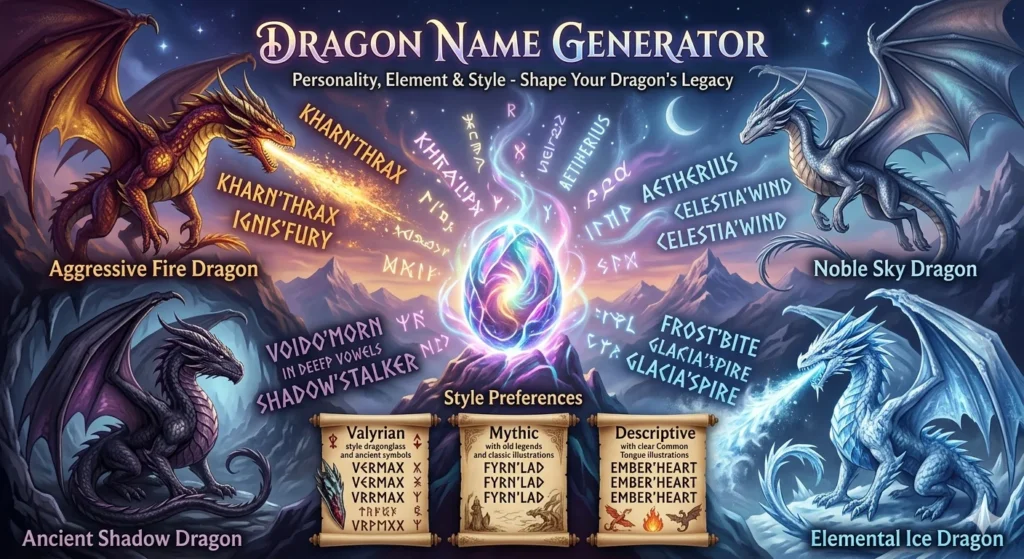
Style Preference controls the naming tradition. Valyrian follows the style of Game of Thrones dragon names. Mythic draws on old legends and historical dragon lore. Descriptive uses direct Common Tongue-style names that are blunt, vivid, and easy to understand.
Each result includes context, so you are not just getting a random syllable blend. You are getting a name with a reason to exist.
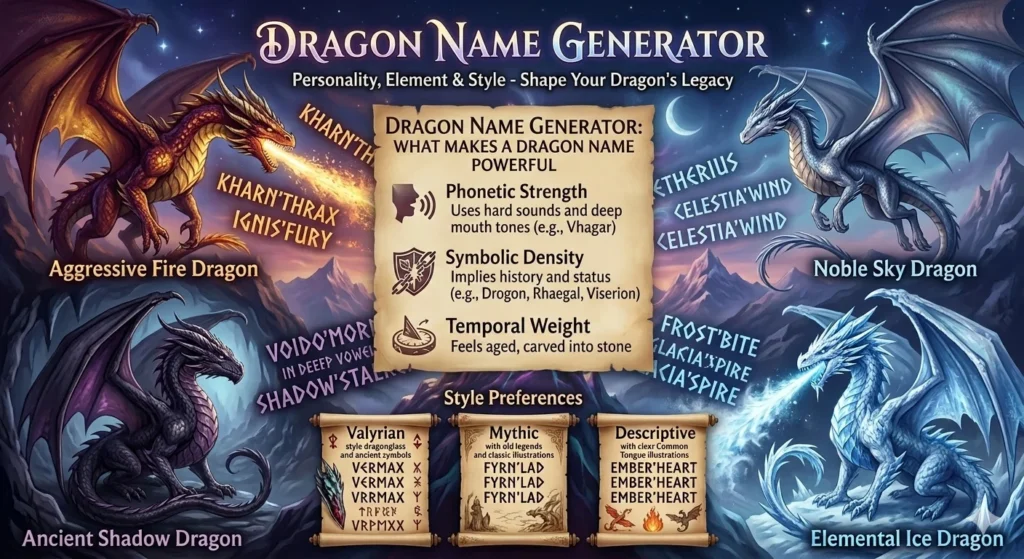
What Makes a Dragon Name Powerful
A strong dragon name needs more than style. It needs structure, meaning, and weight.
Phonetic strength comes first. Dragon names work best when they use sounds that feel hard to say, sharp to hear, or deep in the mouth. That resistance creates force. A name like Vhagar feels heavier than a soft, flowing fantasy name because the sound itself suggests power.
Symbolic density matters too. The best names imply history, status, or danger without overexplaining it. Drogon, Rhaegal, and Viserion feel loaded because they carry personal and cultural meaning. Even without knowing every detail, the names suggest loss, loyalty, and bloodline.
Temporal weight gives the name age. Dragon names should sound like they have existed for centuries. They should feel carved into stone, not invented on the spot. That is why Valyrian-style names work so well: they sound like fragments of an old language, which instantly makes them feel legendary.
Types of Dragon Names You Can Generate
Different dragons need different naming styles, and this generator covers the main ones.
Valyrian Dragon Names (Game of Thrones Style)
These names use the harsh, ancient sound patterns associated with High Valyrian. Expect clusters like vh, rh, ks, and familiar endings like -rax, -xes, -ion, and -gar. They sound noble, foreign, and dangerous at once.
Examples: Balerion, Vhagar, Meraxes, Vermithor, Caraxes, Syrax, Meleys, Arrax, Vermax, Tyraxes
Mythic Dragon Names
These names draw from real legendary traditions — Norse, Greek, Germanic, Celtic, and other old mythic sources. They feel ancient because they are rooted in stories people have told for centuries.
Examples: Fáfnir, Níðhöggr, Jörmungandr, Ancalagon, Glaurung, Ladon, Smaug, Scatha
Dark & Destructive Dragons
These names are built for pure menace. They favor hard stops, guttural sounds, and words that suggest ruin, hunger, plague, or death. They are ideal for dragons meant to terrify armies.
Examples: Gorefang, Deathwing, Nightbane, Shadowmaw, Vorzaxx, Morthgar, Dreadmaw, Ashkore, Ruinwing
Elemental Dragons
Elemental dragons should sound like their nature without becoming too literal. A good elemental name suggests the force behind the creature.
Fire: Pyraxes, Emberwroth, Ashenthar, Infernis, Blazeborne
Ice: Frostmaw, Glaciar, Winterbane, Cryothax, Rimefang
Storm: Tempestus, Thundermaw, Skybreach, Stormcaller, Voltarax
Shadow: Umbraxis, Voidwing, Nightshade, Tenebris, Shadowfell
Earth: Terradon, Stonegard, Mountaincrusher, Granithor, Earthshaker
Powerful Dragon Names
These are for dragons that stand above all others. They sound divine, imperial, or apocalyptic. Use them when the creature is meant to feel like a force of history.
Examples: Imperius, Dominus, Sovereignty, Titanwing, Apocalyx, Worldbreaker, Doomcaller, Eternity
30+ Cool Dragon Names With Meanings
Below there are 30+ cool dragon names in different categories.
Valyrian-Style Names
Vhazorax — “Storm’s Dominion”
Perfect for an ancient dragon that rules coastal territories, inspiring terror in sailors who speak its name only in whispers.
Kyranthos — “Blood of Kings”
Ideal for a dragon bonded to royal bloodlines, suggesting noble heritage and fierce loyalty to its rider.
Morvaxes — “Death’s Shadow”
Suited to a dragon of the night, one that hunts under darkness and leaves no survivors to tell the tale.
Draezaris — “Fire’s Wrath”
For a temperamental dragon whose fury is legendary, whose anger reduces cities to ash.
Velerion — “Sky’s Grace”
Works for a dragon of uncommon beauty and agility, one whose aerial displays inspire wonder rather than pure terror.
Thyraegos — “Thunder Roar”
Best for a dragon whose battle cry alone can shatter stone, whose arrival announces itself through sound before sight.
Zaranthrax — “Ancient Doom”
Perfect for the oldest living dragon, one that remembers the age before humans walked the earth.
Nymaeria — “Night’s Queen”
Suited to a female dragon of extraordinary intelligence and cunning, a strategic hunter rather than a brute.
Khazoryx — “Mountain Fang”
Ideal for a dragon that lairs in the highest peaks, virtually unreachable except by the most determined dragonslayers.
Velarros — “Golden Fury”
For a dragon whose scales gleam like molten gold, whose pride matches its beauty.
Rhaevaxis — “Royal Vengeance”
Works for a dragon that hunts those who wronged its rider, a creature of loyalty and retribution.
Daezmora — “Crimson Death”
Best suited to a dragon known for leaving blood-soaked battlefields in its wake.
Syltharax — “Silver Lightning”
Perfect for an impossibly fast dragon, one that strikes before enemies can react.
Mythic Names
Níðthrax — “Malice Crusher” (Norse-inspired)
For a dragon that embodies the concept of hostile destruction, drawn from the same roots as Níðhöggr.
Heliodorax — “Sun Gift” (Greek-inspired)
Suited to a dragon worshipped as a divine being, one that brings both light and burning judgment.
Brimstónthor — “Sulfur Thunder” (Germanic-inspired)
Ideal for a volcanic dragon, one that emerges from the earth itself trailing smoke and flame.
Caladrius — “Storm Prophet” (Latin-inspired)
For a dragon believed to predict disasters, one that appears before great changes.
Typhonderax — “Tempest Monarch” (Greek-inspired)
Works for a dragon that commands weather itself, drawn from Typhon, father of monsters.
Ormungor — “Serpent Horror” (Norse-inspired)
Best for a particularly serpentine dragon, one whose coils can strangle mountains.
Pythros — “Rot Bringer” (Greek-inspired)
Perfect for a dragon whose very presence corrupts the land, leaving death in its flight path.
Valgaros — “Chooser of the Slain” (Norse-inspired)
Suited to a dragon that appears on battlefields, deciding who lives and who burns.
Dark & Destructive Names
Morthgarrax — “Death’s Embrace”
For a dragon that kills without mercy, whose reputation alone causes armies to flee.
Vorzakal — “Void Hunger”
Best suited to a dragon of insatiable appetite, one that devours entire villages.
Ashkorthax — “Ash Maker”
Perfect for a dragon that reduces everything to cinders, leaving only grey desolation.
Ruinspyre — “Tower of Endings”
Ideal for a dragon so massive it resembles a moving fortress of destruction.
Dreadmaw Obliteron — “Terror Mouth”
For a dragon whose jaws can swallow ships whole, whose bite is legendary.
Nightbane Vexaris — “Curse of Night”
Works for a dragon that hunts exclusively after dark, a nightmare made flesh.
Plaguewind Morthos — “Death Breeze”
Best for a dragon whose breath spreads disease and decay rather than fire.
Emberthrax the Soulless — “Burning Without Mercy”
Perfect for a dragon devoid of any compassion, a pure engine of annihilation.
Voidscale Nihilos — “Nothing Made Flesh”
Suited to a dragon that seems to absorb light itself, whose scales are emptiness given form.
Goretide Kharaxes — “Blood Flood”
For a dragon whose battles leave rivers of blood, whose violence is absolute.
Elemental Names
Pyroclast Infernus — “Fire Shard Born of Below”
Perfect for a dragon that emerged from volcanic eruptions, still carrying the mountain’s fury.
Glaciax the Eternal — “Ice Without End”
Best for an ice dragon of the far north, one that has frozen solid for centuries between wakings.
Stormcaller Tempestyx — “Thunder Summoner”
Ideal for a dragon that brings hurricanes in its wake, whose wingbeats create winds.
Tidehammer Aquarros — “Water Striker”
For a sea dragon, one that can capsize warships with a single tail sweep.
Terraforge Stonegard — “Earth Shaper”
Works for a dragon that can manipulate stone and earth, reshaping landscapes.
Ashwind Embros — “Burning Gale”
Perfect for a fire dragon whose flames spread like wildfire across plains.
Frostfang Cryothax — “Ice Tooth”
Best suited to a dragon whose bite flash-freezes victims, leaving frozen statues.
Voltaris Shockspine — “Lightning Back”
For a storm dragon whose scales crackle with constant electrical discharge.
Shadowmere Umbraxis — “Dark Pool”
Ideal for a shadow dragon that can become intangible, passing through solid matter.
Magmaheart Vulcanox — “Molten Core”
Perfect for a dragon whose internal temperature is so high its blood is liquid stone.
Names Suggesting Ultimate Power
Worldbreaker Apocalyx — “Ender of All”
For the dragon destined to destroy civilization itself, the final apocalypse.
Eternis the Undying — “Forever”
Best for a dragon that cannot be killed by any known means, truly immortal.
Sovereignty Imperius — “Supreme Rule”
Perfect for a dragon that commands all other dragons, the apex of the hierarchy.
Doomcaller Finalyx — “Summoner of Ending”
Ideal for a dragon whose appearance marks the beginning of catastrophe.
Titanwing Colossor — “Giant Flight”
For a dragon of unprecedented size, one that darkens the sky when it flies.
Divineflame Theoros — “God’s Fire”
Works for a dragon worshipped as a deity, one that demands tribute and sacrifice.
Eternity’s Shadow — “Timeless Dark”
Best for a dragon older than recorded history, one that remembers the first age.
Endtimer Chronoxes — “Time’s Conclusion”
Perfect for a prophesied dragon whose awakening signals the end of an era.
How This Dragon Name Generator Works
Unlike random name mashers, this tool builds names with patterns that actually feel dragon-like. It uses sound structure, naming rhythm, and style rules inspired by fantasy and Valyrian dragon lore.
Phonetic Pattern Recognition
The generator looks for consonant clusters and vowel combinations that create a strong impression. Hard clusters like vh, kh, rh, and zx make names feel foreign and ancient. Vowel pairings like ae, oe, and ei add richness without making the name too long. Endings such as -rax, -xes, -ion, and -gar help the name feel like it belongs in a real naming tradition.
Sound-Weight System
Different sounds create different moods. Hard stops like k, g, t, and p feel forceful. Fricatives like s, z, v, and th suggest motion, hiss, or threat. Liquids like l and r add flow and ancient resonance. Nasals like m and n deepen the tone. The generator combines these sounds based on whether the dragon is aggressive, noble, ancient, or monstrous.
Meaning Creation Through Association
The tool does not rely on a full translation system. Instead, it creates meaning through sound association. Certain sound groups naturally suggest ideas like death, fire, royalty, or night. That is why a name with mor feels darker, rha feels more royal, and pyr feels fiery. The result is a name that feels meaningful even before it is explained.
Linguistic Heritage Selection
When you choose Valyrian, the generator follows the patterns of canonical dragon naming. Mythic mode pulls from older legendary traditions. Descriptive mode uses clear English-style compounds for direct impact. This keeps the names consistent, memorable, and suited to the kind of dragon you are building.
How to Choose the Perfect Dragon Name
Generating options is easy. Choosing the right one takes intention.
Match the Dragon’s Personality and Behavior
A clever, controlled dragon should not sound like a mindless weapon. A name like Kyranthos or Velerion fits a calculated or noble creature better than something brutal like Gorefang. On the other hand, a wild destroyer needs a harsher name that sounds dangerous at first glance. Say the name aloud and compare it with the dragon’s behavior. The right name should match its nature immediately.
Consider Power Level and Threat
Not every dragon needs an apocalyptic title. A young dragon can have a shorter, simpler name. A mature dragon should sound weightier and more established. A legendary dragon should have a name that feels larger than ordinary speech, with enough force to carry fear and reputation. Match the name to the dragon’s place in the story.
Align With Story Role
A loyal mount can have a softer, more personal name. A terror weapon should have a name people whisper. A prophecy dragon should sound mythic and timeless. An antagonist’s dragon should be distinct and memorable, not too similar to the hero’s dragon. The name should support the role, not fight it.
Test Pronunciation and Memorability
A good dragon name should be easy enough to remember but exotic enough to feel special. Say it several times. Read it quickly. Imagine a character using it in dialogue. If it is impossible to pronounce or forgettable after one sentence, simplify it. The best names feel natural after the first encounter.
Why Use This Dragon Name Generator
Most name generators rely on random syllables and produce forgettable results. This one is different. It is designed around naming structure, tonal consistency, and fantasy world authenticity.
It gives you more than a name. It gives you a name with context, style, and purpose. It avoids generic fantasy clutter and instead produces names that feel crafted for dragons with history. That matters whether you are writing a novel, running a campaign, or building a complete fantasy world.
The real value is choice. You get several strong options, each with a different tone, so you can pick the one that best fits your dragon’s role, age, temperament, and legend.
Dragon Naming Traditions in Valyrian Lore
In A Song of Ice and Fire, dragon naming is never random. It reflects culture, memory, and status.
The Valyrian Freehold Tradition
Valyrian dragonlords named dragons to honor lineage, power, or feared qualities. Their names often came from High Valyrian roots, which made them sound ancient and aristocratic. That is why names like Balerion, Vhagar, Meraxes, Vermithor, and Caraxes feel so iconic. By contrast, wild dragons with Common Tongue names like Sheepstealer or Grey Ghost feel rougher and more immediate. The naming style itself says something about the dragon.
The Targaryen Inheritance
The Targaryens continued the Valyrian tradition after arriving in Westeros. Daenerys’ dragons are the clearest example: Drogon, Rhaegal, and Viserion all carry memory and loss in their names. That is what gives dragon naming emotional weight. The name is not only about sound; it is also about legacy.
Phonetic Patterns in Canonical Names
Canonical dragon names often share certain traits: strong consonants, clear vowels, and familiar endings like -ion, -rax, -xes, -gar, and -thor. They also rely on rare combinations that feel old and foreign. Understanding these patterns helps you create original names that still feel authentic to Valyrian-style lore.
Gender in Dragon Names
Valyrian dragon names are mostly gender-neutral in form. Female dragons like Vhagar, Meleys, and Meraxes do not follow a separate naming pattern from male dragons like Balerion or Caraxes. That makes the naming system feel more species-based than human-based, which suits a creature that stands outside ordinary social rules.
Cultural Significance
In dragon-rich worlds, a dragon’s name becomes part of public memory. It is preserved by nobles, chroniclers, and storytellers because the name itself carries fear and legend. Speaking a dragon’s name is often a way of invoking its history. That is why choosing the right one matters so much in fantasy writing.
Related Valyrian Tools
A dragon name is only one part of a larger world. These related tools help build consistency across your setting.
High Valyrian Translator
Use this when you need authentic-sounding High Valyrian phrases for commands, inscriptions, prophecies, or ritual speech. It is useful for dragon riders, ancient texts, and magical dialogue that should feel linguistically coherent. Try our High Valyrian Translator
Valyrian Name Generator
Use this for riders, noble houses, or dragonlord families. It helps create human names that match the same cultural tone as your dragon names, which makes the whole setting feel unified. Create your valyrian name now!
Sword Name Generator
Use this for legendary weapons, ancestral blades, and fantasy artifacts that need the same mythic energy as your dragons. It is especially useful when your world treats names as symbols of power and inheritance. Generate your sword name now!