High Valyrian Grammar Explained Simply: Genders, Cases, and Word Order
High Valyrian grammar is the part most fans struggle with the most. Not vocabulary. Not pronunciation.
Grammar.
Many people assume High Valyrian is basically English with dramatic words. That assumption slows learning more than anything else.
High Valyrian grammar works on entirely different principles than English. Once you accept that difference, the language starts to make sense.
In this guide, you’ll learn High Valyrian grammar explained simply without academic jargon or unnecessary complexity. We’ll focus only on what truly matters: genders, cases, and word order.
Why Grammar Matters in High Valyrian
High Valyrian is not a phrasebook language.
It is a complete, internally consistent language.
That means:
• Word order alone does not determine meaning
• Noun endings are not optional
• Grammar decisions affect translation accuracy
• If grammar is ignored, even simple sentences break.
This is why many fans get incorrect results from translation tools. The tools are not always wrong—the input often is.
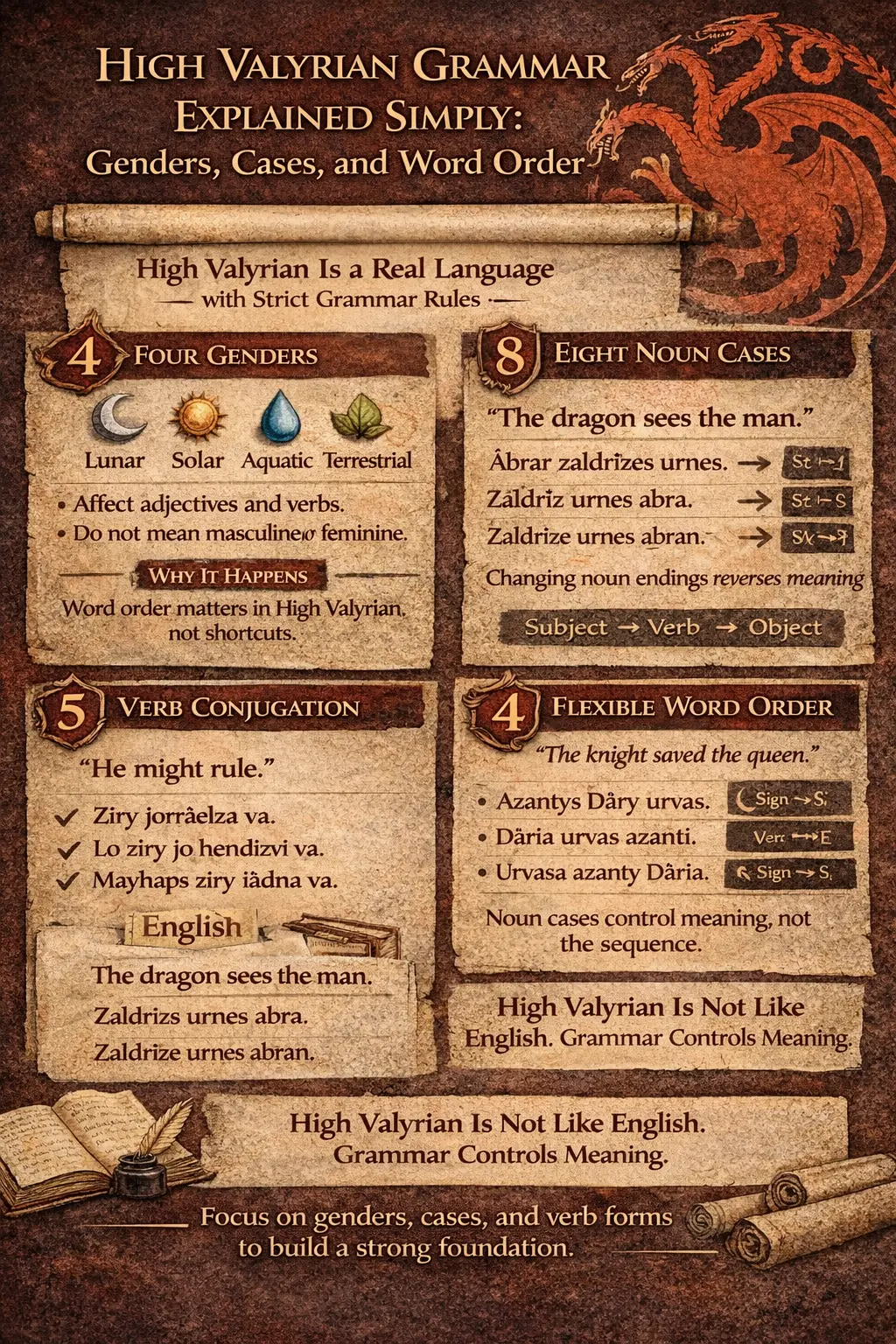
The Four Genders in High Valyrian
High Valyrian has four grammatical genders, which surprises most learners.
They are:
• Lunar
• Solar
• Aquatic
• Terrestrial
These genders are not biological. They do not mean masculine or feminine.
For example:
• Some objects are lunar
• Some abstract concepts are solar
• Some animals are terrestrial
There is no shortcut here. Noun genders must be learned and remembered.
Why gender matters
Grammatical gender affects:
• Adjective endings
• Verb agreement
• Sentence structure
Using the wrong gender makes a sentence feel incorrect to fluent readers, even if the words seem right. This is one of the earliest grammar mistakes fans make.
Noun Cases: The Core of High Valyrian Grammar
English barely uses noun cases.
High Valyrian uses eight.
Cases show what role a noun plays, not where it appears in the sentence.
They can indicate:
• The subject of an action
• The object of an action
• Possession
• Direction
• Location
English vs High Valyrian
English sentence: “The dragon sees the man.”
English relies on word order to show meaning.
High Valyrian relies on noun endings:
• Word order can change
• Meaning stays correct if cases are correct
• Change the case endings, and the meaning reverses
This is why word-for-word translation fails so often. Why translating English to High Valyrian is so difficult
English depends on order. High Valyrian depends on form.
Verb Conjugation Is Meaning-Critical
High Valyrian verbs carry a lot of information.
A single verb can encode:
• Tense (past, present, future)
• Mood (fact, command, possibility)
• Voice (who acts and who receives)
English often leaves these details vague.
Example
English: “He might rule.”
In High Valyrian, you must decide:
• Is this possibility?
• Is this uncertainty?
• Is this intention?
Each choice produces a different verb form.
This is why translations sometimes feel “off.” The translator—human or tool—is forced to interpret meaning.
Skipping this step guarantees errors.
Word Order Is Flexible — Not Random
High Valyrian allows flexible word order, but it is not chaotic.
Because noun cases exist, words can move for emphasis.
English structure:
• Subject → Verb → Object
High Valyrian structure:
• Object may come first
• Verb position can change
• Emphasis shifts with structure
Meaning stays correct only if cases and agreement are correct.
Once understood, this flexibility becomes one of the most powerful features of the language.
Why Fans Keep Making the Same Grammar Mistakes
The same issues appear again and again:
• Ignoring noun cases
• Guessing grammatical gender
• Translating idioms directly
• Trusting tools without grammar checks
These errors produce sentences that look Valyrian—but aren’t correct.
Memorizing phrases cannot replace grammar understanding.
How to Learn High Valyrian Grammar Without Burning Out
A practical approach works best:
• Learn genders slowly and accurately
• Practice cases using very simple sentences
• Study verbs separately before combining systems
• Use translation tools as support, not authority
• Read correct examples as often as possible
This method saves time and prevents frustration.
Final Thoughts
High Valyrian grammar feels difficult at first, and that is normal.
It is challenging because the language is real. It was designed by a professional linguist, not as a decorative TV prop.
Once you understand genders, cases, and word order, everything improves:
• Translation accuracy increases
• Learning speeds up
• Grammar mistakes decrease
Grammar is not the enemy. It is the foundation.
When you respect it, High Valyrian finally starts to make sense.