Why Translating English to High Valyrian Is So Difficult (With Real Examples)
But translating English into High Valyrian is far more difficult than most people expect.
Many assume it works like Google Translate.
Type English. Get correct Valyrian. That assumption leads to incorrect translations and frustration. This difficulty is not a flaw. It exists because High Valyrian is a fully constructed language with deep grammar, not a phrase-based fantasy code.
This article explains why English-to–High Valyrian translation is difficult, using real linguistic reasons and clear examples.
Why English and High Valyrian Don’t Map Cleanly
The core problem is simple.
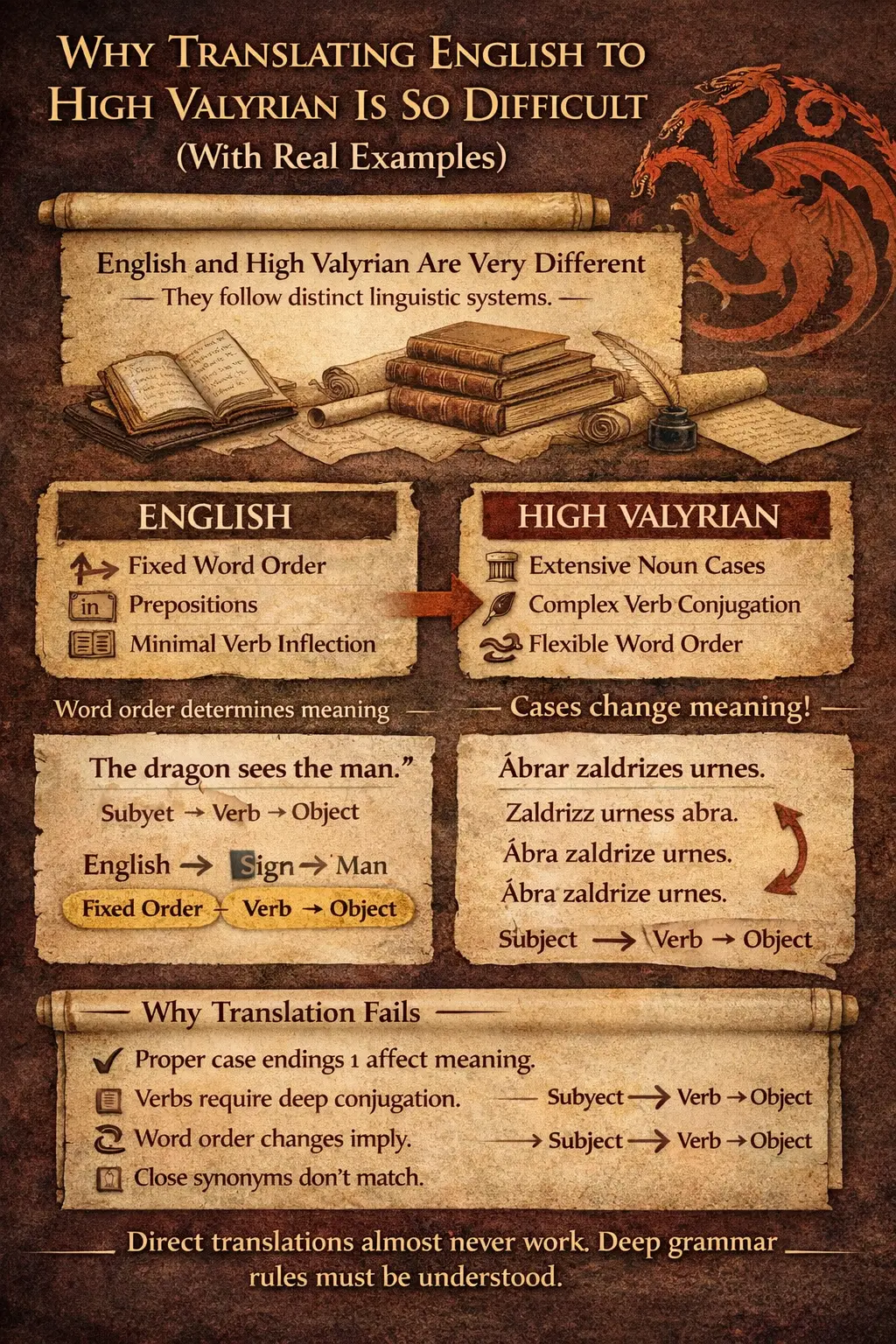
English and High Valyrian are built on very different linguistic systems.
English relies heavily on:
• Fixed word order
• Prepositions instead of noun cases
• Minimal verb inflection
High Valyrian relies on:
• Extensive noun cases
• Verb conjugation based on tense, mood, and voice
• Flexible word order controlled by grammar
Because of this, direct word-for-word translation almost never works.
To understand why translation fails, it helps to first understand what High Valyrian is as a language, not just where it appears on television.
Case System:
English nouns rarely change form. High Valyrian nouns do.
High Valyrian uses eight noun cases.
The correct case depends on the noun’s role in the sentence, not its position.
Conceptual Example
English sentence:
“The dragon sees the man.”
In English, word order shows who is acting.
In High Valyrian:
• “dragon” and “man” must be declined correctly
• Changing the case endings can reverse the meaning
• The same words can produce different meanings
This alone makes automated translation very difficult how High Valyrian translation works
Verb Conjugation Is Meaning-Critical
English verbs are forgiving. High Valyrian verbs are not.
A single High Valyrian verb must encode:
• Tense (past, present, future)
• Mood (indicative, subjunctive, imperative)
• Voice (active, passive, middle)
• Agreement with the subject
Why This Matters
Consider the English sentence: “He might rule.”
This sentence is vague in English.
High Valyrian forces interpretation:
• Is it hypothetical?
• Is it speculation?
• Is it a command?
The translator must choose.
This is why understanding how High Valyrian translation works in practice matters more than trusting raw output.
English Allows Ambiguity — High Valyrian Does Not
English often leaves meaning unclear.
Example:
“She saw him with the sword.”
Who has the sword?
English does not say.
High Valyrian requires clarity.
• Grammar forces a decision
• Different constructions change meaning
When a translation tool outputs one version, it is usually making an assumption.
It is not guaranteeing correctness.
No One-to-One Vocabulary Matches
Many English words do not exist in High Valyrian.
Abstract ideas like:
• freedom
• responsibility
• efficiency
• privacy
require:
• Descriptive phrases
• Context-based substitutions
• Different grammatical constructions
This is why English idioms almost always fail in High Valyrian translation.
Why Translation APIs Struggle With High Valyrian
Most translation APIs are designed for:
• Natural languages
• Large training datasets
• Statistical pattern matching
High Valyrian has:
• A limited text corpus
• Highly rule-based grammar
• Strong context dependence
As a result, APIs often:
• Default to simplified structures
• Ignore noun case nuance
• Flatten verb complexity
This does not make them useless.
It means human understanding is still required.
What This Means for Learners and Fans
For Learners
Translation tools should assist, not decide
Grammar matters more than vocabulary
Context controls meaning
For Fans
Incorrect translations are common
Memorization alone does not work
Understanding structure leads to better results
For serious learners, structured guidance matters more than raw translations.
Final Reality Check
Translating English into High Valyrian is difficult because:
• The language is real, structured, and strict
• English allows ambiguity that Valyrian does not
• Grammar decisions cannot be automated reliably
This difficulty is a sign of authenticity, not weakness.
High Valyrian behaves like a real language because it was built to be one.