Understanding Noun Declension in High Valyrian for Serious Learners
Introduction
Many learners reach a point in High Valyrian where vocabulary is no longer the main obstacle. The real confusion begins when nouns start changing their endings. A word that looked stable in one sentence suddenly appears in a different form in another. At that stage, most learners ask the same question: why does the noun keep changing?
The short answer is this: High Valyrian does not rely heavily on word order to show meaning. Instead, it uses noun declension. The ending of the noun tells you its role in the sentence. Once you understand this system, sentences stop feeling unpredictable and begin to feel structured.
High Valyrian noun declension is built around grammatical cases, number, and agreement. Each noun belongs to a declension class, and each class follows patterns. If you learn those patterns correctly, you gain control over sentence structure, translation accuracy, and comprehension.
In structured learning programs and online learner communities, I have consistently seen that students who truly understand declension improve faster than those who only memorize phrases. This article explains how the system works, why it exists, and how to approach it in a practical way that avoids common mistakes.
What Noun Declension Means in High Valyrian
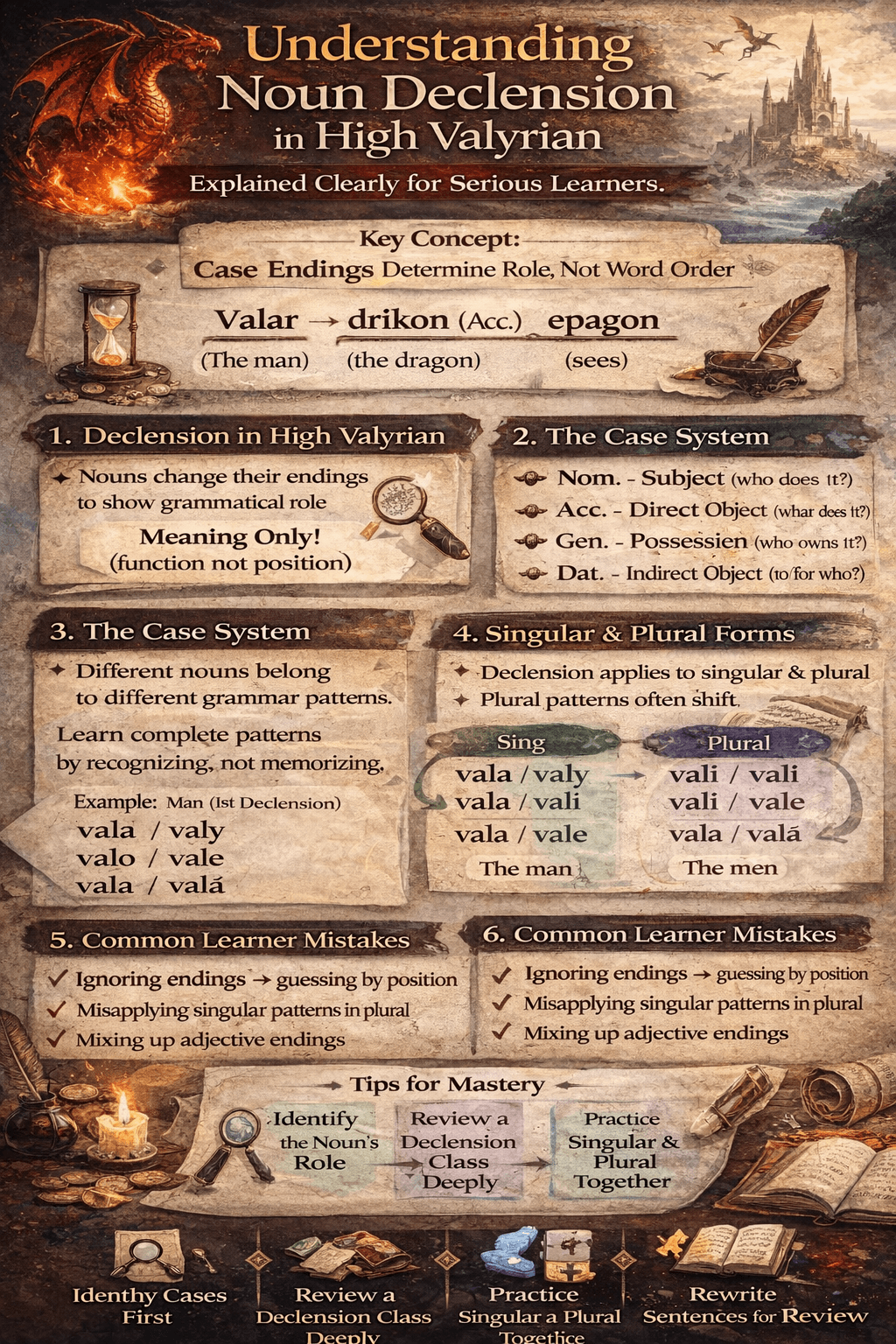
Noun declension refers to the way nouns change their endings depending on their grammatical role in a sentence. In English, we mostly rely on word order. In High Valyrian, endings carry that responsibility.
For example, the subject of a sentence appears in one case, while the direct object appears in another. Instead of moving words around to clarify meaning, High Valyrian marks the noun itself.
In beginner study groups, I often notice learners translating directly from English and assuming that the first noun must always be the subject. That assumption causes confusion when encountering flexible word order. In High Valyrian, word order can change without changing meaning because the case ending already identifies the noun’s function.
This is why declension matters so much. It allows sentences to be rearranged for emphasis without losing clarity. If you want to see how case endings affect meaning in real sentences, you can test examples directly using our High Valyrian translator tool. If you ignore noun endings, you lose the core logic of the language.
Understanding declension means understanding that the noun itself carries grammatical information. Once learners accept this shift in thinking, the system becomes logical rather than intimidating.
The Case System and Why It Exists
High Valyrian uses several grammatical cases, each serving a specific purpose. These include functions equivalent to subject, direct object, possession, indirect object, and more.
The nominative case marks the subject of a sentence. The accusative marks the direct object. The genitive expresses possession. The dative often marks the indirect object. There are also other cases used for location and direction.
Learners frequently memorize case names without understanding their purpose. In long-term learner forums, I have seen repeated confusion between accusative and dative usage because students focus on endings instead of function.
The key is to ask a simple question for every noun: what role is this noun playing? Is it performing the action, receiving it, or owning something?
For example:
If a noun performs the action, it takes the nominative.
If it receives the action directly, it takes the accusative.
If it shows possession, it takes the genitive.
When students train themselves to identify function before form, error rates drop significantly. The case system exists to clarify relationships between words. It is not decorative grammar. It is structural.
Declension Classes and Pattern Recognition
Not all High Valyrian nouns decline in the same way. They belong to different declension classes. Each class follows predictable patterns based on the noun’s ending and grammatical gender.
This is where many learners feel overwhelmed. They see multiple charts and assume each noun must be memorized individually. That approach quickly leads to burnout.
In structured learning environments, successful learners focus on pattern recognition rather than memorization. For example, nouns ending in a certain vowel often follow a consistent declension structure across cases. Once you internalize one pattern, many nouns become easier to predict.
A common mistake is trying to memorize full declension tables without applying them in sentences. When students only review charts, they often freeze during actual reading because recognition skills were never developed.
Instead, I recommend taking one declension class and writing multiple short sentences using the same noun in different cases. By seeing how the noun shifts across contexts, the pattern becomes intuitive.
Declension classes are not random lists. They are organized systems. The key is repetition within meaningful context, not isolated memorization.
Singular and Plural Forms in Declension
Number plays a crucial role in noun declension. Each case has both singular and plural forms, and plural endings can differ significantly from singular ones.
Learners often master singular forms first but struggle when plural appears in reading passages. In community reading sessions, plural genitive and plural dative forms cause the most hesitation.
The reason is cognitive load. Students are already processing case and function. Adding number doubles the complexity. However, the solution is not to delay plural study. It is to integrate singular and plural practice early.
For example, take a noun in the nominative singular and create two sentences: one singular and one plural. Then repeat the process in accusative. This gradual layering prevents overload.
Another frequent issue is assuming plural endings simply add an extra letter. In High Valyrian, plural often changes the internal structure of the noun, not just the ending.
Understanding singular and plural together strengthens recognition speed. It also prevents translation errors where learners misidentify the number of participants in a sentence.
Common Learner Mistakes with Declension
Certain errors appear repeatedly across learner communities.
One major issue is ignoring case endings entirely and translating based on position. This leads to reversed subject and object interpretation.
Another common mistake is overgeneralizing one declension pattern to all nouns. After learning one class successfully, learners sometimes apply its endings incorrectly to unrelated nouns.
A third issue appears during production. When writing original sentences, learners often choose correct vocabulary but attach the wrong case ending because they did not analyze the sentence structure first.
In collaborative study groups, I have observed that learners who pause to identify grammatical roles before writing make fewer declension errors. Those who rush into translation tend to rely on guesswork.
Finally, learners often neglect agreement. In High Valyrian, adjectives must agree with the nouns they modify. Verbs follow similar agreement principles, which you can explore further in our guide to High Valyrian verb tenses. If the noun changes case, the adjective must reflect that change.
Most mistakes are not caused by complexity but by skipping analytical steps. Declension rewards careful thinking. It punishes assumption.
Practical Strategies for Mastering Declension
Mastery comes from structured repetition, not from reading explanations alone.
First, limit your focus. Choose one declension class and work with it for several days. Create sentences that move a noun through nominative, accusative, genitive, and dative.
Second, read slowly. When encountering a declined noun, identify its base form and then determine its case and number. This trains recognition rather than passive exposure.
Third, rewrite sentences by changing grammatical roles. Turn a subject into an object. Convert singular to plural. This forces active manipulation of endings.
In long-running learner forums, students who engaged in active rewriting exercises consistently showed better retention than those who relied only on flashcards.
Fourth, analyze errors carefully. If you misused a case, identify why. Did you misunderstand function? Did you apply the wrong pattern? Did you forget number?
Declension is not mastered through speed. It is mastered through deliberate practice.
Why Declension Becomes Easier Over Time
At the beginning, declension feels mechanical. Learners consciously think through each ending. This slows down reading and speaking.
After consistent exposure, recognition becomes automatic. You begin to see a noun ending and immediately understand its function without translating step by step.
This shift happens when patterns move from conscious recall to recognition memory. It does not happen through memorization alone. It happens through repeated contextual use.
In advanced learner circles, discussions rarely focus on declension charts anymore. Instead, learners debate nuance and stylistic choice. That transition only occurs when declension is internalized.
The goal is not perfection in isolation. The goal is functional fluency where noun endings guide comprehension naturally.
FAQs
Summary and Action Plan
High Valyrian noun declension is not an arbitrary system. It is the backbone of sentence meaning. Noun endings indicate grammatical role, number, and agreement. Once you understand that logic, flexibility in word order becomes less intimidating.
To move forward:
Choose one declension class and master it in context.
Practice identifying grammatical roles before choosing endings.
Integrate singular and plural forms early.
Rewrite sentences to force active manipulation.
Review mistakes analytically, not emotionally.
Declension becomes manageable when approached systematically. Treat it as pattern recognition combined with grammatical reasoning. Over time, noun endings stop feeling like obstacles and start functioning as guides.