
How to Build a High Valyrian Study Routine That Actually Works
Introduction
If you want to learn High Valyrian seriously, you cannot rely on random practice or occasional app sessions. You need structure. If you are organizing your learning resources, keep your main study tools in one place. If you are organizing your learning resources, keep your main study tools in one place. You can access the High Valyrian translation tool and core learning resources from the High Valyrian learning hub.
The short answer is this: a strong High Valyrian study routine is built around grammar depth, controlled vocabulary growth, active production, and regular review. Without these four elements, progress feels slow and unstable.
Many learners begin with excitement because High Valyrian is tied to Game of Thrones and House of the Dragon, but motivation alone does not create fluency. The language was developed by David J. Peterson for HBO’s Game of Thrones, and although it is fictional, its grammar system is detailed and demanding. Cases, verb conjugations, and noun declensions require deliberate practice.
In community study groups and online learner forums, I have seen the same pattern repeatedly. Learners who “study when they feel like it” plateau within months. Those who build a repeatable weekly structure continue improving even after the initial excitement fades.
This guide will show you how to design your own study routine based on real learner behavior, realistic time constraints, and long term retention principles. You will understand not only what to study, but how to organize your week so that progress becomes measurable.
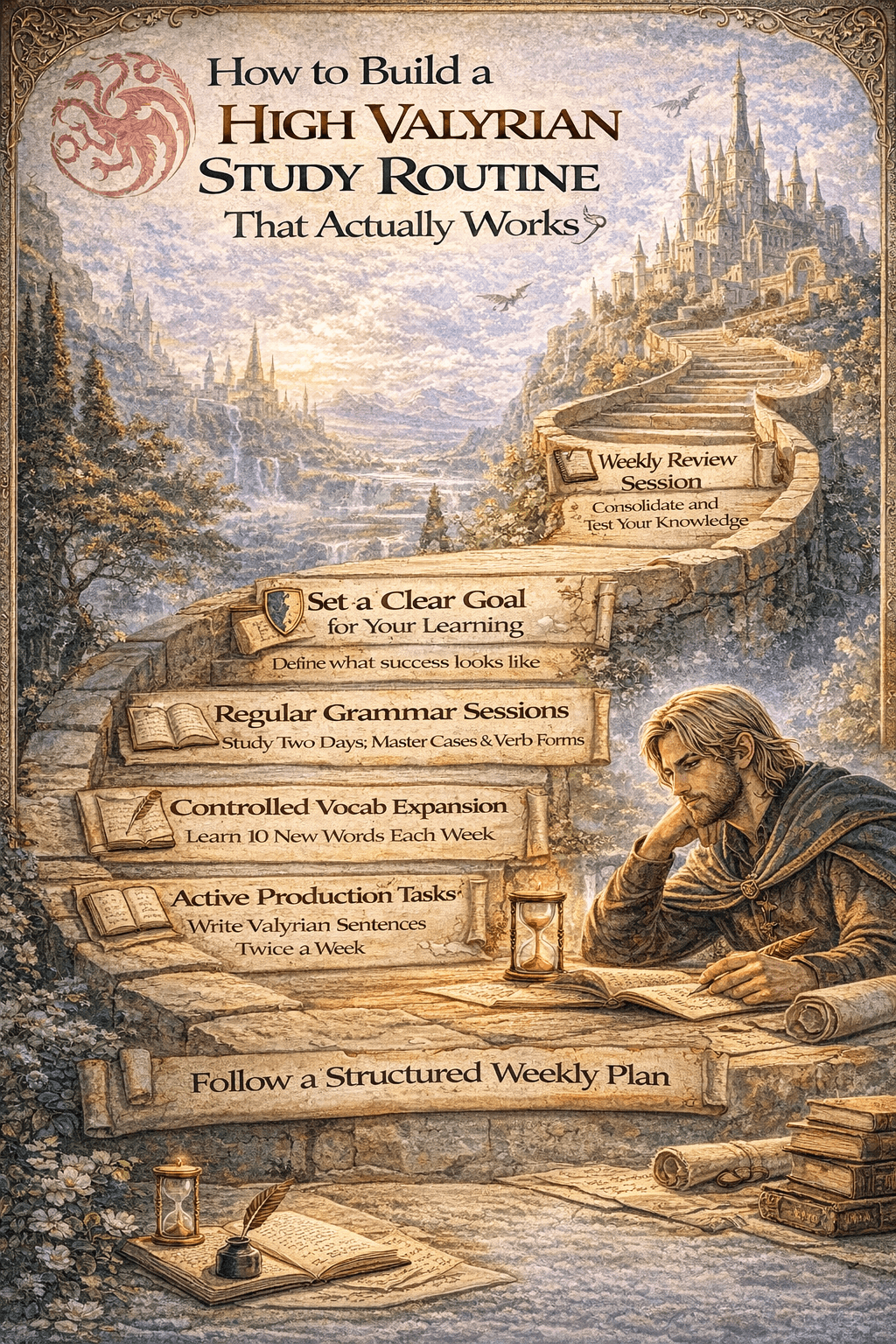
Start With a Clear Definition of Your Goal
Before you design a routine, you need to define what “learning High Valyrian” means for you. This step is often skipped, and it causes confusion later.
In structured language programs I have observed, students who cannot describe their target outcome drift between resources. Some want to translate quotes from Game of Thrones. Others want to hold basic conversations. A few aim to read complex grammatical explanations and produce original sentences.
High Valyrian is not widely spoken in daily life, so your goals will shape your routine more strongly than in natural languages. If your aim is translation accuracy, you will need deeper grammar analysis. If your aim is spoken fluency practice, you must allocate more time to active sentence creation.
A common mistake is setting a vague goal such as “be fluent.” In High Valyrian, fluency is limited by available vocabulary and community usage. A better goal would be:
“I want to confidently produce grammatically correct simple and compound sentences within six months.”
Or:
“I want to understand declension patterns and translate show dialogue without relying heavily on references.”
Once the goal is specific, you can measure progress. If you are still at the early stages and unsure how to structure your first months, follow a structured High Valyrian beginner learning roadmap before designing a personalized routine. Without that clarity, routines collapse because there is no visible improvement.
Write your goal in one sentence. Keep it visible. Every part of your routine must connect back to that sentence.
Structure Your Week Around Grammar Depth
High Valyrian grammar is not optional background knowledge. It is the core system of the language. Learners who avoid grammar in favor of vocabulary quickly reach confusion.
The language has multiple noun cases, adjective agreement rules, and detailed verb conjugation patterns. Many learners underestimate this because it is a constructed language. In reality, its structure resembles classical inflected languages.
In long term learner communities, the most consistent progress comes from dividing grammar study across the week rather than cramming it into one session. For example:
Two focused sessions per week dedicated only to grammar analysis.
During these sessions, you do not memorize words randomly. You analyze:
Why does this noun change form here?
Why is this verb conjugated in this pattern?
What rule explains this sentence structure?
A common mistake is copying example sentences without understanding the case endings. This leads to pattern imitation without real comprehension. After several weeks, learners cannot build new sentences independently.
Instead, dedicate part of your routine to rewriting examples. Change the noun. Change the subject. Modify the tense. Force the rule to prove itself under variation.
Grammar study should feel slightly difficult. If it feels easy, you are likely reviewing material you already understand.
Build Vocabulary Through Context, Not Lists
Many learners start by downloading long vocabulary lists. This feels productive but produces weak retention.
In High Valyrian study groups I observed, learners who memorized isolated words often forgot them within weeks. Those who attached vocabulary to meaningful sentences retained more.
Your routine should include controlled vocabulary expansion. Limit new words to a manageable number per week. Ten to fifteen is realistic for adults with other responsibilities.
For each new word:
Write it in a sentence.
Change the case or verb form if possible.
Connect it to previously learned words.
For example, instead of memorizing a noun alone, create three variations of a sentence using different cases. This reinforces grammar and vocabulary together.
Another mistake is overloading early stages with rare or poetic words from Game of Thrones. Start with functional vocabulary that allows sentence building. Without usable core words, grammar practice becomes abstract.
A weekly review session is critical. Revisit older vocabulary. Remove words you consistently forget and reintroduce them later. This keeps your routine honest and adaptive.
Include Active Production Every Week
Passive exposure is not enough. Reading translations or watching clips from Game of Thrones does not automatically build production skills.
Active production means writing or speaking original sentences without copying.
In structured online practice groups, I have seen learners who understand grammar explanations clearly but freeze when asked to create a sentence independently. This happens when routines are too input heavy.
At least twice per week, dedicate time to:
Writing short paragraphs in High Valyrian.
Translating simple ideas from your daily life.
Answering imaginary questions using correct grammar.
Do not aim for perfection in these sessions. The goal is to expose weaknesses.
One practical technique is the “limited resource method.” Allow yourself only the grammar notes you have studied that week. Do not consult full dictionaries immediately. Attempt production first, then check accuracy.
Common mistake: avoiding writing because mistakes feel discouraging. In reality, mistakes are diagnostic tools. They show exactly what needs reinforcement.
Active production transforms theoretical knowledge into usable skill.
Design Review Cycles to Prevent Forgetting
Most High Valyrian learners quit not because the language is impossible, but because they forget earlier material and feel they are moving backward. If consistency has been difficult for you, study practical strategies for maintaining daily High Valyrian practice without burnout while following a structured plan.
Without review, grammar and vocabulary fade quickly. This is especially true in constructed languages where daily exposure is limited.
A strong routine includes:
Short weekly review sessions.
Monthly consolidation sessions.
During weekly review, revisit grammar rules studied in previous weeks. Test yourself without looking at notes. Rewrite example sentences from memory.
During monthly review, evaluate larger patterns. Can you still explain case usage clearly? Can you conjugate verbs without checking references?
In learner forums, those who implement review cycles show more stable progress. Those who constantly move forward without revision eventually hit confusion walls.
Review is not repetition for its own sake. It strengthens long term retention and reduces frustration.
Balance Enjoyment With Discipline
High Valyrian is connected to entertainment media. Many learners begin because of Game of Thrones or House of the Dragon. Enjoyment matters, but it cannot replace structured study.
Use show dialogue as reinforcement, not as your primary learning source. After studying a grammar concept, find examples in show transcripts. Analyze them. Confirm your understanding.
Do not assume that exposure equals learning. Listening to scenes repeatedly without grammatical awareness creates familiarity, not mastery.
In community discussions, learners who balance structured study with enjoyment tend to stay engaged longer. Those who rely only on entertainment often lose direction once the novelty fades.
Your routine should include one lighter session per week. This could involve translating a favorite quote or analyzing a scene. However, it should always connect back to your grammar and vocabulary goals.
Balance prevents burnout. Discipline prevents stagnation.
Adjust Your Routine Based on Real Feedback
A study routine is not fixed forever. It should evolve.
Every four to six weeks, evaluate:
Are you producing more complex sentences?
Are grammar errors decreasing?
Is vocabulary recall improving?
If not, adjust.
In structured group programs, learners who track their progress adapt faster. For example, if verb conjugations remain weak, increase focused verb drills. If vocabulary retention is low, reduce new word intake.
Another common mistake is copying someone else’s routine blindly. Adults have different schedules and cognitive strengths. Some prefer shorter daily sessions. Others prefer longer weekend blocks.
Test your routine for a month. Keep notes on what feels effective and what feels rushed. Then refine.
Adaptation is not failure. It is responsible learning.
FAQs
Summary and Action Plan
Building your own High Valyrian study routine requires intention. You need a clear goal, structured grammar sessions, controlled vocabulary growth, active production, and regular review.
Start by writing one precise learning objective.
Design a weekly plan with:
• Two grammar focused sessions.
• Two active production sessions.
• One vocabulary expansion session.
• One review session.
After four weeks, evaluate your progress honestly. Adjust based on weaknesses, not preferences.
High Valyrian rewards structured learners. With consistent effort and thoughtful adaptation, measurable progress becomes visible within months.