Can You Learn High Valyrian Without a Teacher?
Introduction
Yes, you can learn High Valyrian without a teacher, but only if you understand what you are taking on. Many learners begin alone because there are very few formal instructors, no large classrooms, and limited structured programs compared to natural languages. The real challenge is not access to information. It is structure, feedback, and long-term consistency.
High Valyrian is a constructed language created for the television series Game of Thrones by linguist David J. Peterson. It has a clear grammatical system, case endings, verb conjugations, and a growing learning community. That makes self-study possible. However, it also means you must build your own system carefully. If you are new to the language, understanding what High Valyrian actually is helps you decide whether self-study is realistic.
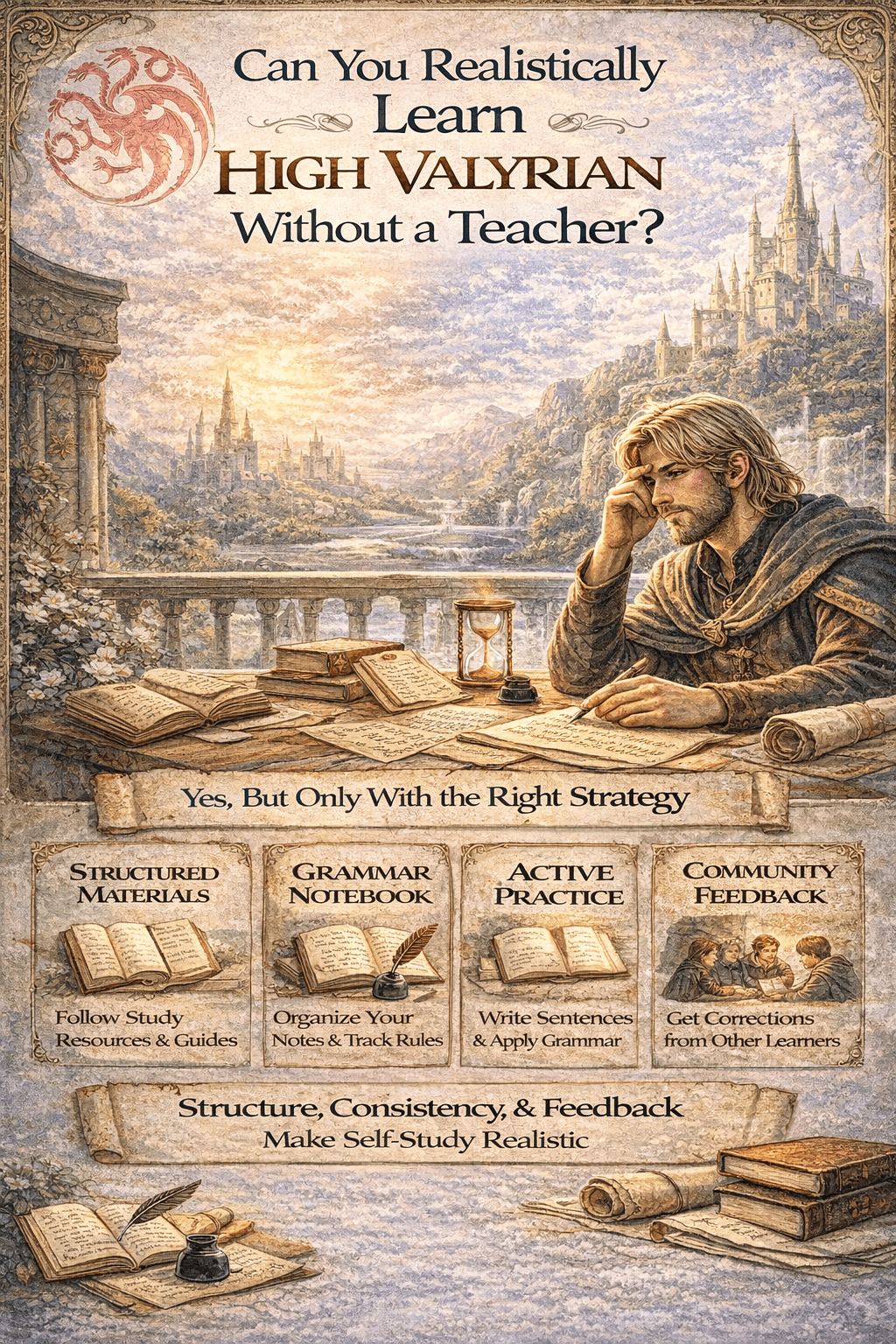
Short answer for quick reference: You can learn High Valyrian independently if you use structured materials, track grammar systematically, practice actively, and engage with the community for feedback. Without those elements, most learners plateau early.
This guide explains what really happens when you study alone, where self-learners struggle, how to replace a teacher effectively, and what realistic progress looks like over time.
What Makes High Valyrian Different From Learning a Natural Language
Many people assume that learning High Valyrian is easier because it is fictional. In practice, it can be harder in certain ways.
High Valyrian was developed by David J. Peterson for HBO’s Game of Thrones. Unlike languages such as Spanish or French, it does not have millions of speakers, full academic departments, or decades of textbooks. The available materials are limited compared to major world languages.
At the same time, High Valyrian has a highly structured grammar. It includes four grammatical genders, multiple cases, and complex verb conjugations. The language was built with internal logic. That logic helps serious learners, but it also requires disciplined study. Many independent learners also question whether High Valyrian is a complete language before committing long-term.
In community discussion groups I have observed, beginners often underestimate the grammar. They focus heavily on vocabulary from the show. They memorize lines like “Valar Morghulis” but cannot form their own sentences. Without a teacher to redirect them toward grammar fundamentals, they develop a very uneven skill set.
A teacher normally guides pacing, corrects misunderstandings early, and prioritizes structure over memorized phrases. When you learn alone, you must consciously create that structure for yourself. If you do not, you may spend months feeling productive while avoiding the hard parts of the language.
Understanding this difference is the first step. High Valyrian is learnable alone, but it requires more deliberate planning than many expect.
The Real Challenges of Learning Without a Teacher
Self-study sounds flexible and empowering. In reality, it exposes specific weaknesses that many learners only recognize later.
The biggest problem is error fossilization. When you misunderstand case endings or verb agreement, you may repeat the same mistake for months. In structured learning programs I have reviewed, learners with regular correction progressed more evenly. Independent learners often built unstable foundations.
Another challenge is pacing. Without deadlines or lessons, motivation fluctuates. In long-term learner forums, I have seen a clear pattern. The first month is full of excitement. By the third month, many learners stop posting. They did not fail because the language was impossible. They failed because they lacked structure.
There is also the illusion of understanding. Reading grammar explanations feels productive. Translating short sentences feels manageable. But when asked to produce original sentences without notes, many self-learners freeze. A teacher normally pushes students into active production earlier.
Finally, feedback is limited. Pronunciation errors, incorrect stress patterns, and subtle grammar confusion often go unnoticed. Over time, these accumulate.
These challenges do not mean you need a teacher. They mean you need to replace the teacher’s functions with systems. Structure, correction, accountability, and deliberate practice must come from somewhere.
How to Replace a Teacher With Structure
If you want to succeed independently, you must build a clear framework.
Start with grammar before heavy vocabulary memorization. Many beginners try to learn hundreds of words quickly. Without understanding noun cases and verb conjugation patterns, those words remain isolated pieces. Study declension patterns slowly and revisit them weekly.
Create a written grammar notebook. Not digital notes scattered across apps. A structured notebook forces organization. In community study groups I have participated in, learners who maintained organized grammar logs retained concepts longer and made fewer repeated errors.
Schedule review sessions. A teacher naturally revisits old material. Alone, you must design spaced repetition into your plan. Every two weeks, review earlier cases and verb forms. Test yourself without looking at notes.
Most importantly, produce language regularly. Write short paragraphs about simple topics. Describe your day. Translate small ideas from English, then check them carefully against grammar rules.
Structure replaces supervision. If you cannot commit to structured review and production, self-study will likely stall.
Using Community Feedback Instead of Direct Instruction
One advantage modern learners have is online access. While High Valyrian does not have formal schools, it has active communities.
Forums, Discord groups, and discussion threads provide informal correction. In several High Valyrian community spaces, experienced learners frequently respond to grammar questions. When beginners post original sentences, they often receive corrections with explanations.
However, community feedback works only if you actively seek it. Many self-learners remain silent readers. They consume content but never post their writing. That limits growth.
To use community feedback effectively, share small pieces of writing weekly. Ask specific questions. Instead of saying “Is this correct?” ask “Did I use the dative case properly here?” This invites detailed correction.
Be prepared for corrections. Some learners withdraw after receiving feedback because it highlights mistakes. In reality, those corrections accelerate progress dramatically.
Community feedback does not replace a professional teacher entirely, but it reduces isolation. It provides accountability and exposure to more advanced usage.
Common Self-Learning Mistakes in High Valyrian
Certain patterns repeat consistently among independent learners.
The first is memorizing phrases from Game of Thrones without analyzing grammar. Recognizing lines is not the same as understanding them. Without breaking down cases and verb forms, learners develop passive recognition only.
The second mistake is skipping pronunciation. High Valyrian includes vowel length distinctions and specific stress patterns. Learners who ignore pronunciation early often struggle later when trying to speak fluidly.
Another common issue is studying inconsistently. Long breaks create regression. Because High Valyrian is not used daily in real life, forgetting happens quickly without regular exposure.
Finally, many learners avoid writing because it feels difficult. Writing exposes gaps clearly. That discomfort is actually useful. In structured environments I have observed, learners who wrote regularly improved faster than those who only read and reviewed flashcards.
Recognizing these mistakes early can prevent months of stagnation.
What Realistic Progress Looks Like Without a Teacher
Expect gradual development, not fluency in a few months.
In the first three months of structured self-study, most learners can understand basic grammar explanations and form simple sentences with effort. Errors remain frequent.
Between six and twelve months, consistent learners begin forming more complex sentences. They still consult notes often, but sentence construction becomes less mechanical.
Beyond one year, progress depends heavily on active usage. Learners who write, engage in discussions, and revise their errors improve steadily. Those who rely mainly on reading plateau.
High Valyrian does not have immersion environments like natural languages. That slows progress slightly. However, because its grammar is consistent and finite, long-term mastery is achievable with persistence.
Set goals such as “write a 150 word paragraph without notes” rather than vague goals like “be fluent.” Concrete tasks measure progress more accurately.
When a Teacher Becomes Necessary
Some learners reach a stage where independent study feels limiting.
If you consistently struggle with complex grammar patterns and cannot diagnose your mistakes, guided instruction may help. A teacher can identify blind spots quickly.
If your goal includes high accuracy, public teaching, or content creation in High Valyrian, professional feedback becomes more important.
However, many learners reach intermediate levels independently before seeking advanced guidance. Self-study does not prevent future formal instruction. It often prepares you to use that instruction more effectively.
The key question is not “Can I learn without a teacher?” It is “Can I create enough structure, feedback, and accountability to replace one?”
FAQs
Summary and Action Plan
You can learn High Valyrian without a teacher, but you must replace the teacher’s role deliberately.
Focus on grammar first. Keep organized notes. Review regularly. Produce original sentences weekly. Seek community correction consistently. Avoid relying only on memorized phrases from the show.
Set measurable goals. Track your writing improvement over time. Expect slow, steady development rather than dramatic breakthroughs.
If you are serious about learning independently, start by exploring the core High Valyrian overview and translation tool available on the homepage, then build structured study around it.
If you reach a point where progress stalls despite structured effort, consider guided feedback. Until then, independent study is realistic and achievable with discipline.