High Valyrian Self-Study Mistakes That Slow Your Progress
Introduction
Many beginners who study High Valyrian alone struggle for the same reason: they treat it like a casual hobby instead of a structured language system. The most common mistakes are inconsistent grammar study, vocabulary memorization without context, relying only on apps, ignoring active production, and avoiding feedback.
If you are studying alone, you are not at a disadvantage. But you do need structure. High Valyrian is a highly inflected constructed language created for HBO’s Game of Thrones by linguist David J. Peterson. It has cases, verb conjugations, agreement patterns, and word order flexibility that do not behave like English. When learners ignore that complexity, progress becomes unstable.
In structured online study groups and long-term learner forums, I have repeatedly seen the same pattern: motivated beginners start fast, feel confident for a few weeks, then hit a wall. That wall is rarely about intelligence. It is about method.
This guide explains the most common mistakes beginners make when studying High Valyrian alone, why those mistakes happen, and how to correct them with realistic, practical adjustments.
Treating High Valyrian Like a Vocabulary Game
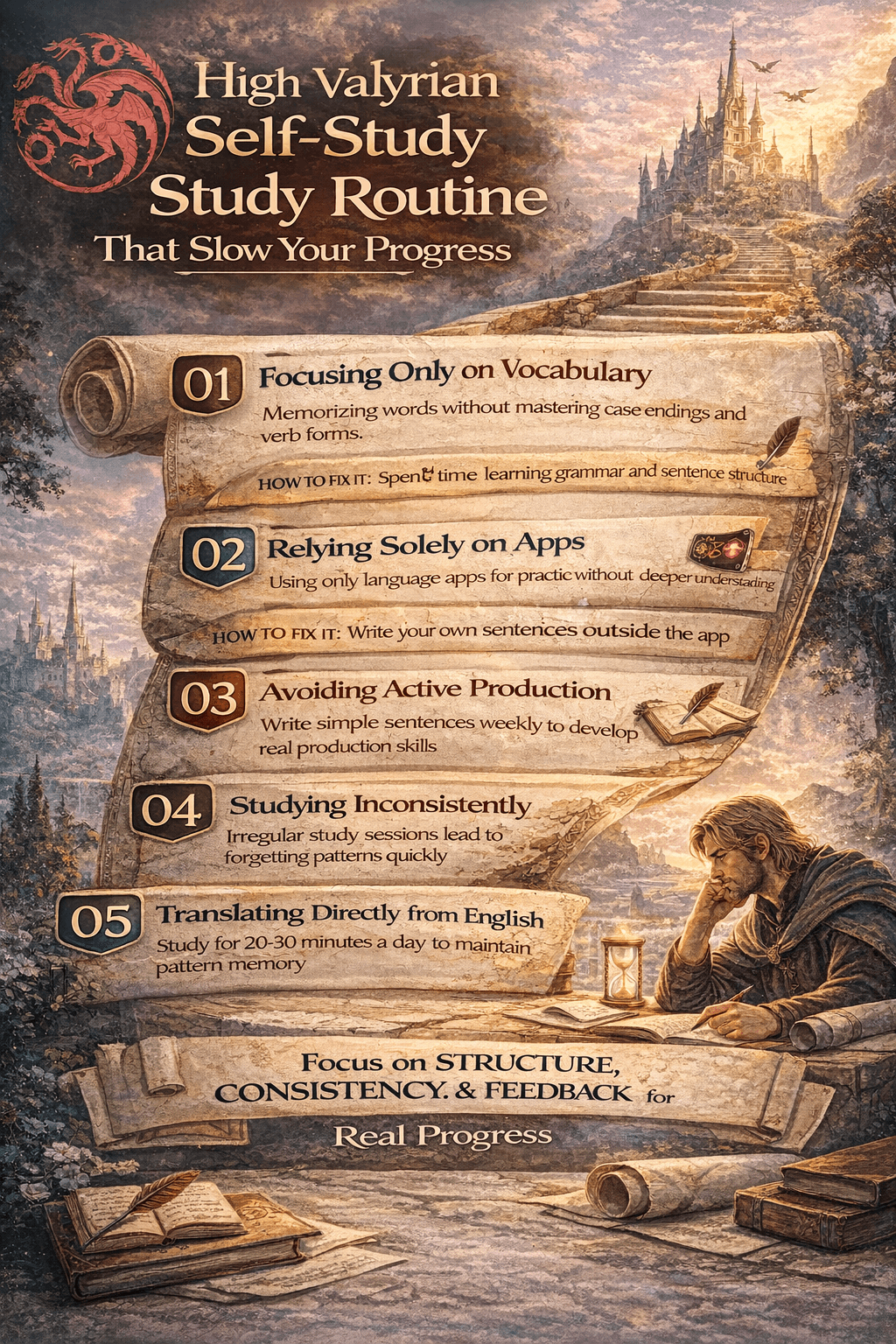
One of the most damaging mistakes beginners make is focusing almost entirely on vocabulary. Many learners begin by memorizing isolated words such as vala, dracarys, or ānogar. Because High Valyrian is associated with Game of Thrones, there is a temptation to collect phrases rather than understand structure.
In independent study settings, I have seen learners build lists of 300 to 500 words while still being unable to form a basic correct sentence. The problem is not effort. The problem is structure.
High Valyrian relies heavily on case endings. If these systems feel unclear, review the core High Valyrian grammar basics before expanding your vocabulary further. Nouns change form depending on their grammatical role. Adjectives must agree in number and case. Verbs encode information about person and number. If you memorize vocabulary without understanding English influences almost every beginner studying High Valyrian alone.declension patterns, you cannot actually use those words.
For example, knowing the dictionary form of a noun is not enough. You must know how it changes in nominative, accusative, genitive, and other cases. Without this, learners often default to English word order and incorrect endings.
A common beginner mistake looks like this: constructing a sentence with correct words but incorrect endings. The sentence feels close, but grammatically it collapses.
The correction is simple but demanding. Spend equal time on declension patterns and conjugation systems as you do on vocabulary. When learning a new noun, learn at least two case forms with it. When learning a verb, practice full present tense conjugation instead of memorizing a single form.
Grammar in High Valyrian is not optional decoration. It is the engine of the language.
Relying Only on Apps Without Deep Practice
Apps are helpful tools. They provide exposure, repetition, and accessibility. However, many self-studying beginners treat app progress as proof of real competence.
In long-term learner communities, I have observed a clear pattern. Learners who rely only on app exercises often plateau after the beginner stage. They can recognize correct answers in multiple choice questions, but they struggle to produce original sentences.
Recognition is not production.
App exercises often test whether you can select the correct answer from four options. Real language use requires generating forms without prompts. This difference becomes clear when learners try to write even five original sentences. Suddenly uncertainty appears. Endings feel unclear. Word order becomes confusing.
Another issue is limited explanation. Apps introduce patterns gradually, but they rarely provide full grammatical analysis. Without understanding why something is correct, learners memorize surface patterns.
If you are studying alone, use apps as reinforcement, not as your main system. After completing a lesson, open a notebook. Write ten original sentences using the target structure. Change subjects, change objects, alter cases. Force yourself to produce.
In structured learning programs, the students who advance fastest are not those who complete the most lessons. They are the ones who write the most original sentences outside the app environment.
Ignoring Active Output and Delaying Writing Practice
Many beginners delay writing because they feel unprepared. They want to “learn more first.” This creates a dangerous loop. They wait to feel confident, but confidence only comes from practice.
In community study groups, beginners who begin writing early, even imperfectly, improve more steadily than those who wait for mastery. The reason is simple. Writing exposes weaknesses immediately. You discover which declensions you do not remember. You notice which verb endings feel unstable.
Learners studying alone often avoid this discomfort. They read explanations, review notes, and revisit vocabulary lists. It feels productive, but it is passive.
Active output changes everything. When you try to describe a simple scenario such as “The dragon sees the king” you must decide case endings, verb agreement, and word order. Every decision strengthens your internal grammar map.
Common beginner mistake: writing one or two sentences occasionally and stopping when unsure.
A better method is structured micro-writing. Choose a single grammar topic. For example, present tense verbs. Write five sentences using only that tense. Keep vocabulary simple. Then revise carefully.
You will make mistakes. That is expected. The act of noticing those mistakes is what builds competence.
High Valyrian rewards production practice because its morphology forces precision. The earlier you start writing, the stronger your foundation becomes.
Studying Irregularly and Losing Pattern Memory
High Valyrian has patterns. Case endings follow predictable structures. Verb conjugations follow identifiable classes. But pattern memory fades quickly without consistency.
One of the most common issues I have seen in self-study environments is inconsistent study frequency. Learners study intensely for three days, then stop for a week. When they return, endings feel unfamiliar again.
Because High Valyrian is structurally rich, gaps in exposure weaken pattern recognition. You can reinforce your daily exposure by using our High Valyrian translator tool, which lets you practice structure and vocabulary in real time while experimenting with sentences. You may remember vocabulary, but the automatic feel of endings disappears.
In structured programs, shorter daily sessions outperform long, irregular sessions. Even 20 to 30 minutes per day maintains grammatical sensitivity. The brain retains inflectional patterns better when exposure is regular.
Another common beginner mistake is reviewing only what feels comfortable. Learners repeatedly revise the same early lessons instead of moving forward and integrating previous topics into new contexts.
Instead, create rotating review cycles. Each week, revisit one older grammar concept and apply it in new sentences. Do not merely reread notes. Use the structure actively.
Consistency is not about intensity. It is about frequency. Regular exposure keeps morphological patterns alive in memory.
Translating Directly from English Structure
English influences almost every beginner studying High Valyrian alone. Because English relies heavily on word order rather than case endings, learners instinctively map English structure onto Valyrian sentences.
This creates subtle but persistent errors.
High Valyrian allows more flexible word order because grammatical roles are marked morphologically. Beginners often produce sentences that follow strict English subject-verb-object order and neglect proper case endings.
This pattern is explained in detail in why translating English to Valyrian is hard, especially for beginners who depend on English word order.
In community writing discussions, I have repeatedly seen sentences that look like literal English translations with Valyrian words substituted. The surface vocabulary is correct, but the grammar reflects English thinking.
This mistake slows development because it prevents learners from internalizing how Valyrian encodes relationships between words.
A corrective strategy is reverse translation practice. Instead of translating from English to Valyrian, take a Valyrian sentence and analyze its structure. Identify case roles. Identify agreement markers. Ask why the ending changes.
Another useful exercise is building sentences from grammatical roles rather than English sentences. For example:
Choose a subject in nominative.
Choose an object in accusative.
Select a verb and conjugate for subject.
Then construct the sentence.
This reduces dependence on English structure and strengthens morphological awareness.
Studying alone makes English interference stronger because there is no teacher immediately pointing it out. You must consciously monitor it yourself.
Avoiding Community Interaction and Feedback
Independent study does not mean isolation. Yet many beginners avoid community spaces because they fear making mistakes publicly.
In long-term learner forums dedicated to High Valyrian, the learners who progress most steadily are not necessarily the most knowledgeable at the start. They are the ones who share sentences, ask questions, and accept corrections.
When studying alone without feedback, errors fossilize. You may repeat incorrect case endings for weeks without realizing it. Because High Valyrian is a constructed language used in a relatively small community, correction resources are limited. That makes community engagement even more important.
A common pattern I have observed: learners write extensively in private notebooks but never test their output publicly. Their confidence grows artificially. When they finally post a sentence, multiple structural corrections appear.
Feedback is not criticism. It is calibration.
If direct interaction feels intimidating, start small. Post one sentence per week. Ask a specific question about a particular ending. Gradually increase participation.
The High Valyrian community, though smaller than major language communities, is generally supportive and linguistically focused. Engaging with it transforms solitary study into collaborative refinement.
Expecting Fast Fluency from a Structurally Complex Language
High Valyrian is a constructed language, but it is not simple. Its design includes case systems, verb classes, derivational morphology, and phonological rules. Beginners often underestimate this because it originates from fiction.
In study discussions, I have seen learners express frustration after one or two months because they are not yet forming complex sentences confidently. The expectation of rapid fluency leads to discouragement.
Unlike conversational languages with simplified grammar exposure through immersion, High Valyrian learning is largely text-based and analytic. This slows perceived progress.
A realistic expectation for self-study is gradual structural familiarity over months, not weeks. You may recognize patterns early, but automatic production takes sustained repetition.
The mistake is not ambition. The mistake is impatience.
Instead of measuring progress by fluency, measure it by structural control. Can you correctly decline a noun across cases? Can you conjugate a verb class without checking notes? These are meaningful indicators.
When learners adjust expectations, motivation stabilizes. Structured patience leads to long-term mastery.
FAQs
Summary and Action Plan
Studying High Valyrian alone is entirely possible. The key is avoiding structural mistakes.
Focus on grammar as much as vocabulary. Use apps as tools, not foundations. Begin writing earlier than feels comfortable. Study consistently rather than intensely. Reduce English interference. Seek feedback when possible. Adjust expectations to match the language’s complexity.
If you want a practical roadmap:
First, choose one core grammar topic per week.
Second, practice active sentence writing daily.
Third, review older material on a rotating schedule.
Fourth, share at least one sentence weekly for feedback.
Fifth, track structural improvement rather than speed.
For a structured starting point, follow the complete High Valyrian beginner learning roadmap instead of improvising your plan.
Independent study works when it is deliberate. High Valyrian rewards precision, consistency, and patience. If you correct these common beginner mistakes early, your progress will feel steady rather than fragile.