High Valyrian Sentence Structure Explained Clearly for Serious Learners
Introduction
High Valyrian sentence structure follows patterns that feel unfamiliar to English speakers at first, but it is not chaotic or random. The language relies on a flexible word order supported by a strong case system, meaning endings on nouns carry grammatical meaning that English usually expresses through position. If you understand how cases, agreement, and verb placement work together, sentences stop feeling confusing and start feeling logical.
Short summary: High Valyrian uses a case system to mark grammatical roles, which allows flexible word order. Most sentences follow a Subject Verb Object pattern, but variation is common. Adjectives agree with nouns in gender, number, and case. Mastery comes from understanding endings, not memorizing fixed patterns.
Many learners arrive from watching Game of Thrones or House of the Dragon and assume the language works like English with exotic vocabulary. In structured study programs and long term learner forums, I have seen the same struggle repeat. Students try to translate word by word while keeping English order. That approach leads to frustration. Once they shift focus to grammatical roles instead of position, comprehension improves quickly. If you want to test how sentence structure changes meaning in real examples, you can experiment with different word orders using the High Valyrian translator tool.
In this guide, we will examine High Valyrian sentence structure step by step, with real learning examples, common mistakes, and practical interpretation strategies.
The Foundation: Cases Determine Function, Not Word Order
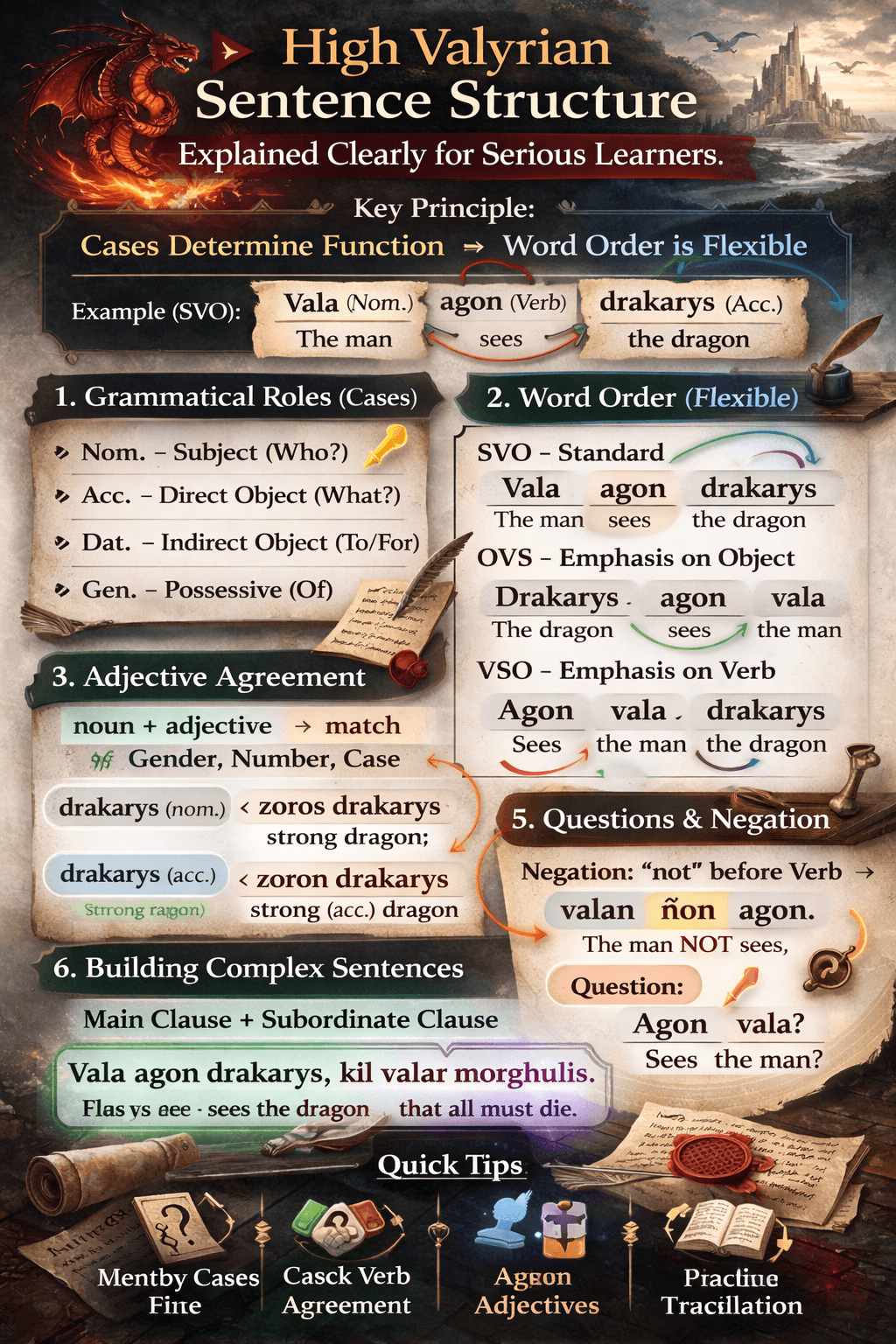
The single most important principle in High Valyrian sentence structure is this: noun endings determine grammatical function. Word order is secondary.
High Valyrian, created by linguist David J. Peterson for Game of Thrones, uses a case system. Nouns change form depending on whether they are the subject, direct object, indirect object, or possessive element in a sentence. Because of this, you do not need strict word position to know who is doing what.
For example, in English:
“The dragon sees the queen.”
If you reverse the order:
“The queen sees the dragon.”
The meaning changes completely.
In High Valyrian, endings make that distinction clear even if you rearrange elements. In beginner study groups, learners often panic when they see a sentence that does not follow English order. They assume they misread it. In reality, they simply have not analyzed the case endings yet.
A common mistake is ignoring declension charts after the first exposure. If you need a structured refresher on noun cases and declensions, review the High Valyrian grammar basics before continuing. Many learners memorize nominative forms but do not internalize accusative or dative endings. Later, when sentences grow longer, comprehension collapses.
A more reliable approach is this:
First identify the nominative noun. That is your subject.
Then identify the accusative noun. That is your direct object.
Finally analyze any dative or genitive forms.
Once you adopt this habit, sentence structure becomes predictable rather than mysterious.
Basic Word Order: What Is Typical and What Is Flexible
Although High Valyrian allows flexibility, there is still a neutral or common order. In most standard declarative sentences, Subject Verb Object is frequent, especially in teaching materials and formal dialogue.
However, because grammatical roles are marked morphologically, variation appears often. You may see Object Subject Verb or Verb Subject Object depending on emphasis or stylistic choice.
In structured classroom style exercises, I observed that learners who cling to one fixed order struggle when encountering authentic dialogue. They expect every sentence to mirror textbook examples.
Consider how emphasis works. If a speaker wants to highlight the object, it may appear earlier in the sentence. This is not random scrambling. It reflects focus.
In English we say:
“It was the dragon that the queen saw.”
High Valyrian can achieve similar emphasis through placement without needing extra structural words.
A frequent beginner error is translating English sentences directly while preserving English rhythm. This leads to unnatural constructions. The better strategy is to construct the sentence around the grammatical core first, then adjust for clarity.
When reading, do not scan left to right expecting meaning to unfold sequentially. Instead, train yourself to pause after each inflected noun and ask: what role is this playing?
Flexibility is not chaos. It is structure supported by morphology.
Understanding Verb Placement and Agreement
High Valyrian verbs carry significant information. They agree with the subject in person and number. Tense and mood are also encoded directly in verb endings.
Verb placement is relatively flexible, but it often appears after the subject in neutral statements. In dramatic dialogue, verbs may appear later for stylistic weight.
In learner communities, I frequently see confusion when students misidentify the verb because they are looking for a familiar English pattern. High Valyrian verbs can look long and complex. Without recognizing the stem and endings, learners miss the core action.
A practical method that works well in advanced study sessions is isolating the verb first. Before analyzing nouns, underline or identify the verb form. Determine:
Who is performing the action based on agreement.
What tense is being used.
Whether the action is complete, ongoing, or hypothetical.
One mistake that persists in intermediate learners is assuming subject pronouns are always necessary. In High Valyrian, they are often omitted because the verb ending already tells you the subject.
For example, instead of saying “I speak,” the verb form alone may imply “I.” Beginners often redundantly add pronouns or search for them unnecessarily.
Understanding that verbs carry structural weight changes how you read. The sentence stops being a string of words and becomes a system of relationships.
Adjective Placement and Agreement in Sentences
Adjectives in High Valyrian must agree with the nouns they modify in gender, number, and case. This is where many learners experience a second wave of difficulty after basic declensions.
In English, adjectives do not change form:
“strong dragon”
“strong dragons”
In High Valyrian, the adjective changes depending on the noun’s grammatical role. If the noun shifts from nominative to accusative, the adjective must follow.
During long term grammar workshops, I observed that learners often memorize adjective forms separately but forget to adjust them during sentence construction. This results in mismatched endings that technically break the grammar.
Placement can vary. Adjectives often follow the noun, but they may also precede it. The key is agreement, not position.
When building sentences, check agreement last. Construct the noun phrase, assign its case, then modify the adjective to match. Skipping that final adjustment is the most common mistake I see in written exercises.
A useful habit is reading the noun phrase aloud and checking whether endings harmonize. Experienced learners develop an instinct for mismatches. That instinct only forms through repeated correction.
Questions, Negation, and Sentence Variation
Sentence structure changes subtly when forming questions or negative statements.
In yes or no questions, word order may shift slightly, or intonation may signal interrogation. Question particles may appear depending on construction.
Negation introduces another layer. Negative markers typically appear before the verb. Beginners often place them incorrectly by copying English patterns.
For example, English uses auxiliary verbs for negation:
“I do not see.”
High Valyrian does not rely on the same auxiliary system. Negation attaches differently and interacts directly with verb structure.
In advanced learner groups, one recurring issue is overcomplication. Students attempt to apply English logical structure instead of analyzing the Valyrian form in front of them.
A practical strategy is to treat negation as part of the verb phrase. When reading, identify whether the action itself is negated rather than searching for separate helping verbs.
Questions also reveal whether a learner truly understands case roles. When word order shifts, only those who track endings maintain comprehension. Others revert to guessing based on position.
Sentence variation is where structure knowledge becomes real skill.
Building Complex Sentences: Subordination and Coordination
Once learners move beyond simple declarative sentences, complexity increases. High Valyrian allows subordinate clauses, coordinated clauses, and relative constructions.
In coordinated sentences, conjunctions link two clauses of equal weight. Structure remains similar to simple sentences, but learners must track two verbs and multiple noun roles.
Subordinate clauses demand more attention. Word order may shift, and verb forms may reflect dependency. In structured online programs, I have seen many learners plateau at this stage. They can handle isolated sentences but struggle when clauses embed within each other.
The solution is not memorizing longer examples. It is practicing clause isolation. Separate the main clause from the subordinate clause. Identify each verb independently. Then analyze how they connect.
A frequent error is losing track of case agreement across clauses. Learners correctly decline a noun in the main clause but forget to adjust its role in the subordinate clause.
Complexity in High Valyrian is cumulative. If foundational case recognition is weak, advanced structures collapse.
Translating From English Without Distorting Structure
Translation is where sentence structure weaknesses become obvious.
Many learners begin with English sentences and attempt to convert them word by word. This approach creates unnatural results because English relies heavily on fixed order while High Valyrian relies on inflection.
In long term learner communities, I have seen two groups emerge. The first group writes grammatically correct but unnatural sentences because they cling to English sequencing. The second group rethinks the sentence in structural terms before writing.
A more reliable translation method looks like this:
First determine the core action.
Then assign grammatical roles.
Then choose appropriate case endings.
Finally adjust word order for emphasis.
This stepwise approach prevents English interference.
Expect slow progress in the beginning. Sentence structure mastery is not about memorizing patterns. It is about internalizing relationships between elements.
When learners reach the stage where they can rearrange sentence elements without losing meaning, they have crossed from beginner decoding into structural understanding.
FAQ
Summary and Action Plan
High Valyrian sentence structure is governed by inflection. Cases determine grammatical roles. Word order provides emphasis but does not define function. Verbs encode subject information. Adjectives must agree precisely. Questions and negation require structural awareness. Complex sentences demand clause isolation.
To build mastery:
If you are still building your foundation, follow a structured High Valyrian beginner learning roadmap so sentence structure does not feel overwhelming
Spend dedicated time reviewing declension patterns.
Practice identifying subject and object purely by endings.
Rewrite simple sentences with varied word order.
Analyze dialogue from the series by marking grammatical roles.
Write short paragraphs and review agreement carefully.
Approach structure as a system, not a translation puzzle. When you read endings accurately, sentences become stable and predictable. That stability is the foundation for fluency.