Understanding High Valyrian Verb Tenses in Real Use
Introduction
Short answer: High Valyrian verb tenses are built around present, past, and future systems, but their real meaning depends on aspect and verb type. Memorizing endings is not enough. You must understand how the language thinks about action. If you want to see how verb forms behave in real sentences, you can test different tense variations directly inside our High Valyrian translator tool.
High Valyrian verb tenses look complex at first, but they are not random or unpredictable. They follow a system that becomes logical once you see how time, aspect, and verb class interact. Many learners struggle not because the grammar is impossible, but because they expect it to work like English. It does not.
High Valyrian marks tense through endings that change based on person, number, and verb class. More importantly, it expresses how an action unfolds in time, not just when it happens. Once you understand that difference, verb charts stop feeling overwhelming.
In study groups and structured learning communities, I have seen the same pattern repeat. Learners who focus only on tables remain confused. Those who study real sentences begin to see consistency. This guide explains how the tense system actually works in practice, with examples and realistic expectations.
The Foundation: Time Versus Aspect in High Valyrian
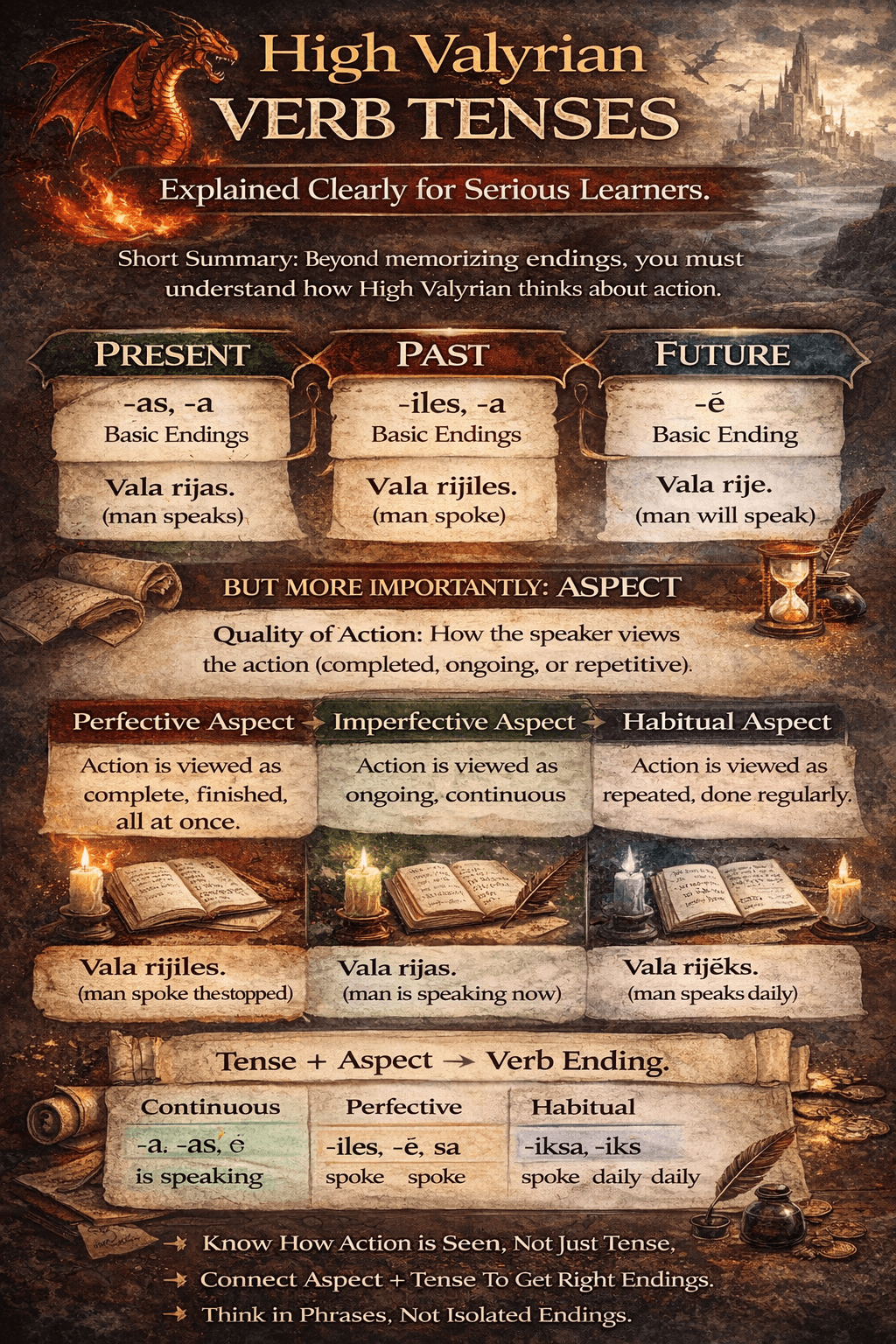
Most English speakers approach tense as a time label. Past means before now. Present means now. Future means later. High Valyrian does mark time, but it also cares deeply about aspect, meaning how the action unfolds.
In community reading sessions, learners often translate a present tense form automatically as “is doing.” That works sometimes, but not always. The High Valyrian present can describe general truths, ongoing actions, or even scheduled events depending on context.
Consider a simple verb like “to speak.” In English, “I speak” and “I am speaking” feel different. In High Valyrian, the distinction may not match English perfectly. Context and adverbs often clarify whether the action is habitual or happening right now.
The past system shows this even more clearly. There are forms that indicate a completed action and forms that describe a past state. In learner forums, confusion usually appears when students translate every past form as a simple English past. They miss whether the action was finished, ongoing, or background information.
The key shift is this: tense tells you where the action sits in time. Aspect tells you how the action unfolds. High Valyrian uses both together. Once you train yourself to ask, “Is this action completed, ongoing, or general?” the forms start making sense.
Present Tense: More Flexible Than It Looks
The present tense is usually the first form learners encounter. It seems straightforward. You learn endings, match them with pronouns, and build simple sentences. However, the present tense in High Valyrian carries more nuance than beginners expect.
In structured exercises I have reviewed, many learners overuse explicit time markers such as “now” because they feel unsure. They write sentences that are grammatically correct but unnatural. Native-style usage often relies on context instead.
The present tense can express:
General truths
Habitual actions
Ongoing events
Near-future actions in certain contexts
For example, if a character says they travel tomorrow, the present form may be used with a time expression. English speakers expect a future form. High Valyrian does not always require one.
A common mistake is assuming that the present tense must describe something happening at this exact moment. In reading discussions, students often misinterpret dialogue because they attach too much urgency to the present form.
Another difficulty is agreement. Verb endings must match person and number precisely. Small errors in endings can change meaning. In practice, learners who drill conjugations without sentences struggle to apply them. Those who practice short dialogues gain faster control.
The present tense is not just a beginner form. It is structurally central to the language.
Past Tense Forms and the Problem of Direct Translation
The past system causes the most confusion. Not because it is illogical, but because it does not map neatly onto English.
High Valyrian distinguishes between different types of past meaning. Some forms emphasize completion. Others describe background states or conditions. When learners translate word for word, they often flatten these distinctions.
In reading workshops, I have seen students translate two different past forms into the same English sentence. They miss subtle narrative signals. In storytelling, those signals matter.
For example, imagine a scene where a character ruled a city for many years. One past form may describe the state of ruling. Another may highlight a specific act of ruling. English often collapses both into “ruled.”
The mistake usually begins with memorization without context. Students learn endings but never see how authors use them in narrative sequences.
A helpful method is to read short passages and underline every past verb. Then ask two questions: Is this describing a finished event? Or is it describing a condition or background action? Over time, patterns become visible.
Another challenge is overcorrecting. After discovering aspect differences, some learners try to force every past action into a specific interpretive box. Not every sentence carries dramatic nuance. Sometimes a past verb simply reports a fact.
Understanding the past system requires exposure, not just charts.
Future Tense and Intentionality
The future tense in High Valyrian is more straightforward than the past, but it still carries nuance. It expresses expected or planned action. However, intention and certainty can depend on context.
In group translation exercises, learners sometimes use the future form in places where the present would sound more natural. This happens especially when they translate English promises or scheduled events.
High Valyrian may use a future form to express clear intention, especially in formal declarations. In narrative dialogue, context often does the work instead.
Another point often missed is that the future tense interacts with modal meaning. When a speaker is making a strong vow, the choice of form can carry emotional weight. In community discussions of dramatic scenes, students notice that certain future constructions feel more authoritative.
A realistic expectation: you will misuse the future tense at first. This is normal. The correction usually involves simplifying, not complicating.
Instead of asking, “Is this future enough?” ask, “Does the sentence clearly show that the action has not happened yet?” If yes, the structure is likely correct.
Verb Classes and Why Endings Change
One reason learners feel overwhelmed is that High Valyrian verbs are grouped into classes. These classes determine how tense endings attach to the stem.
In study programs, this is often where motivation drops. Students think they must memorize endless variations. In reality, patterns repeat.
Different verb classes reflect historical sound patterns. The endings themselves are systematic. Once you identify the stem type, the conjugation follows predictable rules.
The most common mistake I observe is ignoring the verb class and attaching endings mechanically. This leads to forms that look plausible but are incorrect.
A better approach is to learn verbs in small groups by class. Practice conjugating three or four verbs that share the same pattern. Then compare them. Your brain begins to see structure rather than chaos.
Another common issue is switching classes accidentally when speaking quickly. This happens even with intermediate learners. The solution is slow, deliberate practice with full sentences.
Verb classes are not an obstacle. They are part of the internal logic of the language.
Agreement: Person, Number, and Precision
High Valyrian verbs change according to person and number. This is familiar to learners of other inflected languages, but it still causes errors.
In peer review exercises, subject-verb agreement errors appear frequently in longer sentences. Learners manage agreement in short statements, but once a sentence includes subordinate clauses, mistakes increase.
The difficulty is cognitive load. When you are thinking about vocabulary, tense, and word order at the same time, agreement slips.
A practical method is backward checking. After writing a sentence, locate the verb and identify its subject. Confirm that the ending matches. This simple habit reduces errors significantly.
Another pattern I have noticed is overreliance on pronouns. Because the verb ending already shows person and number, pronouns are often optional. Beginners include them in every sentence, which is not wrong, but can sound repetitive.
Precision in agreement is not decorative. It carries grammatical meaning. Small changes in endings can shift the subject entirely.
Real Learning Path: From Charts to Narrative Control
Most learners begin with conjugation tables. That is appropriate. But progress depends on moving beyond isolated forms.
In long-term learner forums, those who reach fluency levels do three things consistently:
They read authentic sentences regularly.
They write short paragraphs, not just single sentences.
They review corrections carefully instead of rushing forward.
Verb tenses become clear when you see them in connected narrative. Try rewriting a short story in the present tense, then in the past. Notice what changes. This exercise reveals how aspect shapes storytelling. This shift only becomes natural when you start thinking in High Valyrian instead of translating from English.
Expect confusion in the beginning. That confusion usually means you are noticing nuance. Over time, the system feels coherent.
Do not aim for perfection immediately. Aim for consistency. If you control present and basic past forms accurately, you have built a strong foundation. Advanced nuance develops gradually through exposure and correction.
FAQs
Summary and Action Plan
High Valyrian verb tenses work through a structured interaction of time, aspect, verb class, and agreement. The difficulty comes from expecting English patterns.
Focus first on mastering the present tense and basic agreement. Then study how the past distinguishes between completed actions and background states. Learn verb classes in small groups and practice with full sentences.
Read short narrative passages and identify tense usage. Rewrite simple stories in different tenses. Review your errors carefully.
Progress in this system is steady when practice is contextual. If you move beyond charts and into real usage, the tense system stops feeling overwhelming and begins to feel precise and logical.