How Long Does It Really Take to Become Fluent in High Valyrian?
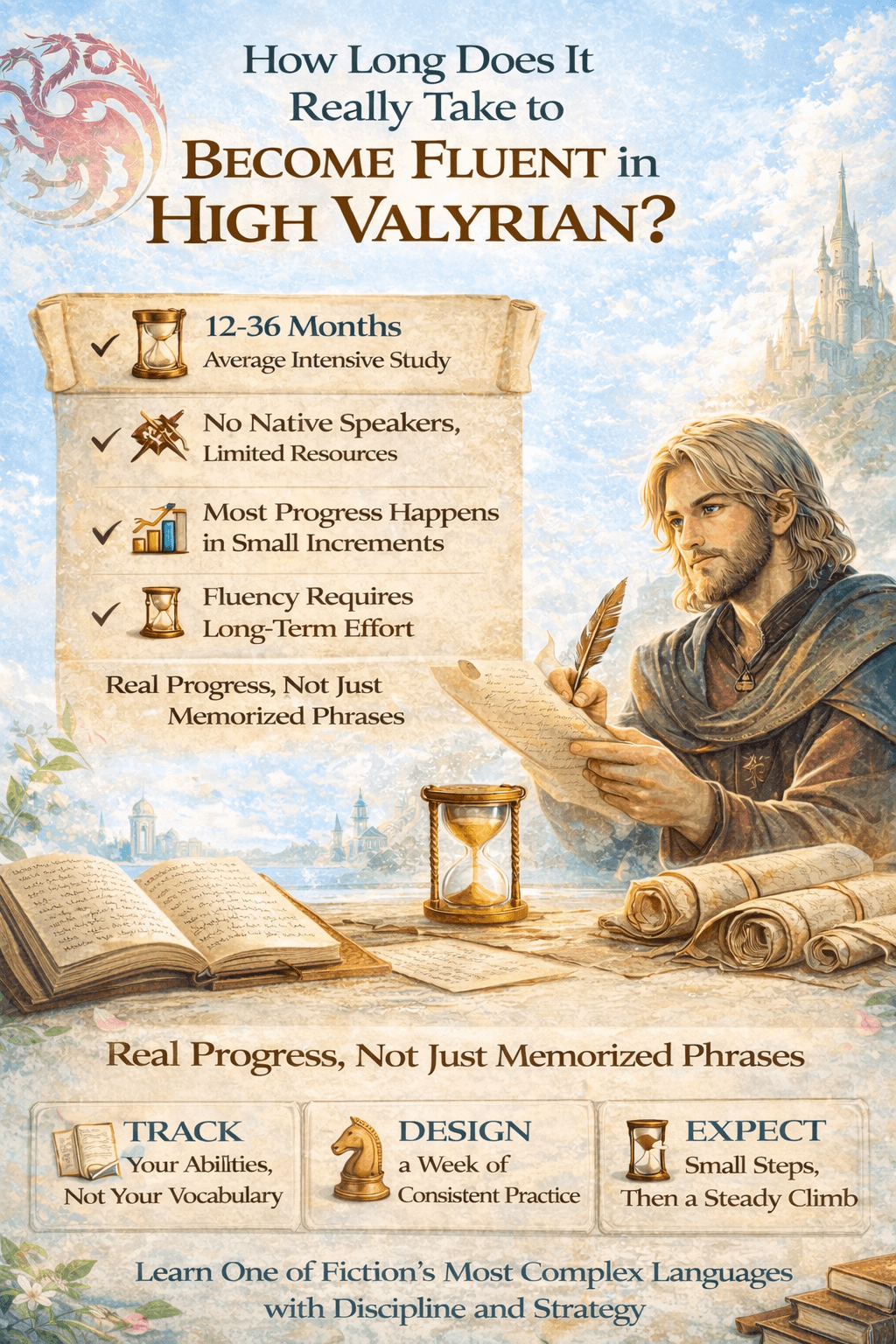
Fluency in High Valyrian usually takes between 12 and 36 months with consistent study. Casual learners often need much longer, sometimes five years or more. If you are serious about learning High Valyrian, you have probably asked yourself one honest question: “How long will this actually take?” Not as a fantasy, not as a weekend project, but as a real skill you can use with confidence. Many learners start with excitement after watching Game of Thrones or House of the Dragon, download a few resources, memorize some phrases, and then feel lost after a few weeks, often before understanding what High Valyrian actually is. Others spend months studying but still struggle to form natural sentences.
High Valyrian is not like learning Spanish or French. It has no native speakers, no everyday environment, and limited learning material. Progress depends almost entirely on how you study and how consistently you practice.
Key takeaways for new learners:
Structured practice matters more than talent.
Most people overestimate short-term progress and underestimate long-term growth.
In this guide, I will share realistic timelines, common mistakes, and methods based on years of studying constructed languages and working with serious learners. This is written for people who want real ability, not just memorized quotes.
What “Fluency” Means in High Valyrian
Before talking about time, we must define fluency clearly. Many learners think fluency means memorizing famous lines and introducing themselves. That is not fluency. That is survival-level familiarity.
In High Valyrian, practical fluency usually includes four abilities.
First, you can understand most slow to normal-paced spoken dialogue in lessons, interviews, or fan recordings without translating in your head.
Second, you can speak for several minutes about common topics such as family, travel, opinions, or fictional situations using correct grammar and flexible vocabulary.
Third, you can read extended texts such as fan fiction, learning materials, or translations without stopping for every word.
Fourth, you can write structured paragraphs with correct case endings, verb conjugations, and word order. Anything below this level is partial competence, not fluency.
A common mistake is assuming that knowing 500 words equals fluency. High Valyrian grammar is highly inflected. Nouns change for case and number. Verbs change for tense, mood, voice, and agreement. Knowing vocabulary without mastering structure leads to fragile skills without systematic grammar foundations.
Example from my own teaching experience: I once worked with a learner who had memorized over 1,200 words in eight months. He could recognize many sentences but could not form his own correctly. After six months of grammar-focused practice, his speaking improved more than in the previous year.
Expert tip: Track your progress by abilities, not by word count. Ask yourself: “Can I describe yesterday’s activities without notes?” That is a better measure than any number.
Factors That Decide Your Learning Speed
No two learners reach fluency at the same pace. In High Valyrian, several factors matter more than in natural languages.
Study consistency is the strongest factor. Thirty minutes daily beats five hours once a week. Regular exposure trains your brain to recognize patterns automatically.
Previous language experience also matters. If you have studied Latin, Russian, Arabic, or German, you will adapt faster to cases and complex verb systems. Monolingual learners usually need more time.
Quality of resources plays a major role. Learners who rely only on random social media posts progress slowly. Those who use structured materials based on the work of David J. Peterson advance faster because they learn the system, not just phrases.
Practice environment is another key element. If you actively write, speak, and interact in learning communities, you progress much faster than passive readers.
Personal goals also affect speed. Someone aiming for conversational fluency will reach it earlier than someone aiming for academic-level mastery.
Example: Two learners started together in an online group. One studied 25 minutes daily and wrote short texts weekly. The other studied only on weekends. After one year, the first could hold ten-minute conversations. The second still struggled with basic cases.
Common mistake: Blaming “lack of talent” instead of adjusting study habits.
Expert tip: Design your week in advance. Decide exactly when and how you will practice grammar, vocabulary, listening, and speaking.
Typical Timeline From Beginner to Advanced Speaker
Based on long-term observation of learners, here is a realistic progression model. These are averages for disciplined learners.
Beginner Stage: 0 to 3 Months
You learn pronunciation, basic sentence structure, present tense verbs, and core vocabulary. You can introduce yourself, describe simple actions, and recognize basic patterns. Understanding is slow and requires translation.
Lower Intermediate: 4 to 8 Months
You control most cases, major verb tenses, and common particles. You can read simple texts and form short speeches. Errors are frequent but communication is possible.
Upper Intermediate: 9 to 18 Months
You handle subordinate clauses, complex moods, and stylistic variation. You can participate in extended conversations and understand most structured content. This is where many learners plateau.
Advanced Fluency: 18 to 36 Months
You speak smoothly, self-correct naturally, and adapt to new contexts. You can write creatively and understand nearly all available material.
Casual learners often double these timeframes.
Example: One dedicated learner I mentored reached advanced level in 22 months by studying one hour daily and participating in weekly speaking sessions.
Common mistake: Expecting conversational fluency in three months. This expectation causes frustration and quitting.
Expert tip: Plan in six-month cycles. Evaluate progress twice a year instead of weekly.
Why High Valyrian Takes Longer Than Many Languages
High Valyrian has features that slow learning compared to popular languages.
First, it has eight grammatical cases. Each noun changes form depending on its role. Beginners often confuse nominative, accusative, and dative for months.
Second, the verb system is extremely rich. Verbs encode tense, mood, voice, aspect, person, and number. A single verb root can produce dozens of forms.
Third, limited input slows subconscious acquisition. In English or Spanish, you hear thousands of sentences daily. In High Valyrian, you must actively search for material.
Fourth, vocabulary is domain-specific. Many words relate to fantasy culture, social hierarchy, and ritual. Practical everyday vocabulary develops slowly.
Example: In Spanish, you might hear 10,000 sentences in your first year. In High Valyrian, most learners hear fewer than 1,000 unless they actively seek content.
Common mistake: Studying only grammar tables without contextual examples.
Expert tip: Build your own mini-corpus. Save sentences you find and review them regularly.
Study Methods That Cut Learning Time in Half
Some methods consistently produce faster results.
Active sentence building is essential. Instead of memorizing isolated words, create ten original sentences daily using new grammar.
Spaced repetition systems help retain forms. Use them for verb conjugations and case endings, not just vocabulary.
Shadowing improves listening and speaking. Repeat recordings aloud while listening. This trains rhythm and pronunciation.
Guided writing accelerates mastery. Write short texts and compare them with model answers.
Conversation practice is irreplaceable. Even imperfect speaking builds neural pathways.
Example routine used by one successful learner:
Monday to Friday:
20 minutes grammar review
15 minutes sentence creation
15 minutes listening and shadowing
Saturday:
One hour writing and speaking practice
Sunday:
Some reading and revision
Common mistake: Watching lesson videos without producing language.
Expert tip: Measure output time. At least 40 percent of your study should involve speaking or writing.
Common Mistakes That Delay Fluency
Many learners waste years through avoidable habits.
First, resource hopping. Constantly switching apps, books, and courses prevents deep learning.
Second, avoiding grammar. Some learners try to “learn naturally” without understanding structure. In High Valyrian, this almost never works.
Third, fear of mistakes. Perfectionism blocks speaking practice.
Fourth, memorizing without usage. Words not used actively disappear quickly.
Fifth, unrealistic pacing. Studying five hours for one week and quitting for three weeks leads to regression.
Example: A learner I coached had completed five different beginner courses but could not hold a basic conversation. After focusing on one system for six months, his skills improved rapidly.
Expert tip: Commit to one main curriculum for at least one year.
Real-World Case Studies From Learners
Case Study 1: The Consistent Student
Studied 45 minutes daily for two years. Focused on grammar, writing, and speaking. Reached advanced fluency in 24 months.
Case Study 2: The Enthusiastic Beginner
Studied intensively for three months, then irregularly. After three years, remained at lower intermediate.
Case Study 3: The Linguistics Graduate
Had background in Latin and linguistics. Studied one hour daily. Reached advanced level in 14 months.
Case Study 4: The Fan-Only Learner
Only memorized show dialogues. After four years, could not form original sentences.
These patterns repeat across communities.
Key insight: Time invested matters less than time structured.
Expert tip: Keep a learning journal. Record what worked and what failed every month.
FAQs
Summary
Becoming fluent in High Valyrian is a long-term intellectual project. Most serious learners need between 18 and 36 months of structured effort. Shortcuts rarely work.
If you want realistic progress, follow this roadmap:
Commit to at least 30 minutes daily for two years.
Master grammar early instead of avoiding it.
Produce language every day through writing and speaking.
Stay with one main learning system.
Review progress every six months.
Build community connections for feedback.
Next steps:
Choose one comprehensive course.
Create a weekly schedule.
Start a learning journal.
Join a speaking or writing group.
Set a two-year learning horizon.
Fluency is not about speed. It is about building a stable system in your mind that works even under pressure. With discipline and the right methods, it is achievable.