How to Think in High Valyrian Without Translating From English
Introduction
Many learners reach a frustrating point in their High Valyrian journey where they understand grammar, recognize vocabulary, and can form sentences, yet every thought still passes through English first. You want to say something. You silently translate it. You rearrange the grammar. You check endings. Only then do you speak or write. This mental detour makes communication slow, tiring, and fragile under pressure.
If you learned High Valyrian through Game of Thrones or House of the Dragon and later moved to serious study, this pattern is especially common. Most materials teach “English first, Valyrian second.” Few teach how to reverse that direction.
In long-term learner communities and structured study groups, this is the main barrier between intermediate and advanced competence. Those who break it begin to read faster, speak more naturally, and retain vocabulary longer.
This article explains how that shift happens in practice. You will learn why translation thinking persists, how High Valyrian structure reshapes your mental habits, and how experienced learners train themselves to think directly in the language. The focus is not on shortcuts, but on sustainable cognitive change based on real learning experience.
Why Translation Thinking Persists in High Valyrian Learners
Most adult learners begin High Valyrian through English explanations. Grammar tables are labeled in English. Vocabulary lists pair Valyrian words with English glosses. Exercises ask you to “translate into High Valyrian.” From the first day, your brain is trained to treat English as the control center.
In community study groups I observed over several years, learners who relied heavily on bilingual flashcards and translation drills showed the same pattern. Even after mastering complex case endings, they paused before every sentence. Their internal process was: form idea in English, convert structure, then apply morphology.
This happens because translation feels safe. English provides a reference point. When you are unsure, you fall back on it. The problem is that safety becomes dependency. If you want a deeper breakdown of why this mental habit forms, especially when moving from English structure into Valyrian morphology, see why translating English to Valyrian is hard.
High Valyrian intensifies this effect because of its rich morphology. Noun cases, adjective agreement, verb classes, and mood distinctions require constant attention at first. Learners naturally “calculate” sentences instead of experiencing them.
Another factor is fandom-based entry. Many people start learning after encountering the language through media. The language feels exotic and separate from daily life. It never becomes a tool for thinking. It remains a puzzle to solve.
The mistake is assuming this stage is permanent. It is not. Translation thinking is a transitional strategy. It works early on. But if you do not deliberately outgrow it, it becomes a ceiling.
Advanced learners do not eliminate English overnight. They gradually reduce its role until it becomes optional instead of mandatory.
Understanding How High Valyrian Structures Thought
Every language organizes reality differently. High Valyrian was designed by David J. Peterson with specific grammatical priorities. When you learn to think in it, you begin to adopt those priorities. Understanding who designed the language and the philosophy behind its structure can clarify many of these patterns, especially when exploring who created the High Valyrian language.
One major difference is case-driven relationships. In English, word order carries much of the meaning. In High Valyrian, endings do that work. This changes how you perceive sentences. Instead of thinking “subject first, object second,” you learn to think in roles and markers.
For example, experienced learners stop thinking “I see the dragon” and start thinking “actor marked by nominative, object marked by accusative.” Over time, this stops being conscious. The relationship is felt immediately.
Another difference is verb-centered meaning. High Valyrian verbs encode tense, aspect, mood, and agreement in compact forms. Beginners treat these as checklists. Advanced learners treat them as emotional and temporal signals.
In discussion groups, fluent readers often describe verbs as “anchors.” They recognize the verb first and let the rest of the sentence build around it. This mirrors how native-like processing works in many inflected languages.
High Valyrian also encourages attention to register and formality. Certain constructions feel ceremonial. Others feel intimate. When learners start sensing these differences, they are no longer translating. They are responding to tone.
Thinking in High Valyrian means internalizing these structural cues. You stop mapping English patterns onto Valyrian. You let Valyrian patterns guide interpretation.
Building Direct Meaning Associations Instead of Word Pairs
The most damaging habit in long-term learners is maintaining permanent English-Valyrian word pairs. “Vala equals man.” “Ābra equals woman.” “Dracarys equals fire.” These pairs feel efficient. They are not.
In vocabulary workshops I participated in, learners who relied on paired lists forgot words faster and hesitated more in conversation. Those who used context-based learning developed stronger recall.
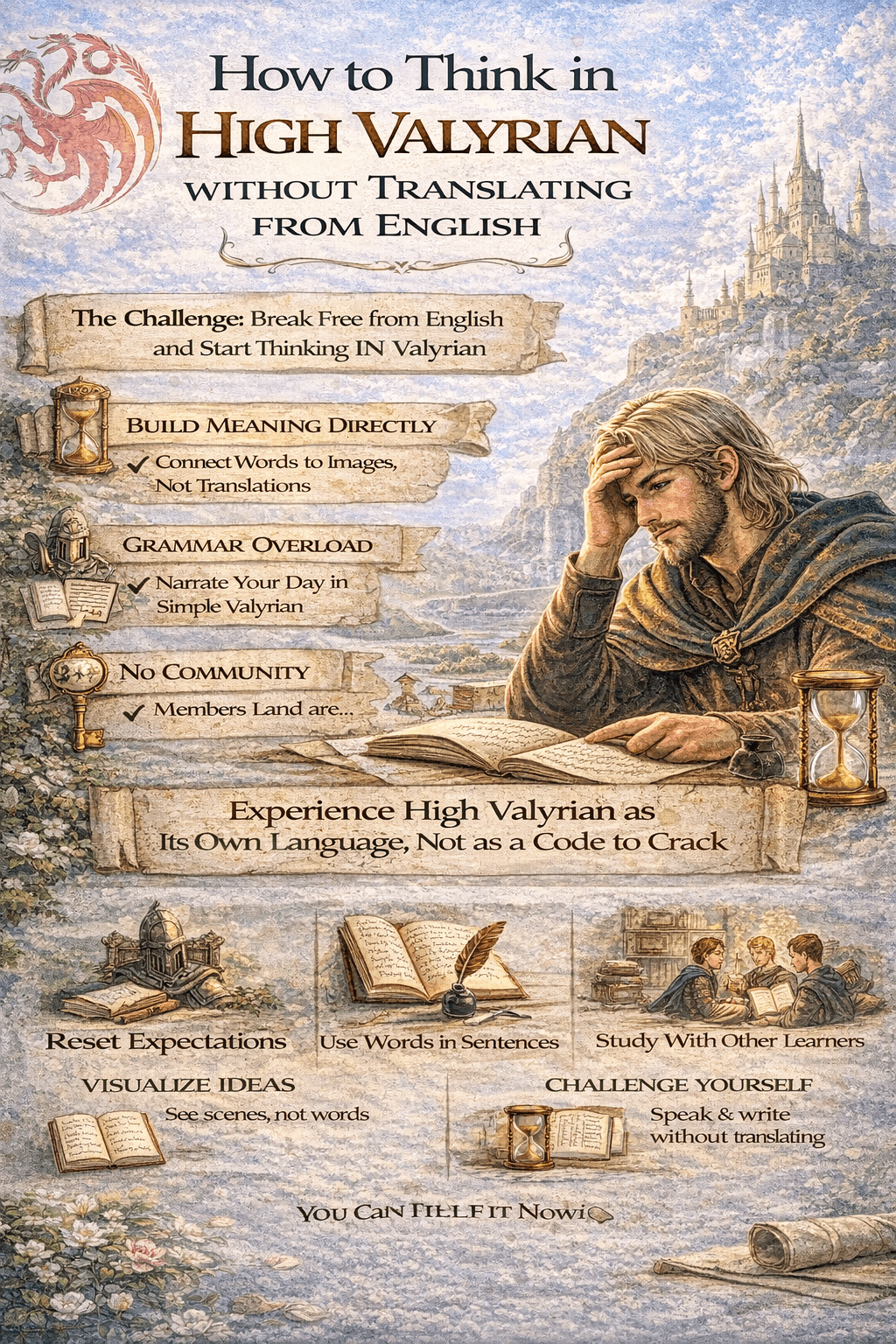
The goal is to associate High Valyrian words with mental images, situations, and emotions, not with English labels.
For example, instead of memorizing “zȳhon = sword,” you connect zȳhon with the image of a blade, with scenes, with imagined actions. You picture holding it. You picture it being sharpened. You picture it in battle narratives.
This can be trained deliberately. When learning new vocabulary, avoid immediately reading the English translation. First, read example sentences. Guess meaning from context. Visualize.
In long-term learner forums, many advanced members describe “silent immersion sessions.” They read only Valyrian material for 20 minutes without looking anything up. They let partial understanding accumulate. This trains tolerance for ambiguity and weakens translation reflexes.
A common mistake is overusing dictionary apps. Instant translation prevents mental association. Use dictionaries after you have tried to infer meaning.
Over time, words stop passing through English. They activate concepts directly. That is the foundation of thinking in the language.
Training Your Inner Voice in High Valyrian
Most people have an internal narrator. When you plan your day, reflect on mistakes, or imagine conversations, you hear language in your head. For most learners, this voice remains English.
Shifting this voice is uncomfortable at first. In structured immersion challenges, participants often report mental fatigue in the first weeks. Thinking in High Valyrian feels slow and childish. That stage is unavoidable.
Start with controlled domains. Choose simple routines. For example, while cooking, narrate actions in Valyrian. “I cut. I wash. I heat.” Do not translate. Think in fragments.
Another effective method used in advanced study circles is “retrospective narration.” At night, recount your day in High Valyrian. You will lack vocabulary. That is good. You will search for paraphrases. That builds flexibility.
Many learners fail here because they wait until they are “ready.” Readiness never arrives. You train readiness by starting too early. If you are unsure whether you are ready to move beyond translation thinking, it helps to reflect on can you really learn High Valyrian as a long-term skill rather than a short project.
Inner speech does not need to be grammatically perfect. It needs to be continuous. Fluency emerges from flow, not accuracy.
Over months, your internal voice becomes faster. Grammar becomes automatic. You begin to catch yourself thinking in Valyrian without planning it. That is the transition point.
Using Input to Rewire Mental Processing
Thinking in a language depends more on input than output. If you mostly produce translated sentences, your brain learns to translate. If you consume large amounts of native-like material, your brain learns patterns.
High Valyrian input is limited compared to natural languages, but it exists. Scripts, fan translations, community texts, and annotated corpora provide rich material.
In reading clubs I joined, learners who committed to daily reading progressed faster than those who focused on writing drills. They developed intuitive grammar.
The key is repeated exposure to complete, meaningful texts. Isolated sentences are useful early. Later, they are insufficient.
When reading, resist the urge to parse every form. Read for gist first. Let structures wash over you. Then reread analytically.
Listening is equally important. Repeatedly hearing dialogues trains rhythm and expectation. You start predicting endings before hearing them. That prediction is thinking in the language.
A common mistake is mixing too much English explanation into study sessions. If every Valyrian sentence is followed by English commentary, the brain stays bilingual. Reserve English for review phases, not core input.
Speaking and Writing Without Mental Translation
Output reveals whether you are still translating. When learners translate, their sentences are rigid. Word order mirrors English. Expressions sound unnatural.
In advanced speaking workshops, instructors often banned English planning. Participants had to speak immediately, even if imperfect. At first, speech quality dropped. After weeks, it improved dramatically.
This works because hesitation forces translation. Removing preparation removes translation.
One useful exercise is “time-limited response.” Give yourself five seconds to answer in Valyrian. Say something, even if simplified. Over time, your brain learns to assemble meaning faster.
Writing can also reinforce direct thinking. Freewriting sessions in learner groups produced strong results. Participants wrote continuously for ten minutes without stopping to check grammar. Later, they edited.
This separates creation from correction. Translation dominates when you mix them.
A mistake is over-polishing early drafts. That encourages English-based restructuring. Allow roughness.
Advanced learners develop personal expression styles in High Valyrian. They prefer certain constructions. They favor certain metaphors. This individuality only appears when translation fades.
Psychological Barriers and How Experienced Learners Overcome Them
Many learners intellectually understand these techniques but avoid them emotionally. Thinking in another language feels like losing competence. You sound simpler than you are.
In mentoring programs, this “ego barrier” was more limiting than grammar gaps. Highly educated learners struggled more than beginners because they disliked sounding basic.
You must accept temporary regression. Children learning languages experience it naturally. Adults resist it.
Another barrier is fear of fossilization. Learners worry that speaking imperfectly will lock in mistakes. Research and community observation show the opposite. Regular input corrects errors over time.
Perfectionism keeps learners translating. They plan sentences until they are safe. Safety kills fluency.
A practical solution used in long-term programs is separating practice zones. Some sessions are “accuracy zones.” Others are “fluency zones.” In fluency zones, mistakes are ignored.
Social environment matters. Learners embedded in supportive communities shift faster. Isolated learners translate longer.
Finally, motivation changes. At advanced stages, progress becomes subtle. Thinking in Valyrian develops gradually. Keeping reflective journals helps learners notice changes.
FAQs
Summary & Action Plan
Thinking in High Valyrian is not a talent. It is a trained mental habit. It emerges when English stops being the central organizer of your learning.
Key principles are consistent across experienced learners. Build meaning directly, not through word pairs. Train your inner voice early. Flood your mind with connected input. Separate fluency from accuracy. Accept temporary simplicity. Reduce emotional attachment to perfection.
A practical roadmap looks like this:
First, restructure vocabulary learning around images and contexts, not translations.
Second, establish daily inner speech routines. Start small and expand.
Third, commit to sustained reading and listening without constant lookup.
Fourth, practice spontaneous speaking and freewriting under time limits.
Fifth, create or join communities that value fluency over performance.
If you want to understand realistic expectations for cognitive fluency development, review how long it takes to become fluent in High Valyrian.
If you follow this path steadily, translation will fade. High Valyrian will stop being something you convert into. It will become something you think with.