High Valyrian vs English: Why Direct Translation Often Fails
Many people assume translation is simple.
English in.
High Valyrian out.
That approach works reasonably well for many modern languages.
It does not work here.
I learned this the hard way. At first, I blamed translation tools. Later, I realized the real problem wasn’t the tools at all.
English and High Valyrian are built on fundamentally different linguistic principles. Because of that, direct translation often fails, even when every word looks correct.
This article explains why.
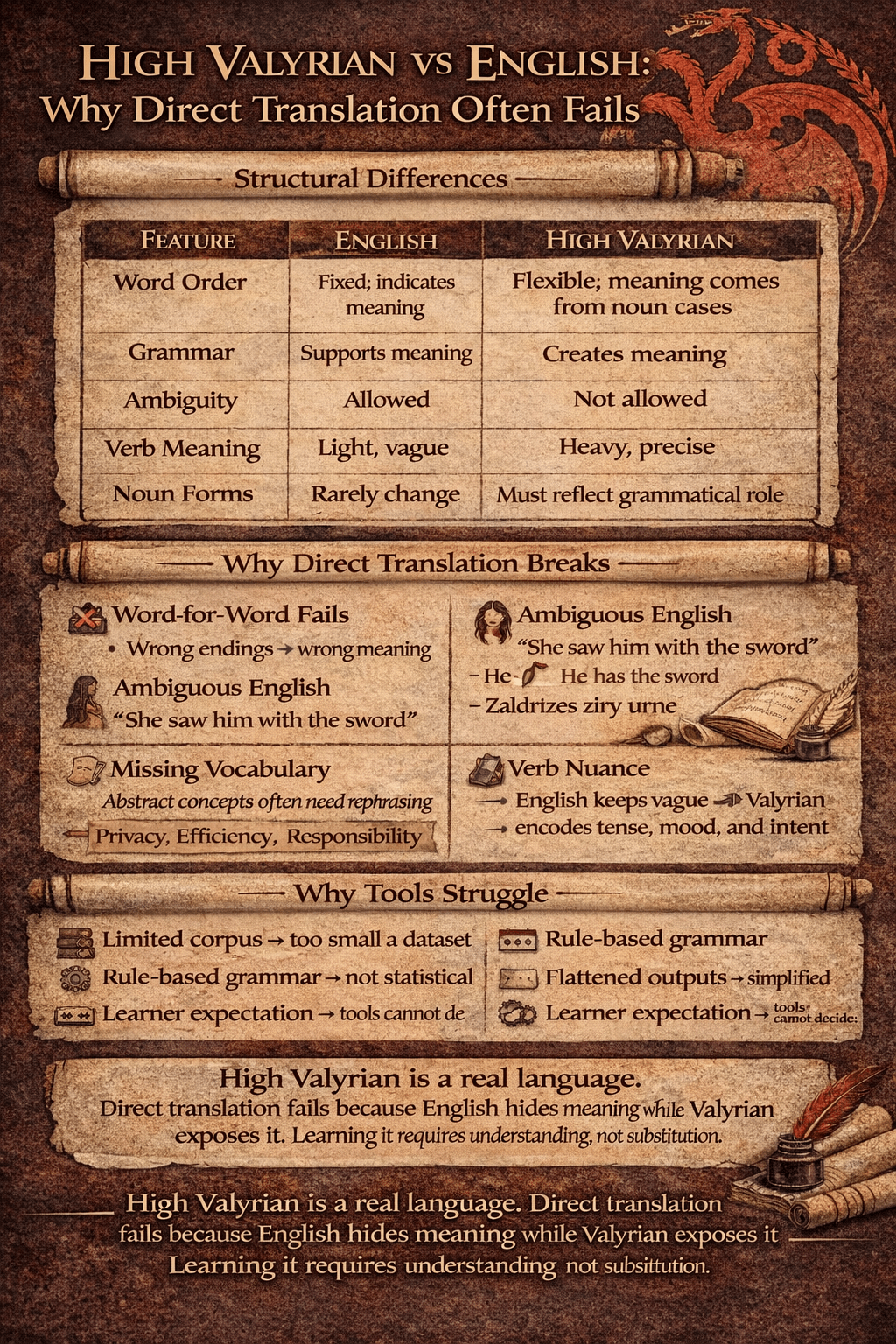
English and High Valyrian Are Built on Opposite Assumptions
English is flexible.
High Valyrian is strict.
English relies on:
• Fixed word order
• Helper words and prepositions
• Meaning left implicit through context
High Valyrian relies on:
• Noun cases
• Precise verb forms
• Grammar that forces meaning to be explicit
In English, grammar supports meaning.
In High Valyrian, grammar creates meaning. High Valyrian grammar basics
That single difference explains most translation failures.
Word Order Carries Meaning in English
In English, position tells you who is doing what.
“The dragon killed the man.”
“The man killed the dragon.”
The words are identical.
Only the order changes.
High Valyrian does not work this way.
Word order is flexible.
Meaning comes from noun endings, not position.
If the case endings are wrong, the sentence is wrong, even if every word is
technically correct.
This is why word-for-word translation produces broken results.
High Valyrian Uses Noun Cases — English Does Not
English nouns rarely change form.
High Valyrian nouns almost always do.
Each noun must reflect its grammatical role, such as:
• Subject
• Object
• Possession
• Direction
• Purpose
English often does not specify these roles clearly.
High Valyrian requires you to choose.
When translating, English gives no guidance, the translator must interpret meaning first.
This is where direct translation collapses.
English Allows Ambiguity
English is comfortable with unclear meaning.
“She saw him with the sword.”
Who has the sword?
English does not say.
High Valyrian does not allow this ambiguity.
Grammar forces clarity.
Different structures create different meanings.
A translator must pick one interpretation.
That choice may not match the original intent.
This is not a translation error.
It is a structural mismatch between languages.
Verb Meaning Is Heavier in High Valyrian
English verbs are light.
“He might rule.”
“She could go.”
The meaning remains vague.
High Valyrian verbs are heavy.
A single verb must encode:
• Time
• Certainty
• Intention
• Command versus possibility
English leaves options open.
High Valyrian demands decisions.
Direct translation cannot preserve this vagueness.
Many English Words Do Not Exist in High Valyrian
English includes many modern abstract concepts:
• Privacy
• Efficiency
• Responsibility
• Freedom
High Valyrian often lacks direct equivalents.
The meaning must be rebuilt using:
• Descriptive phrasing
• Contextual restructuring
• Grammatical adjustments
This is translation, not substitution.
Word-for-word replacement fails here every time.
Why Translation Tools Struggle
Most translation systems are designed for:
• Large datasets
• Natural language evolution
• Statistical probability
High Valyrian offers none of these.
It has:
• A limited corpus
• Rule-driven grammar
• Meaning that depends on interpretation
To function at all, tools simplify. They flatten grammar. They guess cases. They choose safe verb forms.
The output may look correct.
It is often incomplete.
Why Learners Feel Stuck
Most learners do not fail. Their expectations do.
They expect:
• Direct mapping
• One correct answer
• Fast progress
High Valyrian does not offer this.
Progress looks like:
• Understanding why something is wrong
• Recognizing structural errors
• Making fewer assumptions
This feels slow.
But it is real learning.
What Works Better Than Direct Translation
The correct approach is indirect.
Start with meaning.
Identify roles.
Choose grammar.
Then form the sentence.
This feels unnatural at first.
Later, it becomes logical.
That shift is where real progress begins.
Final Reality Check
Direct translation fails because:
• English hides meaning
• High Valyrian exposes meaning
• Grammar choices cannot be skipped
This is not a flaw in the language.
It is proof that it was built seriously.
High Valyrian behaves like a real language because it is one.
And that is exactly why learning it feels harder than people expect.