How Negation Works in High Valyrian Grammar
Short summary: High Valyrian negation usually uses “da” before the verb, but placement, emphasis, and verb form matter. Understanding structure is more important than memorizing translation equivalents.
Negation in High Valyrian is not complicated because it is rare. It feels complicated because learners try to apply English logic to a language that does not organize meaning the same way. In simple terms, High Valyrian forms negation primarily with the particle “da” placed before the verb. However, that small rule becomes less obvious when tense, mood, emphasis, or poetic structure enter the picture.
Many learners reach a point where they can form solid affirmative sentences but hesitate when they want to say something negative. They know how to say “The dragon flies,” yet pause when trying to say “The dragon does not fly,” or “I did not see him.” In structured learning groups and long-term learner forums, this hesitation appears again and again.
This guide explains how negation truly functions in High Valyrian, why learners struggle with it, and how to practice it correctly without relying on English patterns.
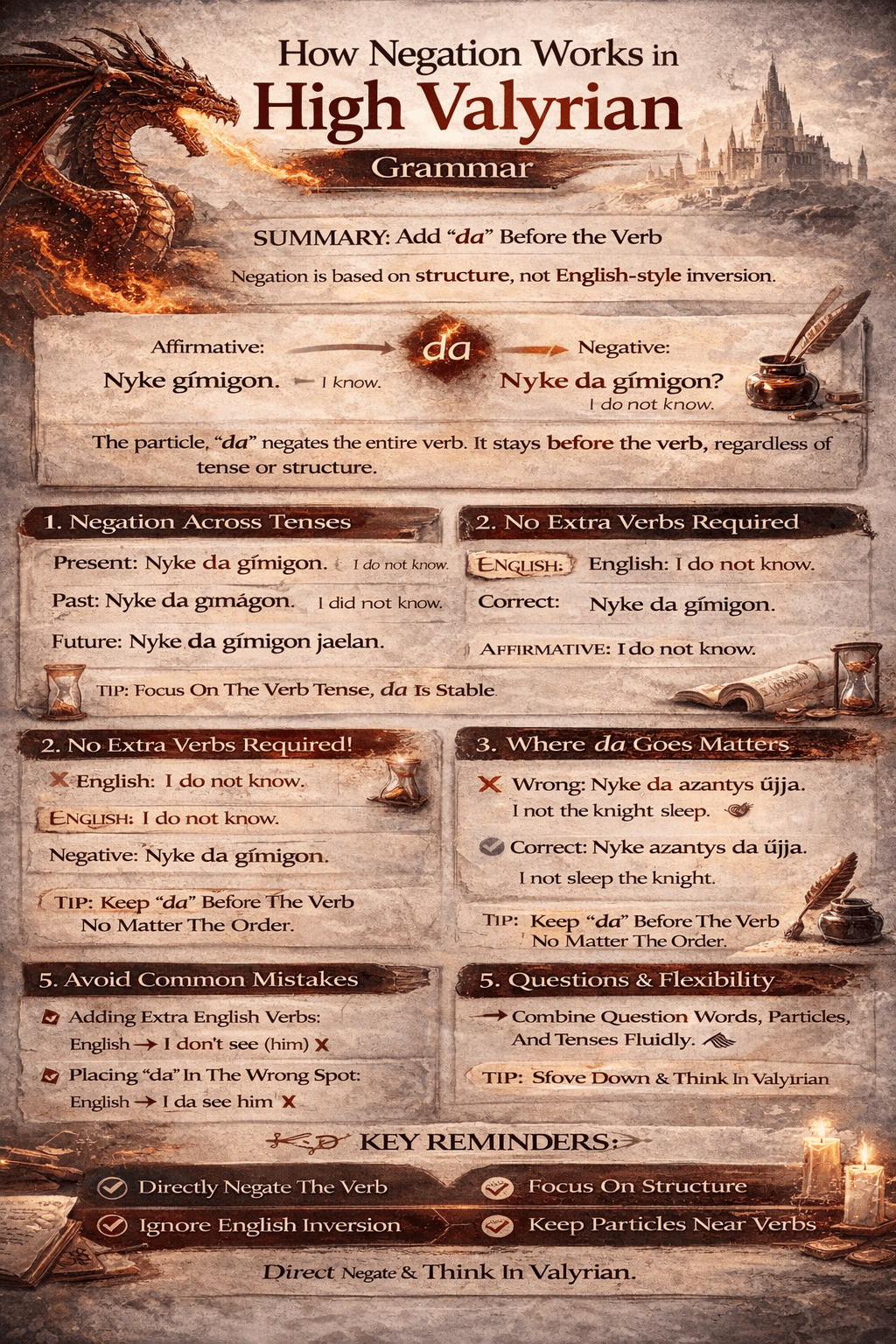
The Core Negation Particle “Da”
At the center of High Valyrian negation stands the particle “da.” It precedes the verb and negates the entire verbal idea. Structurally, it is simple. Functionally, it demands precision.
For example:
Nyke gīmigon.
I know.
Nyke da gīmigon.
I do not know.
The particle “da” comes directly before the verb. It does not attach to the subject. It does not replace the verb. It does not require an auxiliary verb like English “do.” This is where learners often overcomplicate things.
In community-based translation exercises based on material from Game of Thrones and House of the Dragon, many learners initially tried to insert an extra support verb, mirroring English patterns. They would attempt constructions equivalent to “I do not know” with a structural separation. High Valyrian does not require that. The verb itself carries tense and agreement. “Da” simply negates it.
A common beginner mistake is placing “da” too early in the sentence, especially when objects or adverbs appear.
Incorrect structure learners often produce:
Nyke da vala gīmigon.
Correct structure:
Nyke vala da gīmigon.
Why does this matter? Because High Valyrian word order allows flexibility, but particles tend to stay close to what they modify. “Da” modifies the verb, not the subject or object.
When learners understand that “da” belongs to the verb phrase, not the subject phrase, their sentence accuracy improves immediately.
Negation Across Tenses
One of the reassuring aspects of High Valyrian negation is that tense does not change the form of “da.” The verb changes according to tense, but “da” remains stable.
Present tense:
Nyke da gīmigon.
I do not know.
Past tense:
Nyke da gīmagon.
I did not know.
Future tense:
Nyke da gīmigon jaelan.
I will not know.
In structured grammar workshops, learners often expect a special negative past or future form, similar to some natural languages. High Valyrian does not introduce a separate negative conjugation system. The tense is expressed through the verb, and negation is expressed through “da,” which becomes much clearer once you understand High Valyrian verb tenses in depth. These two systems operate independently.
However, learners sometimes accidentally shift meaning by misunderstanding aspect. For example, if the past tense form is imperfective versus perfective, negation can slightly alter the nuance. Saying “I did not know” versus “I have not known” depends entirely on the verb form chosen, not on “da.”
The practical lesson is this: first master tense formation. Then add negation. Do not try to learn “negative tense” as a separate system. They are layered, not fused.
Negation in Questions
Negating a question introduces an additional layer of confusion, especially for learners influenced by English auxiliary inversion.
In English:
Do you not know?
Don’t you know?
In High Valyrian, the structure remains more stable. The question particle or interrogative structure handles the question. “Da” still negates the verb.
For example:
Skorosi nyke da gīmagon?
Why did I not know?
Notice that “da” still sits before the verb. It does not move because the sentence is interrogative.
In group translation sessions, learners frequently misplaced “da” when forming rhetorical questions. They felt that because English shifts word order in questions, High Valyrian must do the same. It does not rely on auxiliary inversion in the English sense.
A common error:
Da nyke gīmagon skorosi?
This feels logical to an English speaker but disrupts the expected structure. The interrogative element and the negation must each remain in their functional positions.
The key insight is that question formation and negation are separate systems, something we analyze more deeply in our High Valyrian question formation guide. They interact, but they do not reshape each other structurally.
Double Negatives and Emphasis
English generally avoids double negatives in formal contexts. Some languages use them as standard grammar. High Valyrian does not rely on systematic double negation in the way certain Romance or Slavic languages do.
However, emphasis can occur through lexical choice rather than grammatical stacking.
In advanced learner discussions, especially when analyzing dramatic dialogue from Game of Thrones, students sometimes attempted to intensify negation by repeating “da” or adding another negative element. This typically produces unnatural results.
Instead of doubling the particle, emphasis is better achieved through word order, tone, or reinforcing vocabulary.
For example, placing an object first for emphasis:
Ñuha dārilaros nyke da gīmagon.
My king I did not know.
The emphasis falls on “my king,” not on the negation particle itself.
Understanding this prevents learners from importing the logic of languages that require negative concord. High Valyrian negation is structurally economical. Adding extra negatives usually signals misunderstanding rather than intensity.
Negating Non-Verbal Sentences
One subtle challenge appears when learners attempt to negate nominal or adjectival sentences. High Valyrian often implies “to be” rather than explicitly stating it in every context.
For example:
Nyke vala.
I am strong.
To negate:
Nyke da vala.
Here, “da” still precedes the predicate element functioning as the verb. Learners sometimes assume they need a separate negative form of “to be,” especially if they are used to languages where the copula changes in negative contexts.
In peer correction sessions within online Valyrian communities, one recurring issue was overcomplication. Learners searched for a hidden negative copula form. In most cases, the structure remains consistent. “Da” negates the predicate.
However, nuance matters. If a sentence omits an explicit verb in poetic or elevated style, the learner must determine what element is functioning verbally before inserting “da.”
The principle remains: identify the verbal core. Negate that element.
Word Order Flexibility and Its Limits
High Valyrian allows more word order variation than English, which gives learners creative freedom. However, negation has positional expectations.
Because “da” modifies the verb, it must stay near it. If learners move the verb for emphasis or stylistic reasons, “da” moves with it.
For example:
Vala nyke gīmigon.
Strong I am.
Negated:
Vala nyke da gīmigon.
The particle follows the verb wherever it appears.
In advanced exercises focused on stylistic variation inspired by dialogue from House of the Dragon, learners experimented with dramatic fronting. Many forgot to relocate “da” accordingly. This produced sentences where negation appeared detached from the verb, creating ambiguity.
Flexibility does not mean randomness. High Valyrian has patterns. Respecting the bond between “da” and the verb prevents structural drift.
Common Learner Mistakes and Why They Happen
Most negation errors fall into predictable categories.
First, English interference. Learners expect auxiliary verbs and inverted structures.
Second, overcorrection. After learning that “da” negates verbs, some learners begin placing it before any word they wish to negate, even when that word is not functioning verbally.
Third, emphasis confusion. Learners try to intensify negation by repeating particles.
In long-term structured programs, one effective exercise involved giving learners affirmative sentences and asking them to negate them without translating into English first. When students thought directly in High Valyrian structure, accuracy improved dramatically.
The deeper issue is conceptual. English organizes negation around auxiliary support. High Valyrian attaches negation directly to the verb. Once learners internalize that difference, progress becomes steady.
Negation is not a memorization problem. It is a structural alignment problem.
Practical Training Strategy for Mastery
To build confidence with negation, practice in layers.
First layer: simple present tense affirmative and negative pairs.
Second layer: introduce past and future forms while keeping vocabulary stable.
Third layer: add objects and adverbs to test placement.
Fourth layer: convert statements into questions without disturbing negation placement.
In community practice groups, learners who progressed methodically avoided fossilized mistakes. Those who rushed into complex poetic constructions often carried early placement errors into advanced writing.
A particularly effective drill involves rewriting short narrative passages from Game of Thrones by turning all positive statements into negative ones while maintaining tense consistency. This forces attention to verb form and particle placement simultaneously.
Mastery comes from repetition with awareness. Not from memorizing rules once.
FAQs
Summary and Action Plan
Negation in High Valyrian relies on a single core principle: “da” negates the verb. Everything else builds on that foundation.
To apply this knowledge:
Practice tense formation independently before adding negation.
Always identify the verbal core of the sentence.
Place “da” immediately before that element.
Test negation inside questions without copying English inversion.
Avoid double negatives unless you fully understand stylistic context.
Work progressively from simple declarative sentences to stylistically flexible constructions.
If you build negation skill slowly and structurally, it becomes automatic. The hesitation many learners experience disappears once they stop translating and start thinking within High Valyrian grammar itself.