
How to Review High Valyrian Effectively Without Forgetting What You Learned
Short answer: An effective High Valyrian review requires structured retrieval practice, focused grammar recycling, controlled vocabulary rotation, and consistent sentence production. Passive rereading does not work. Active recall does.
Learning High Valyrian is exciting at first. The grammar feels elegant. The cases and verb endings feel powerful. But after a few weeks, many learners notice something uncomfortable. They forget the forms they studied carefully. They hesitate when forming sentences. Vocabulary disappears faster than expected.
Effective review is the difference between temporary exposure and real competence. If you want structured practice alongside review, you can test sentences directly using the High Valyrian translator tool.
High Valyrian is a structured constructed language created by linguist David J. Peterson for Game of Thrones. Its case system, verb conjugations, and derivational patterns require deliberate reinforcement. Casual rereading is not enough.
If you build review into your weekly routine correctly, you stop relearning the same material again and again. Instead, your knowledge stabilizes and begins to compound.
This guide explains how to review High Valyrian in a way that strengthens grammar accuracy, vocabulary retention, and real sentence control. Everything here is based on observed learner behavior in structured study groups and long-term language forums, not generic study advice.
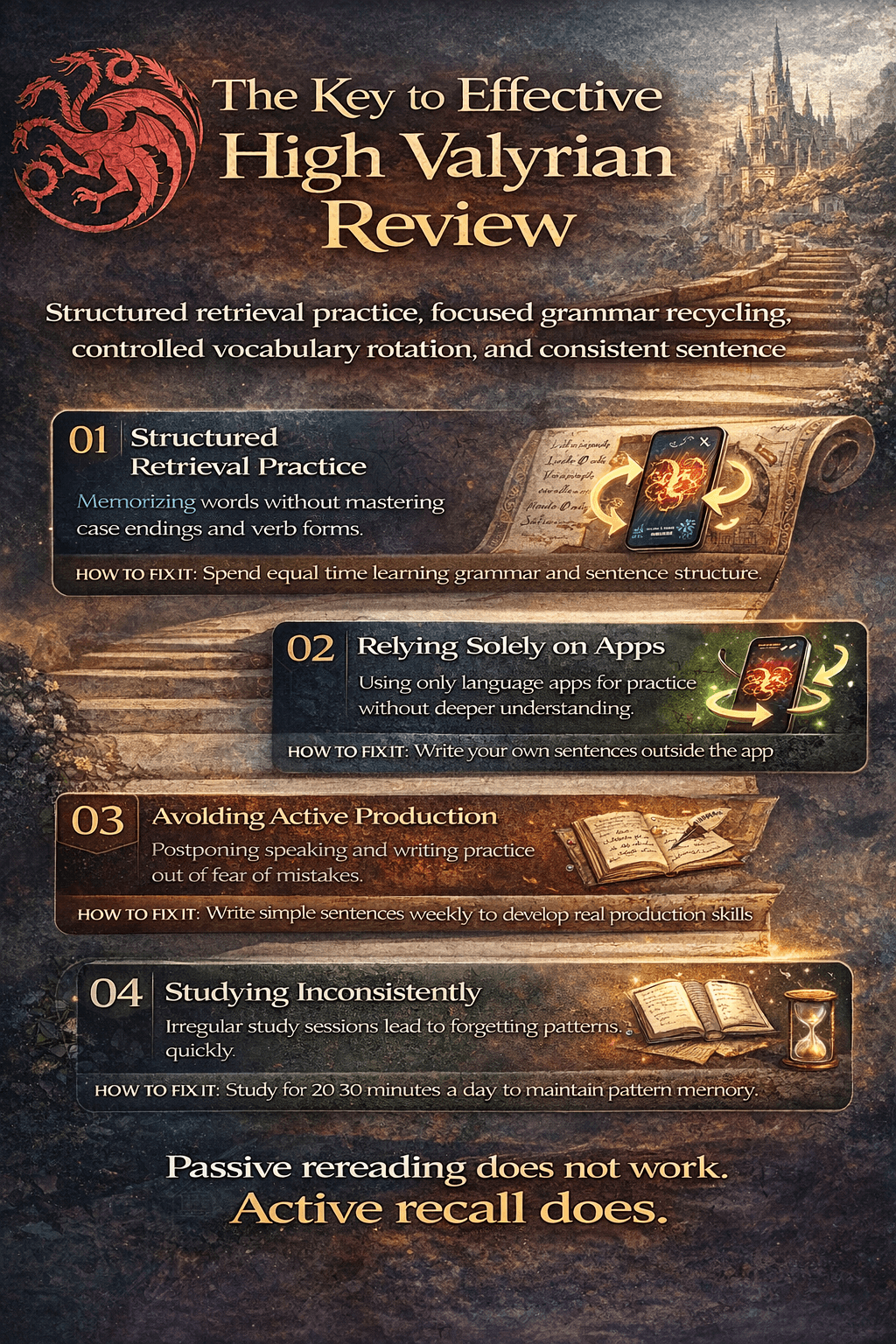
Why High Valyrian Is Easy to Forget Without Proper Review
High Valyrian looks small compared to natural languages, but it is structurally dense. Noun cases change endings. Verbs shift according to tense and agreement. Adjectives follow patterns that feel logical only after repetition.
In community discussion spaces and study programs, one pattern appears repeatedly. Learners move forward too quickly. They finish a lesson, understand it in the moment, and then move on without reinforcement. Two weeks later, they cannot decline a noun correctly or recall a verb class pattern.
The problem is cognitive, not motivational.
High Valyrian relies heavily on form recognition. For example, the difference between nominative and accusative endings may seem obvious during study. But if you are not regularly forced to retrieve those forms from memory, recognition does not turn into recall.
Rereading grammar notes feels productive because everything looks familiar. Familiarity creates a false sense of mastery. But when learners try to write an original sentence without notes, uncertainty appears.
Effective review must challenge recall, not recognition.
This is especially important for inflected languages like High Valyrian. If you cannot actively produce endings, you cannot form correct sentences. Review must simulate real use, not passive exposure.
Shift From Rereading to Active Retrieval
The first major adjustment most learners need is this: stop reviewing by rereading notes.
In structured High Valyrian learning communities, students who relied on rereading grammar explanations plateaued quickly. Those who forced themselves to recall rules from memory progressed steadily.
Active retrieval means closing your notes and testing yourself.
For example, instead of rereading noun case endings, write down a noun like vala and attempt to decline it across cases without checking references. After finishing, compare your answers. The correction process strengthens memory far more than passive review.
The same applies to verbs. If you studied present tense forms last week, write five original sentences today using that tense without looking. You will notice gaps immediately. That discomfort is useful. It shows where review should focus.
A simple structure for retrieval sessions:
Choose one grammar topic.
Attempt production without notes.
Check accuracy.
Rewrite incorrect forms correctly.
Repeat two days later.
In learner groups, those who followed this pattern reported fewer long-term mistakes. Errors reduced because review forced precision.
The key principle is effort. If review feels easy, it is probably ineffective.
Build a Weekly Grammar Recycling System
High Valyrian grammar accumulates. If you learn cases in week one and verb classes in week two, both must stay active. Otherwise, earlier material fades.
A strong review system rotates old material deliberately.
In long-term study environments, the most stable learners used a four-week recycling model:
Week 1 material reappears in Week 2.
Week 2 material reappears in Week 3.
Week 3 material reappears in Week 4.
Week 4 material cycles back in Week 5.
This does not mean rereading everything. It means using old structures in new sentences.
For example, if you learned adjective agreement earlier, force yourself to combine it with new vocabulary. Write short descriptive sentences that require correct case and agreement simultaneously.
Many learners review grammar in isolation. They practice cases alone. Then verbs alone. But real language use combines systems. Review must mirror that complexity.
One effective method observed in structured programs involves short composition tasks. Once per week, learners write a 100 word paragraph in High Valyrian using at least three previously learned grammar elements. This reveals weaknesses immediately.
Recycling prevents the common problem of “I knew this last month but now I forgot.”
Grammar must stay in rotation until it becomes automatic.
Control Vocabulary Review With Precision
Vocabulary loss frustrates learners more than grammar.
High Valyrian vocabulary is limited compared to natural languages, but learners still struggle with recall. The mistake is usually reviewing too much at once.
In online learner forums, students who created massive vocabulary lists retained very little. Those who limited active vocabulary to smaller rotating sets performed better.
Effective vocabulary review follows three principles:
Small active pools.
Frequent retrieval.
Contextual usage.
Instead of reviewing fifty words in one session, choose fifteen. Write sentences with them. Use different cases or verb combinations. Two days later, test recall without looking.
Context matters deeply. Isolated word memorization fades quickly. But if you attach vocabulary to sentences, memory strengthens.
For example, rather than memorizing a word meaning “dragon,” create multiple variations of sentences involving it. Change tense. Change number. Change adjective agreement.
In structured learning communities, learners who tied vocabulary to grammar exercises retained words longer than those who relied only on flashcards.
Flashcards are useful, but they must be followed by production.
Vocabulary review should feel controlled, not overwhelming.
Use Writing as Your Primary Review Tool
Writing is the most powerful review method for High Valyrian.
Reading and listening are limited due to the language’s fictional nature. You cannot immerse yourself fully as with natural languages. That means production becomes central.
In group learning settings, the strongest learners wrote regularly. Even short daily compositions of three to five sentences made a difference.
Writing forces you to:
Recall vocabulary.
Apply correct cases.
Choose correct verb forms.
Notice gaps.
Many learners avoid writing because it exposes weaknesses. But that exposure is exactly what review requires.
A useful approach is thematic writing. Choose simple themes such as daily routine, descriptions of fictional settings, or dialogue scenes inspired by Game of Thrones. Restrict yourself to grammar you have already learned.
Then review your writing carefully. Compare with grammar references. Identify patterns in your mistakes.
Over time, you will see recurring errors. Maybe you consistently misapply a certain case ending. That pattern tells you what to review next.
Writing transforms review from passive repetition into diagnostic training.
It is not about creativity. It is about structural accuracy.
Identify and Track Recurring Errors
Effective review is not random. It is targeted.
In long-term High Valyrian discussion groups, one habit separated steady learners from frustrated ones. The steady learners tracked their errors.
After each writing session, they recorded mistakes in a dedicated notebook. For example:
Incorrect accusative ending.
Wrong verb agreement.
Adjective mismatch.
Then, during review sessions, they practiced those exact weaknesses.
Without tracking, learners repeat mistakes unconsciously. They may think they are improving, but the same structural errors persist.
A focused correction cycle looks like this:
Write sentences.
Mark mistakes.
Categorize errors.
Create five new sentences correcting that error type.
Recheck two days later.
This process reduces fossilized mistakes.
Review should not just strengthen what you already do well. It should repair what repeatedly fails.
High Valyrian grammar rewards precision. If you want to see the most common structural problems learners repeat, review this breakdown of High Valyrian grammar mistakes. Tracking errors makes review efficient and intentional.
Balance Short Daily Reviews With Deeper Weekly Sessions
Review frequency matters more than review length.
Short daily sessions of ten to fifteen minutes are more effective than one long weekly session. Memory stabilizes through spacing.
However, daily review should be focused. Choose one grammar structure or one vocabulary set. Perform retrieval practice. Write a few sentences. Stop.
Once per week, conduct a deeper session. Combine grammar topics. Write a longer paragraph. Review accumulated mistakes. Revisit earlier lessons.
In structured study environments, learners who maintained consistent short sessions retained more than those who studied intensely but irregularly.
Consistency builds automaticity.
High Valyrian is manageable if you keep structures active. It becomes fragile when neglected for long stretches.
Review is not about intensity. It is about rhythm.
Avoid Common Review Mistakes That Slow Progress
Several patterns appear repeatedly among learners struggling with retention.
First, reviewing only what feels comfortable. Learners often repeat topics they enjoy, ignoring weaker areas. Effective review targets difficulty.
Second, confusing recognition with mastery. If you can recognize a form in a textbook, that does not mean you can produce it.
Third, skipping correction. Some learners write sentences but never verify accuracy. Practice without feedback reinforces errors.
Fourth, overwhelming review sessions. Attempting to revise everything at once leads to shallow reinforcement.
Finally, abandoning review when progress slows. Plateaus are normal. Structured repetition eventually pushes knowledge into long-term memory.
High Valyrian rewards disciplined, methodical review. The language’s internal logic becomes clearer only after repeated structured use.
FAQs
Summary and Action Plan
Effective High Valyrian review depends on active recall, grammar recycling, controlled vocabulary practice, writing production, and error tracking.
Here is a practical weekly structure:
Daily:
Ten minutes of retrieval practice.
Write three to five sentences using one grammar focus.
Check accuracy.
Twice weekly:
Review a previous grammar topic.
Combine it with current material in new sentences.
Weekly:
Write a longer paragraph.
Identify recurring errors.
Create targeted correction exercises.
Keep vocabulary pools small and rotating. Avoid passive rereading as your main method. Focus on production.
If you maintain this rhythm consistently for two months, you will notice fewer forgotten forms and more confident sentence construction. For a full structured framework beyond review, see this detailed High Valyrian study routine.
Review is not repetition for its own sake. It is deliberate strengthening of weak connections.
When done correctly, High Valyrian stops feeling fragile. It starts feeling controlled.