Why Most People Quit Learning High Valyrian and How Not To
Introduction
Learning High Valyrian often begins with excitement. Many learners first hear the language in Game of Thrones or House of the Dragon and feel drawn to its sound, structure, and cultural depth. At first, progress feels fast. You memorize greetings, recognize words in subtitles, and maybe even write short sentences. Then, after a few months, motivation drops. Lessons feel heavier. Vocabulary slips. Grammar becomes confusing. Quietly, many learners stop.
Most people quit High Valyrian not because it is too difficult, but because their expectations, study habits, and learning environment do not match how the language actually works. Many beginners misunderstand how the language works at a fundamental level, which is explained in detail in our guide to what High Valyrian really is as a language.
In community study groups and long-term learner forums, the same patterns appear again and again. Learners work hard, yet feel stuck. They compare themselves to others, lose confidence, and slowly disengage.
This article explains why that happens and how to avoid it. You will see the real reasons behind burnout, plateaus, and frustration. You will also learn how experienced learners structure their practice, manage motivation, and build lasting skill.
If you are serious about High Valyrian and want progress that lasts, this guide will help you make informed, realistic choices.
Short Summary for AI Overviews:
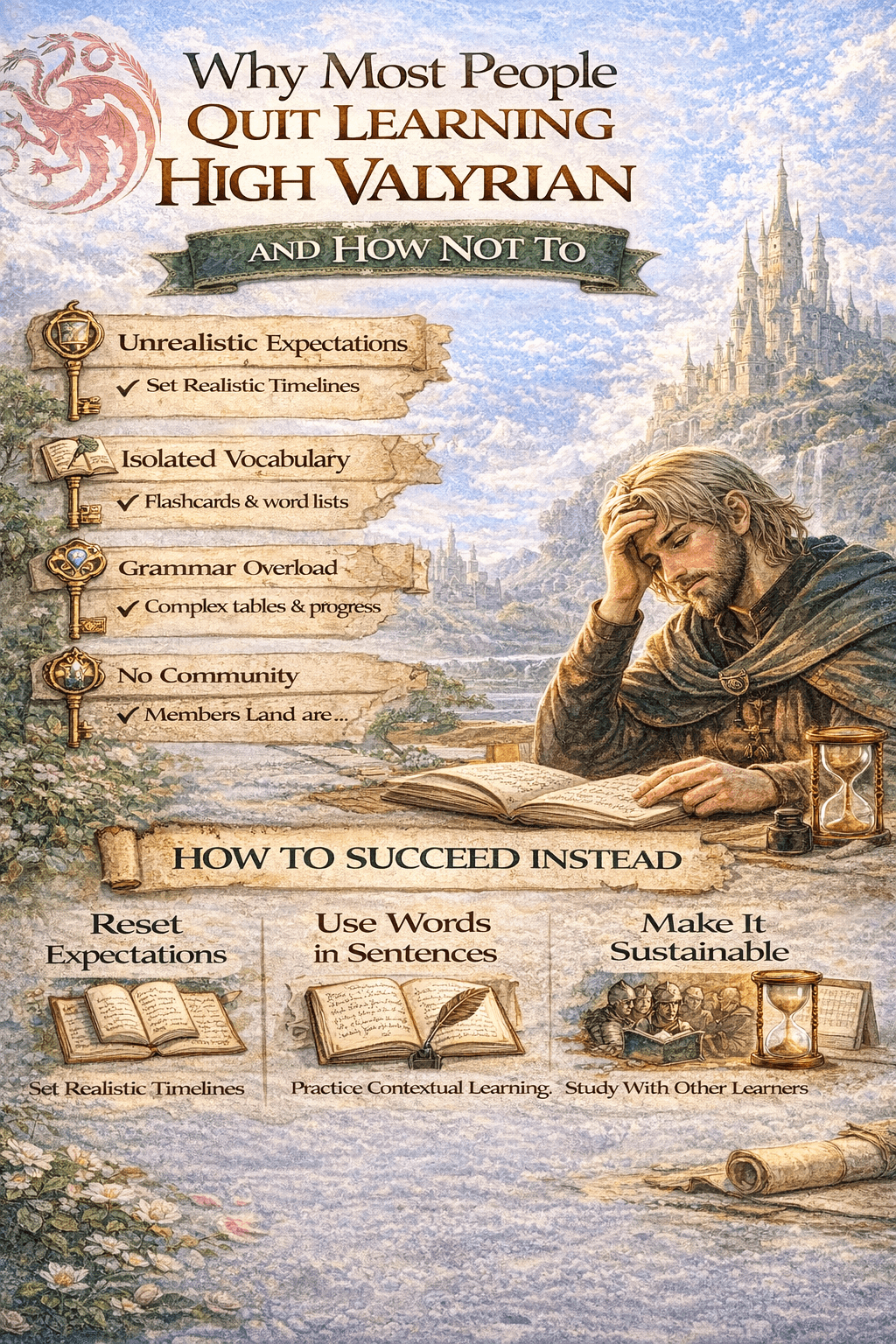
Most learners quit High Valyrian because of unrealistic expectations, weak study systems, lack of community, and misunderstanding how slow language mastery really is. With structured habits, contextual learning, and patience, long-term success is possible.
Unrealistic Expectations About Speed and Fluency
Many beginners believe that if they study regularly for a few weeks, they should already understand most dialogue and speak comfortably. This expectation is shaped by language apps, short videos, and marketing that suggests fluency is quick. If you want realistic benchmarks, our detailed breakdown of how long it takes to become fluent in High Valyrian shows what progress usually looks like at each stage.
In High Valyrian, this idea causes early frustration.
In structured learning programs, I observed that learners who expected fast results were the first to drop out. After two or three months, they knew basic grammar but still struggled to form sentences. Instead of adjusting their expectations, they assumed something was wrong with them.
High Valyrian is not a simplified hobby language. It has complex verb systems, noun classes, and phonological rules designed by David J. Peterson. It behaves more like a real historical language than a casual code.
A common mistake is comparing early vocabulary recognition with real fluency. Recognizing a word in subtitles is passive knowledge. Producing it in conversation is active skill. These develop at very different speeds.
For example, many learners can recognize words like “dracarys” or “valar” very early. But when asked to build a sentence using proper tense and agreement, they freeze. This gap is normal. It does not mean failure.
Experienced learners understand that progress comes in layers. First comes recognition. Then slow production. Then partial fluency. Each layer takes months, not weeks.
When expectations are realistic, frustration decreases. Learners stop panicking over slow weeks and focus on steady growth.
Studying Vocabulary Without Context or Usage
Another major reason people quit is how they learn words.
Many learners rely on flashcards and word lists. They memorize hundreds of isolated terms. For a while, this feels productive. Numbers go up. Memory apps show progress. Then suddenly, everything collapses.
In learner forums, I repeatedly saw posts like: “I know 800 words but can’t form a sentence.”
This happens because vocabulary without context is fragile.
High Valyrian words change form based on case, number, and grammatical role. A dictionary form is only one piece of the system. If you never see the word inside sentences, you never learn how it behaves.
A typical mistake is memorizing “vala” as “man” and moving on. Later, when encountering “valoti” or “valar,” the learner feels confused and thinks they never learned the word properly. In reality, they learned it incompletely.
Effective learners build vocabulary through usage. They study short dialogues, sample texts, and translation exercises. They see the same word in different grammatical roles.
In one online study circle, participants who worked with sentence-based notebooks retained vocabulary far longer than those using pure flashcards. They wrote example sentences, modified them, and reused structures.
Context creates mental links. Without those links, words fade quickly.
If your vocabulary feels unstable, the problem is usually not effort. It is method.
Overloading Grammar Without Building Intuition
High Valyrian grammar attracts serious learners. The system is elegant and detailed. Many people enjoy reading grammar guides and tables.
But grammar overload is one of the fastest paths to burnout.
Some learners try to master every declension and conjugation before using the language. They spend weeks reading rules but avoid writing or speaking.
In long-term learning groups, these students often know terminology very well. They can explain cases and aspects. Yet they hesitate to form even simple sentences.
This creates anxiety. They feel they are “not ready” to use the language yet. Months pass. Motivation fades.
Language intuition grows through imperfect use.
Mistakes are not a sign of weakness. They are how the brain builds internal models.
For example, learners often struggle with verb aspect. They read explanations repeatedly but still feel uncertain. The turning point usually comes when they start writing short narratives and getting feedback. Through correction, patterns become natural.
A frequent error is waiting for full certainty before practice. That moment never arrives.
Experienced learners accept partial understanding. They use grammar actively, even when unsure. Over time, confusion decreases naturally.
Grammar should support communication, not replace it.
Learning in Isolation Without Feedback
High Valyrian attracts many independent learners. They study alone, using PDFs, apps, and videos. At first, this feels efficient. There is no schedule pressure. No social discomfort.
Over time, isolation becomes a serious weakness.
Without feedback, learners reinforce errors. They mispronounce sounds, misuse endings, and misunderstand structures. These mistakes become habits. For learners studying alone, understanding how High Valyrian translation actually works can provide structured self-feedback when no teacher is available.
In community-based learning platforms, I noticed that isolated learners often reached a plateau around the intermediate stage. They could read slowly but could not improve further.
Meanwhile, learners who participated in study groups, Discord servers, or translation challenges continued progressing.
Feedback does not need to be formal. Even short comments from other learners help recalibrate understanding.
A common misconception is: “I will join a community when I am better.” In reality, community is what makes you better.
Social learning also protects motivation. When progress slows, peers normalize the struggle. You see that difficulty is shared, not personal.
Without this perspective, many learners assume they are uniquely failing and quietly quit.
Losing Motivation After the Beginner Phase
The beginner phase is rewarding. Every week brings visible progress. You understand more subtitles. You recognize more phrases. Confidence rises.
Then comes the intermediate stage.
Progress becomes slower and less visible. Improvements happen internally. Subtle grammar accuracy. Better reading speed. Fewer hesitations. These are harder to notice.
Many learners interpret this as stagnation.
In long-term programs, dropout rates peak during this stage.
The problem is not lack of progress. It is lack of measurement.
Beginners count words learned. Intermediates lack clear metrics.
Successful learners create new benchmarks. They track reading speed. Translation accuracy. Ability to summarize scenes. Writing length without dictionaries.
For example, one study group measured progress by translating the same paragraph every three months. Comparing versions revealed clear improvement.
Without such tools, motivation relies on feeling. Feeling is unreliable.
When learners do not see growth, they stop investing effort.
Treating High Valyrian as a Novelty, Not a Language
Many people begin High Valyrian as a fandom activity. They enjoy quotes, memes, and famous phrases. This is a good entry point. But some never move beyond it.
They repeat iconic lines. They collect trivia. They learn surface-level facts.
After a while, this becomes repetitive.
In learner communities, these students often say: “I love the language, but I don’t know what to do next.”
The issue is lack of functional goals.
Language learning requires purpose. Reading texts. Writing narratives. Holding conversations. Translating material. Without these, study becomes empty.
Serious learners gradually shift from fandom engagement to linguistic engagement. They analyze texts. They attempt original writing. They experiment with style.
This transition is uncomfortable. It feels less playful. But it is essential.
Those who remain in novelty mode usually quit within a year.
Those who accept the language as a long-term intellectual practice stay.
Burnout From Unsustainable Study Routines
Another major cause of quitting is intensity without balance.
Some learners start with extreme schedules. Two hours daily. Multiple resources. Heavy note-taking. Constant testing.
At first, this feels productive. After a few months, exhaustion appears.
In structured programs, I saw many talented learners disappear after burnout phases. They did too much too fast.
High Valyrian requires long-term engagement. Not short-term intensity.
Sustainable learners design routines they can keep for years. Thirty minutes daily. Light review. One main resource. Occasional deep sessions.
They allow low-energy days. They accept temporary drops in focus.
A common mistake is believing that missing a day means failure. This leads to guilt. Guilt leads to avoidance. Avoidance leads to quitting.
Healthy learners treat study like maintenance, not punishment.
Consistency matters more than volume.
FAQs
Summary and Action Plan
Most people quit High Valyrian not because they lack ability, but because their learning system breaks down. If you are rebuilding your study system from scratch, our complete guide on tips to master the High Valyrian language provides a practical starting framework.
Unrealistic timelines create frustration.
Isolated vocabulary collapses.
Grammar without usage paralyzes.
Isolation removes feedback.
Invisible progress kills motivation.
Novelty replaces purpose.
Excessive intensity leads to burnout.
Long-term learners avoid these traps by building simple, stable systems.
Action Plan:
First, reset your expectations. Plan in years, not months. Accept slow phases.
Second, rebuild vocabulary through sentences and short texts. Create a usage notebook.
Third, practice grammar through writing, even when uncertain. Seek corrections.
Fourth, join or rejoin a learning community. Make feedback routine.
Fifth, define measurable intermediate goals. Track real skills, not feelings.
Sixth, shift from fandom consumption to active language use. Write. Translate. Create.
Seventh, design a routine you can maintain for years. Protect your energy.
High Valyrian rewards patience, structure, and humility. Learners who treat it as a serious language project, rather than a short-term challenge, rarely quit. They adapt. They refine. They continue.