Active vs Passive Voice in High Valyrian Explained
Introduction:
Most learners who reach an intermediate level in High Valyrian eventually ask the same question: does this language really use active and passive voice the same way as English. The short answer is no, and misunderstanding this point causes more long term confusion than almost any other grammar topic.
High Valyrian does not treat voice as a simple stylistic choice. It is tightly linked to case marking, verb morphology, and how information is framed for the listener. In structured learning groups and long running learner forums, I have repeatedly seen students who know hundreds of words and dozens of verb forms still struggle to express simple ideas because they rely too heavily on English habits.
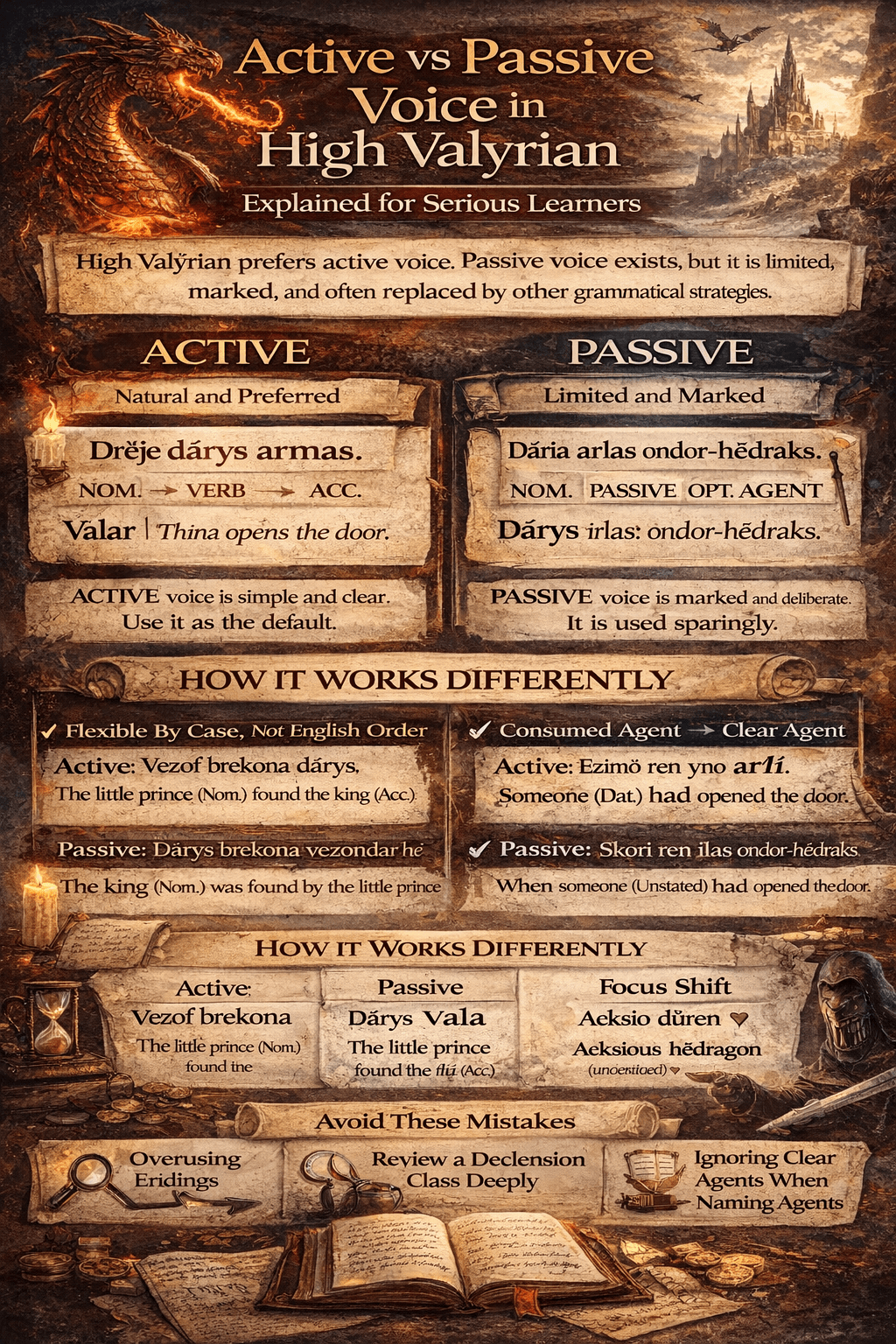
This article answers the core question early. High Valyrian strongly prefers active constructions, and passive voice exists but is limited, marked, and often replaced by other grammatical strategies. If you try to force English style passives into High Valyrian, your sentences may be technically formed yet sound unnatural or unclear. In situations like this, it helps to test your phrasing using a reliable High Valyrian Translator tool to see how active constructions are typically structured.
You will learn how active voice actually works in real High Valyrian usage, when passive voice is acceptable, and when it should be avoided. Every section is grounded in real learning situations, including mistakes I have seen repeatedly in study groups focused on material from Game of Thrones and related canonical sources. The goal is practical clarity, not abstract grammar theory.
How Voice Works Differently in High Valyrian Compared to English
English learners often approach High Valyrian with an assumption that voice is mainly about rearranging word order. In English, the difference between “The dragon burned the city” and “The city was burned by the dragon” feels mostly stylistic. In High Valyrian, the shift is deeper and more structural.
High Valyrian is a heavily inflected language. To fully understand how active and passive roles are marked, study the High Valyrian noun declension guide in detail. Meaning is carried by endings, not by position. The agent of an action, the patient, and the verb all signal their roles through case and agreement. Because of this, active voice is not just the default. It is the clearest and most economical way to express action.
In multiple community learning programs, beginners often try to translate English passives word for word. They look for a direct equivalent of “was done by” and feel frustrated when they cannot find one that behaves the same way. This leads to overuse of marked constructions that are rarely needed.
Another key difference is communicative focus. High Valyrian tends to foreground who is responsible for an action. This fits the language’s narrative and rhetorical style, especially in formal or dramatic contexts. Passive voice, which hides or downplays the agent, is therefore less common and more purposeful.
Understanding this difference early helps prevent fossilized errors. Learners who internalize that voice choice affects clarity, not just tone, progress faster and produce sentences that feel intentional rather than translated.
Active Voice as the Natural Core of High Valyrian Expression
Active voice is the backbone of High Valyrian. Most verbs are taught, learned, and used in active constructions, and native style usage almost always favors them.
In active voice, the subject performs the action, marked clearly by case and verb agreement. This allows High Valyrian to maintain flexible word order without ambiguity. In study groups analyzing canonical dialogue, active constructions dominate even in situations where English might allow a passive.
For example, when describing events, commands, or historical actions, speakers consistently name the actor. This is not just tradition. It reduces processing load for the listener. Because High Valyrian sentences can become morphologically dense, removing the agent often makes comprehension harder, not easier.
A common learner mistake is assuming that avoiding repetition requires passive voice. In English writing classes, students are often taught to vary sentence structure by using passives. In High Valyrian, repetition of active agents is not stylistically weak. It is often preferred.
In long term learner communities, I have seen advanced students rewrite entire passages after realizing that their overuse of passive voice made the text feel distant and vague. Once rewritten with clear agents, the same content became more vivid and easier to parse.
The practical takeaway is simple. If you are unsure whether to use active or passive voice in High Valyrian, choose active. You will almost always be closer to natural usage.
Passive Voice in High Valyrian and Its Real Limits
Passive voice does exist in High Valyrian, but it is limited and marked. It is not a neutral alternative to active voice.
In instructional settings, passive forms are usually introduced later because they rely on a deeper understanding of verb morphology. They are used when the agent is unknown, irrelevant, or deliberately concealed. Even then, learners are often surprised by how rarely native style texts rely on them.
One recurring issue in structured programs is learners using passive voice to sound formal. This mirrors English academic writing habits. In High Valyrian, passive constructions often sound heavier and more deliberate, sometimes even evasive.
There are also syntactic constraints. Not every verb forms a natural passive, and forcing one can produce sentences that are grammatically possible but pragmatically odd. This is something learners only notice after feedback from experienced speakers or instructors.
In a long running online translation project, several contributors independently replaced passive constructions with active ones after peer review, noting that the original sentences felt translated rather than composed.
Passive voice in High Valyrian should be treated as a tool, not a default option. It is best reserved for specific communicative goals, not routine narration.
When High Valyrian Uses Other Strategies Instead of Passive Voice
One of the most important insights for serious learners is that High Valyrian often avoids passive voice by using entirely different grammatical strategies.
Instead of saying that something “was done,” speakers may use impersonal constructions, omit the agent when it is obvious from context, or shift focus using word order and emphasis. A deeper look at High Valyrian sentence structure guide explains how word order can change focus without relying on passive voice. These strategies achieve similar discourse goals without invoking passive morphology.
In teaching environments, this realization often comes as a breakthrough moment. Learners stop searching for a passive equivalent and start thinking in terms of information structure. What matters is not whether the sentence is active or passive, but what the listener needs to know first.
For example, in narrative contexts, the affected object may be placed early in the sentence while the verb remains active. The agent is still present, but the focus shifts naturally.
This approach aligns with how High Valyrian handles emphasis more broadly. Rather than changing voice, speakers adjust case prominence, verb placement, or clause structure.
Learners who adopt these strategies tend to sound more fluent and less translated. They also gain flexibility, since they are no longer limited to a binary active passive choice.
Common Learner Errors with Voice and How to Fix Them
Across years of observing learner progress, certain errors appear again and again.
The most frequent is overusing passive voice to avoid naming the agent. This often comes from fear of making case mistakes. Ironically, this avoidance usually leads to more complex errors.
Another common problem is mixing English passive logic with High Valyrian morphology. Learners form passives correctly but use them in contexts where no native speaker would choose them.
There is also confusion between grammatical passive voice and pragmatic backgrounding. Many learners believe that if something is less important, it must be passive. In High Valyrian, importance is often conveyed through placement and agreement, not voice.
Fixing these issues requires deliberate practice. In structured exercises, I often ask learners to rewrite passive sentences into active ones without changing the meaning. This reveals how much unnecessary complexity the passive added.
Over time, learners who focus on clarity rather than stylistic imitation develop a more intuitive sense of voice.
Teaching Voice Through Real Usage Rather Than Rules
One reason voice is so challenging is that it is often taught as a set of rules rather than as a pattern of usage.
In community based learning environments, the most effective approach has been exposure to authentic examples followed by guided analysis. Instead of asking whether a sentence is active or passive, learners ask why that form was chosen.
This mirrors how High Valyrian was designed to function. It is a language meant to sound intentional and expressive, not mechanically transformed.
Instructors who emphasize usage over labels see better long term retention. Learners stop asking for direct English equivalents and start evaluating sentences on their own terms.
Voice becomes a communicative decision rather than a grammatical hurdle.
FAQs
Summary and Action Plan
Active voice is the foundation of High Valyrian. Passive voice exists, but it is not a stylistic default and should not be treated as one. Many learner difficulties come from applying English expectations to a language that organizes information differently.
To move forward, focus on clarity, not transformation. When expressing an action, name who performs it. Use passive constructions only when they serve a clear purpose. Pay attention to how canonical examples handle emphasis without changing voice.
A practical learning roadmap looks like this. First, master active constructions with confidence. Second, study passive forms as marked options, not alternatives. Third, observe how emphasis is handled through structure rather than voice. Finally, seek feedback in community settings to refine intuition.
Approached this way, voice stops being a problem and becomes a powerful expressive choice.