How Questions Are Formed in High Valyrian Grammar
Introduction
Many learners reach a stage in High Valyrian where they can form statements confidently but hesitate the moment they need to ask a question. The grammar feels stable when saying “The dragon flies,” yet uncertainty appears when trying to ask “Does the dragon fly?” or “Where is the dragon?”
The short answer is this: High Valyrian does not rely on heavy word order changes the way English does. Instead, it uses particles, intonation, and interrogative words while largely preserving its case system and sentence structure. If you understand how statements work, you are already halfway to forming questions correctly.
In structured learning groups and online learner forums, I repeatedly see the same pattern. Students try to force English-style inversion into High Valyrian. They move verbs unnecessarily, misplace particles, or forget that cases still govern the roles of nouns even in questions.
This guide explains how High Valyrian forms yes or no questions, content questions, embedded questions, and more subtle interrogative constructions. Each section focuses on real learner difficulties, not just rules. By the end, you will know not only how to build questions, but why the system works the way it does.
The Foundation: Statement Structure Before Question Structure
Before discussing questions directly, it is important to understand that High Valyrian questions grow out of its normal declarative structure. Unlike English, which often requires auxiliary verbs such as “do,” High Valyrian does not restructure the entire sentence when asking something.
In many beginner study circles, learners attempt to “translate the question shape” instead of the meaning. For example, an English learner might assume that to ask “Does he see the dragon?” the verb must move before the subject. That instinct comes from English grammar, not from High Valyrian.
High Valyrian relies heavily on its case system, which is explained in detail in this complete High Valyrian noun declension guide. The nominative still marks the subject. The accusative still marks the direct object. These grammatical roles do not disappear just because the sentence becomes interrogative.
In practice sessions, I often see learners produce sentences that technically form a question but scramble case endings because they are concentrating on interrogative form. The result is grammatically inconsistent.
The key principle is this: keep the grammatical skeleton intact, especially if you are still working through common High Valyrian case system confusions. A question is usually a modification of tone or the addition of a particle, not a restructuring of the clause. Once learners internalize this, their question formation becomes much more stable.
Yes or No Questions and the Interrogative Particle
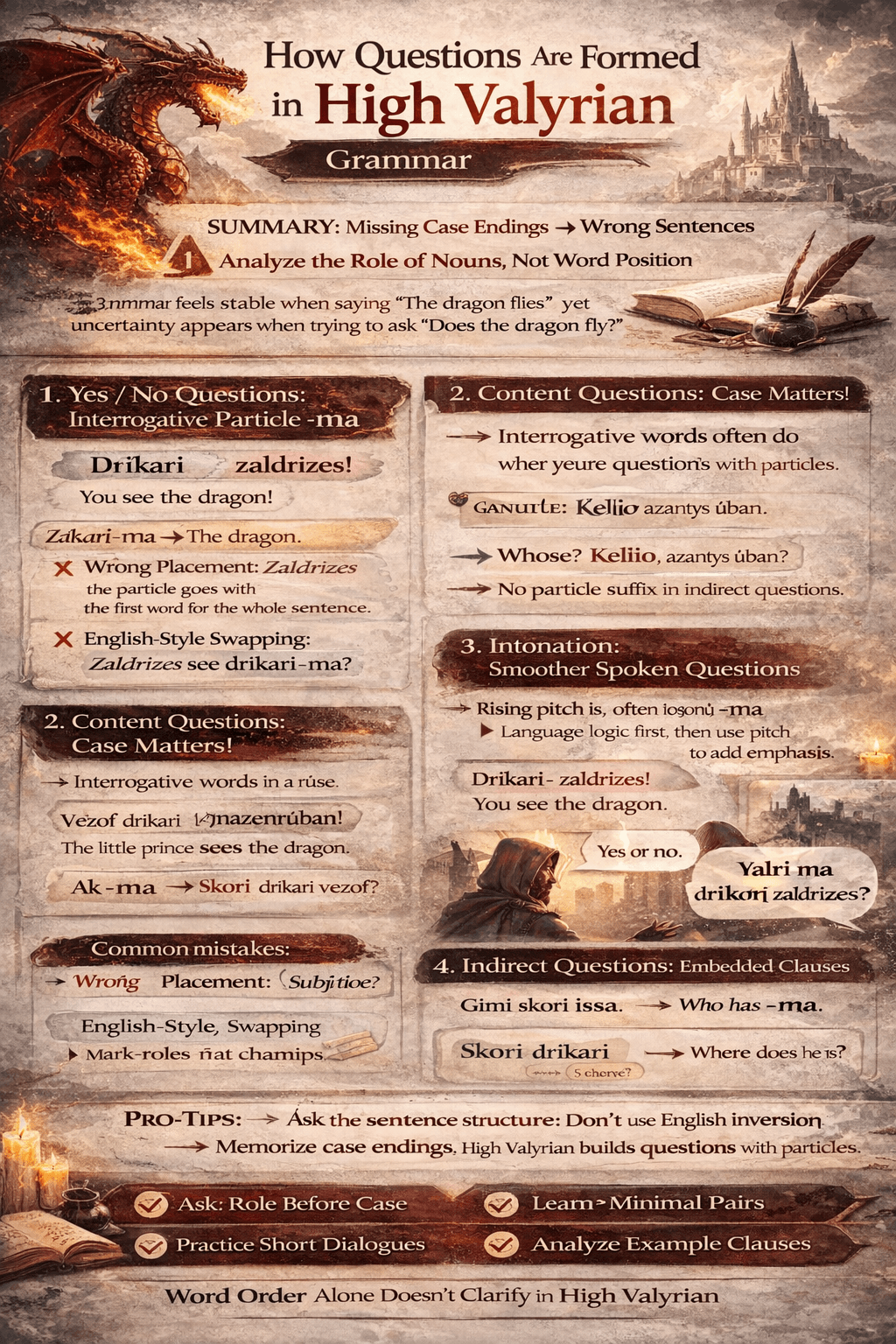
High Valyrian commonly uses the interrogative particle “-ma” to turn a statement into a yes or no question. This particle is attached to the first word of the sentence.
This feature surprises English speakers because it does not require auxiliary verbs or inversion. Instead of rearranging the sentence, you attach a small marker that signals interrogative force.
For example, a statement meaning “You see the dragon” can become a yes or no question by attaching “-ma” to the first word. The core word order and case endings remain the same.
In community translation exercises, learners frequently make two mistakes with “-ma.” First, they attach it to the wrong word. The particle must attach to the first word of the clause, not randomly within the sentence. Second, they forget that pronunciation matters. Because “-ma” attaches directly, it forms one phonological unit.
Another common misunderstanding appears in longer sentences. When there is an introductory element, such as a time expression or adverb, the particle still attaches to the first word, even if that word is not the subject. Learners sometimes think it must attach to the verb. It does not.
Understanding this particle eliminates the urge to rearrange word order unnecessarily. High Valyrian prefers subtle grammatical marking over structural disruption, a feature that reflects what makes High Valyrian a complete language.
Word Order in Questions: Stability Over Inversion
One of the biggest conceptual shifts for English speakers is accepting that High Valyrian does not rely on subject-auxiliary inversion.
In English, we change “She is here” into “Is she here?” This movement signals interrogation. In High Valyrian, the interrogative particle and intonation carry that function.
In advanced learner groups, especially those translating dialogue from A Song of Ice and Fire and its television adaptation Game of Thrones, I observed a consistent pattern. Learners exposed heavily to English dialogue subconsciously tried to invert verbs in High Valyrian translations. This often created unnatural constructions.
High Valyrian is flexible in word order due to its case system, but flexibility does not mean randomness. When forming questions, you generally keep the natural word order of the statement. The interrogative marker does the work.
If a learner insists on copying English inversion, the result may still be understandable but will not reflect authentic High Valyrian style. Over time, this habit fossilizes and becomes difficult to correct.
The practical approach is simple. First build a correct declarative sentence. Then apply the interrogative particle. Only after that should you consider stylistic adjustments, if necessary. This layered method reduces errors dramatically.
Content Questions with Interrogative Words
Content questions, such as who, what, where, and why, function differently from yes or no questions. High Valyrian uses interrogative pronouns and adverbs that occupy the grammatical role required by the sentence.
Here the case system becomes especially important. If you are asking “Who sees the dragon?” the interrogative word must appear in the nominative case because it functions as the subject. If you ask “Whom does the dragon see?” the interrogative pronoun must reflect the accusative.
In long-term learner forums, confusion about case alignment in questions is one of the most frequent issues. Students remember to use interrogative vocabulary but forget that those words decline like other nouns or pronouns.
Another recurring difficulty appears in indirect questions. Learners sometimes leave interrogative words in base form without adjusting them for grammatical function. The result sounds incomplete.
A useful learning exercise involves rewriting a declarative sentence by replacing one element with an interrogative word while preserving all case endings. This practice builds automatic awareness of grammatical roles.
Content questions in High Valyrian are structurally consistent with statements. The difference lies in which element is unknown, not in a wholesale rearrangement of the sentence.
Intonation and Spoken Questions
While written High Valyrian often relies clearly on particles and interrogative words, spoken language introduces another layer: intonation.
In spoken practice sessions within online pronunciation groups, learners often ask whether rising pitch alone can signal a question. The answer is nuanced. Intonation can reinforce interrogative meaning, but it does not replace grammatical marking in most formal contexts.
If you rely only on rising pitch without using the interrogative particle where required, the sentence may sound incomplete or ambiguous.
However, intonation does affect emphasis. For example, stressing a particular word in a content question can highlight contrast or emotional tone. In dramatic dialogue recreations inspired by House of the Dragon, advanced learners experiment with intonation to express suspicion, urgency, or disbelief.
The key distinction is this: grammar creates the question; intonation shapes its emotional color. Learners who confuse the two often produce sentences that feel theatrically correct but grammatically weak.
Training your ear with authentic audio material helps align structure and sound. Even reading questions aloud during private study can reinforce correct rhythm and attachment of particles.
Embedded and Indirect Questions
Embedded questions appear inside larger sentences, such as “I know where he is” or “She asked whether the dragon lives.”
In High Valyrian, embedded questions do not always use the interrogative particle in the same way as direct questions. Instead, they behave more like subordinate clauses.
In intermediate grammar workshops, learners frequently overapply “-ma” inside indirect clauses. They treat every question concept as if it must visibly look like a direct interrogative.
The better approach is to analyze the grammatical function. In “She asked where he is,” the clause “where he is” functions as the object of “asked.” It retains interrogative meaning but integrates syntactically into a larger structure.
Case endings, again, remain consistent. The internal grammar of the embedded clause must still be correct.
A reliable method for mastering embedded questions is to first form the direct question correctly. Then transform it into a subordinate clause by removing the interrogative particle if the structure requires it and adjusting word order according to standard subordination patterns.
This step-by-step transformation reduces confusion and reinforces structural awareness.
Common Learner Errors and How to Correct Them
Across structured programs and community study groups, certain patterns appear repeatedly.
One frequent error is double marking. A learner may attach “-ma” and also attempt English-style inversion. This creates an unnecessary hybrid structure.
Another issue is ignoring case endings in interrogative pronouns. Because attention shifts to question formation, learners forget agreement and declension.
A third problem involves overgeneralization. After learning that “-ma” attaches to the first word, some students attach it to conjunctions or particles without understanding clause boundaries.
Correction requires deliberate slowing down. Write the declarative form first. Check all case endings. Identify which element is unknown. Apply the interrogative strategy appropriate to the type of question.
In peer-review exercises I observed, students who verbalized their reasoning out loud made fewer long-term errors. Explaining why a pronoun must be in a particular case strengthens grammatical intuition.
Accuracy in questions is not about memorizing patterns. It is about respecting the structure already present in the language.
Realistic Expectations for Mastery
Question formation in High Valyrian feels difficult at first because it exposes weaknesses in case knowledge and clause structure.
In long-term learner communities, progress tends to follow a predictable pattern. Beginners overthink inversion. Intermediate learners overuse particles. Advanced learners refine subtle distinctions between direct and embedded questions.
Improvement comes from controlled practice. Translating simple dialogues is more effective than memorizing isolated rules. Repetition builds automatic attachment of “-ma.” Case drills strengthen interrogative pronoun accuracy.
It is normal for learners to hesitate when forming spontaneous questions in conversation practice. Even advanced students pause briefly to ensure correct attachment and case marking.
Fluency develops when the structure becomes internalized. That happens through consistent exposure, correction, and careful analysis of authentic examples.
FAQs
Summary and Action Plan
To form questions in High Valyrian accurately, keep the declarative structure stable. Use the interrogative particle for yes or no questions. Apply correct case endings to interrogative words in content questions. Avoid English-style inversion.
A practical roadmap looks like this:
First, practice transforming simple statements into yes or no questions using the particle.
Second, replace individual sentence elements with interrogative words while maintaining case accuracy.
Third, work with short dialogues to integrate questions into realistic contexts.
Fourth, practice embedded questions by converting direct questions into subordinate clauses.
Consistent, structured practice builds confidence. When you understand that High Valyrian questions modify structure rather than overturn it, the system becomes logical and manageable.