The Best Way to Memorize High Valyrian Vocabulary for Real Fluency
Introduction
If you have been studying High Valyrian for more than a few weeks, you have probably experienced the same frustration many serious learners face. You recognize words when you read them. You remember them when you see them in subtitles from Game of Thrones or House of the Dragon. But when you try to speak, write, or think in the language, those words disappear.
This is not a personal failure. It is a predictable result of how most people try to memorize vocabulary.
In structured learning groups and long-term online study communities, I have consistently seen the same pattern. Learners collect hundreds of word lists, review them daily, and still struggle to use basic vocabulary naturally after months of effort. Meanwhile, a smaller group builds a much smaller vocabulary but can actually use it with confidence.
The difference is not intelligence or talent. It is method.
The best way to memorize High Valyrian vocabulary is to build active, contextual memory through repeated use, meaningful association, and gradual consolidation. This article explains exactly how to do that, based on years of observing learners in real study environments and teaching programs inspired by the linguistic work of David J. Peterson.
You will learn why most memorization systems fail, how to build vocabulary that stays with you, and how to turn isolated words into usable language.
Why Traditional Vocabulary Memorization Fails in High Valyrian
Most High Valyrian learners begin with the same approach. They download flashcard decks, copy word lists, and repeat translations until they feel familiar. At first, this feels productive. You can recognize dozens of words within days. Progress seems fast.
Then something strange happens.
After several weeks, retention collapses. Words you reviewed many times suddenly feel distant. You hesitate when speaking. Writing becomes slow and mechanical. This is not caused by laziness. It is caused by how memory works.
In community study groups, I have often watched learners confidently recite translations during review sessions, then freeze during simple conversation exercises. The same learners can pass vocabulary quizzes but cannot form spontaneous sentences.
This happens because most traditional methods build recognition memory, not retrieval memory, highlighting how differently High Valyrian handles words compared to English.
Recognition memory means you know a word when you see it. Retrieval memory means you can pull it from your mind when you need it. Real language use depends on retrieval.
Flashcards and lists encourage passive exposure. Your brain learns to associate “Valyrian word equals English word” in a very narrow context. Outside that context, the association weakens.
High Valyrian makes this problem worse because of its inflection system. A single root can appear in many forms. If you memorize only dictionary forms, you fail to recognize them in real sentences. If you memorize only isolated forms, you cannot adapt them.
Another major issue is emotional disengagement. Repetitive drilling creates mental fatigue. After several weeks, many learners begin to skim reviews instead of engaging with them. Retention drops silently.
Effective memorization must solve three problems at once. It must support retrieval, adapt to grammatical variation, and remain mentally engaging over time.
How High Valyrian Structure Changes Vocabulary Learning
High Valyrian is not organized like English. Its grammar deeply shapes how vocabulary functions. Ignoring this structure leads to weak memory.
In High Valyrian, nouns change based on case and number. Verbs change based on tense, mood, and voice. Adjectives agree with nouns. Word order shifts for emphasis. A single “word” in a dictionary is only a starting point.
In structured learning programs, beginners often complain that “I memorized this word, but I cannot recognize it anymore.” When examined closely, the word is simply appearing in a declined or conjugated form.
For example, a learner memorizes a noun in nominative singular. Later, they encounter it in genitive plural. Their brain treats it as a new word. The original memory does not activate.
This happens because the learner stored the word as a fixed image, not as a flexible pattern.
Advanced learners handle this differently. They memorize words together with their grammatical behavior. When learning a noun, they also learn its declension type. When learning a verb, they notice its class and stem changes.
In long-term forums, the learners who progress fastest are not those with the largest word lists. They are those who consistently connect vocabulary to structure.
They do not memorize “to go.” They memorize “this verb belongs to this class and behaves like this.”
They do not memorize “king.” They memorize “this noun declines in this pattern.”
This creates a network of memory instead of isolated points. Networks are much harder to forget.
High Valyrian vocabulary must be learned as living elements in a system, not as static labels.
Building Active Memory Through Context and Sentence Creation
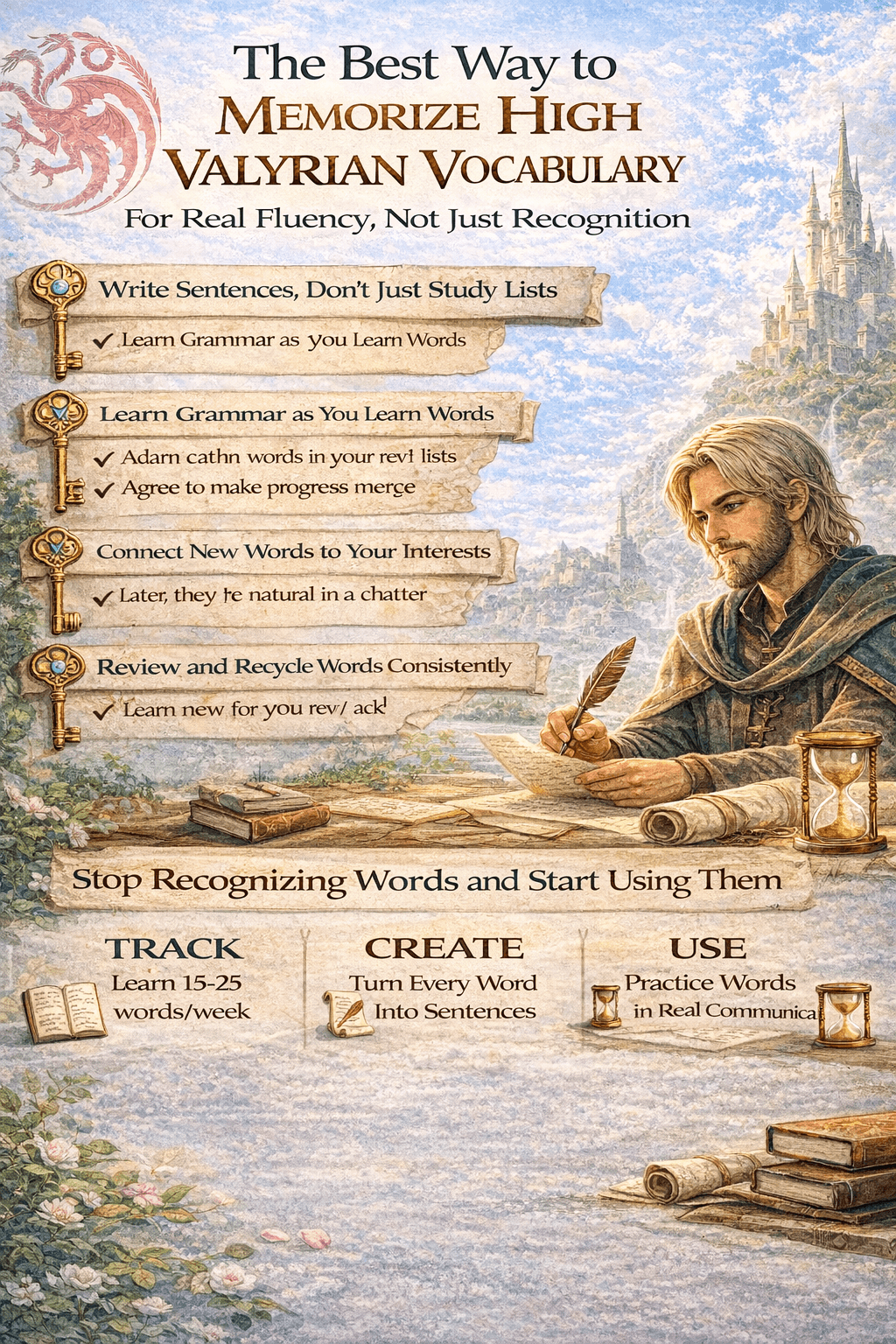
The most reliable way to convert vocabulary into usable knowledge is through sentence-based learning.
In every serious study group I have observed, learners who write and speak regularly retain far more words than those who only review.
This is because sentences force your brain to retrieve, adapt, and connect words simultaneously.
A practical example illustrates this clearly.
Two learners study the same 30 words in one week. The first learner reviews them on flashcards. The second learner writes five original sentences every day using those words.
After two weeks, both take part in a speaking session. The first learner recognizes most words but struggles to use them. The second learner uses them naturally, even making small grammatical mistakes.
The second learner has stronger memory because each word is tied to multiple contexts.
When you create a sentence, you must decide:
Which form of the word fits here?
How does it agree with others?
What order sounds natural?
This mental effort strengthens memory.
Effective sentence practice is not about writing perfect grammar. It is about building retrieval pathways.
In guided programs, learners are often encouraged to keep “micro journals” in High Valyrian. These are short daily entries about simple topics: what they did, what they plan, what they observed.
Over months, these journals become powerful memory tools. Words appear again and again in different settings. They stop feeling foreign.
Common mistake: copying example sentences without modification. This feels productive but produces shallow memory. Always change something. Alter tense, subject, or object.
Your goal is to force active construction, not passive imitation.
Using Spaced Repetition Without Becoming Dependent on It
Spaced repetition systems are popular among language learners. They can be helpful, but only when used correctly.
In many learning communities, I have seen learners become trapped by their review apps. They spend more time maintaining decks than using the language. Vocabulary becomes a daily chore rather than a tool.
Spaced repetition works best as a support system, not a foundation.
Its main value is timing. Reviewing a word just before you forget it strengthens memory. But timing alone is not enough.
If your flashcards only contain “Valyrian word equals English word,” you are training recognition, not usage.
High-quality cards include context.
Instead of:
Word on front. Translation on back.
Use:
Sentence with missing word.
Or sentence with altered form.
Or prompt that requires producing a phrase.
In advanced study groups, learners often redesign their decks after several months. They remove simple translation cards and replace them with production-based cards.
Example:
Front: “Translate: I will see the dragon tomorrow.”
Back: Full High Valyrian sentence.
This forces recall of vocabulary and grammar together.
Another mistake is excessive daily volume. Some learners review hundreds of cards daily. Mental fatigue sets in. Accuracy drops. Learning slows.
A smaller, high-quality deck reviewed carefully is far more effective.
Use spaced repetition to protect what you already learned. Do not rely on it to build deep knowledge.
Creating Personal Meaning and Emotional Anchors
Memory strengthens when information connects to personal meaning.
This is not a vague psychological idea. It is observable in learning communities.
In long-term study programs, learners who connect vocabulary to their own interests, stories, and experiences retain far more than those who treat words as abstract data.
For example, a learner interested in fantasy writing begins composing short scenes in High Valyrian. Another learner interested in linguistics analyzes verb patterns in detail. Both outperform learners who only follow exercises.
Why?
Because emotional and intellectual engagement creates multiple memory pathways.
When you associate a word with a story you wrote, a joke from a group chat, or a debate you had, it becomes anchored in experience.
Practical method:
Choose small personal themes. Daily routine. Favorite characters. Imaginary scenarios. Reflections on learning.
Reuse vocabulary within these themes.
In one community writing challenge, learners were asked to describe the same fictional city every week. Over time, place-related vocabulary became deeply ingrained because it was reused creatively.
Another powerful anchor is teaching.
Learners who explain words to others remember them better. In peer mentoring groups, vocabulary retention improves dramatically among those who regularly answer questions.
Explaining forces you to reorganize knowledge in your own words. This strengthens memory.
If you study alone, write explanations as if you were teaching someone else.
Managing Cognitive Load and Avoiding Vocabulary Overload
One of the most common causes of failure in High Valyrian learning is overload.
Enthusiastic beginners often try to memorize 50 or 100 words per week. For a short time, this works. Then progress collapses.
In longitudinal studies of learner communities, steady learners who maintained 15 to 25 new words per week outperformed intensive learners after six months.
The brain needs time to consolidate language.
High Valyrian adds extra load because each word carries grammatical complexity. Learning too many at once prevents deep processing.
Symptoms of overload include:
Frequent forgetting
Confusion between similar forms
Avoidance of speaking
Declining motivation
Effective learners build in consolidation phases.
They spend several weeks using mostly old vocabulary in new ways. They recycle words in different contexts. They slow down intentionally.
Another important factor is sleep and review spacing. Learners who study late at night and skip next-day review forget more. Consolidation happens during rest.
Practical guideline from experienced programs:
Add new words only when old ones feel automatic in basic sentences.
Automatic does not mean perfect. It means you do not hesitate.
Slower progress that sticks is always better than fast progress that fades.
Integrating Vocabulary Into Real Communication Practice
Vocabulary becomes permanent when it is used for real communication, even in limited form.
In active online communities, learners who participate in chats, voice sessions, and collaborative writing retain far more than silent learners.
This does not require fluency. Beginners benefit as well.
A simple example: weekly “micro conversations” where learners exchange three sentences about a topic. These sessions produce dramatic improvement in recall.
Why?
Because communication adds pressure and unpredictability. You cannot rely on memorized sequences. You must adapt.
This activates deeper memory systems.
Common fear: “I am not ready yet.”
In every program I have observed, learners who wait for readiness delay progress. Those who participate early make more mistakes but learn faster.
Mistakes are not failures. They are memory anchors. You remember the word you misused far longer than the one you never tried.
Effective communication practice includes:
Short written exchanges
Guided speaking drills
Collaborative storytelling
Role-play scenarios
The key is low-stakes repetition.
Avoid environments where mistakes are punished. Choose supportive communities.
If no community is available, simulate interaction. Record yourself speaking. Respond to prompts. Rewrite dialogues.
Vocabulary grows strongest when it serves real expression.
FAQs
Summary
Memorizing High Valyrian vocabulary is not about collecting words. It is about building a usable system in your mind.
The most reliable path combines structure, context, repetition, and communication.
Practical roadmap:
First, limit new vocabulary to a manageable amount and focus on understanding how each word behaves grammatically.
Second, turn every new word into multiple sentences. Write daily. Speak regularly, even if imperfect.
Third, use spaced repetition only for protection, not as your main learning tool. Design cards that require production.
Fourth, connect vocabulary to personal meaning through writing, storytelling, and teaching.
Fifth, participate in real or simulated communication as early as possible.
Finally, schedule consolidation periods where you recycle old words in new contexts instead of constantly adding new ones.
If you follow this approach consistently for several months, your vocabulary will stop feeling fragile. Words will appear when you need them. Sentences will form more easily. High Valyrian will begin to function as a real language in your mind, not just a collection of memorized terms.