Understanding Common High Valyrian Case System Confusions
Introduction
Many learners of High Valyrian reach a point where vocabulary is no longer the problem. They know dozens of words, can form simple sentences, and understand basic verb conjugations. Yet their sentences still feel unstable. The reason is almost always the same: confusion about the case system.
High Valyrian uses grammatical cases to show how nouns function inside a sentence. Word order alone does not carry meaning the way it does in English. If the case ending is wrong, the meaning shifts or becomes unclear. That is why even advanced learners sometimes produce sentences that sound unnatural to experienced readers.
Short summary: Most High Valyrian case mistakes come from treating it like English, misunderstanding how verb arguments work, or confusing similar endings. These problems are fixable with structured practice and awareness of patterns.
In long-term learner forums and structured study groups, I have repeatedly seen the same misunderstandings appear. This article explains the most common case confusions, why they happen, and how to correct them through practical reasoning rather than memorization alone.
Why English Speakers Struggle with the High Valyrian Case System
High Valyrian marks grammatical relationships through endings attached to nouns. If you want to test how these endings change meaning in real sentences, try analyzing examples inside our High Valyrian Translator tool. English relies mostly on word order. Because of this, English-speaking learners often assume that if a sentence “looks right,” it is correct. In High Valyrian, that assumption fails quickly.
For example, in English, “The dragon sees the knight” depends on position. If you reverse the nouns, the meaning reverses. In High Valyrian, endings indicate who performs the action and who receives it. Word order becomes more flexible.
In structured learning programs I have observed, beginners frequently memorize vocabulary lists without internalizing case patterns. They then produce sentences that rely on English-style structure. The result is inconsistent marking of subjects and objects.
Another issue is that learners often focus on singular forms first. They become comfortable with a few endings and assume they apply broadly. Once plural forms, collective forms, and irregular stems enter the picture, their system collapses.
A practical adjustment is to stop translating word by word. Instead, learners should identify the role of each noun before choosing its ending. Ask: Is this noun performing the action? Receiving it? Showing possession? Indicating location? That mental shift changes everything.
High Valyrian is not unusually complex compared to many natural languages, but it demands attention to function. Once learners start thinking in roles rather than positions, case confusion decreases significantly.
Nominative vs Accusative Confusion
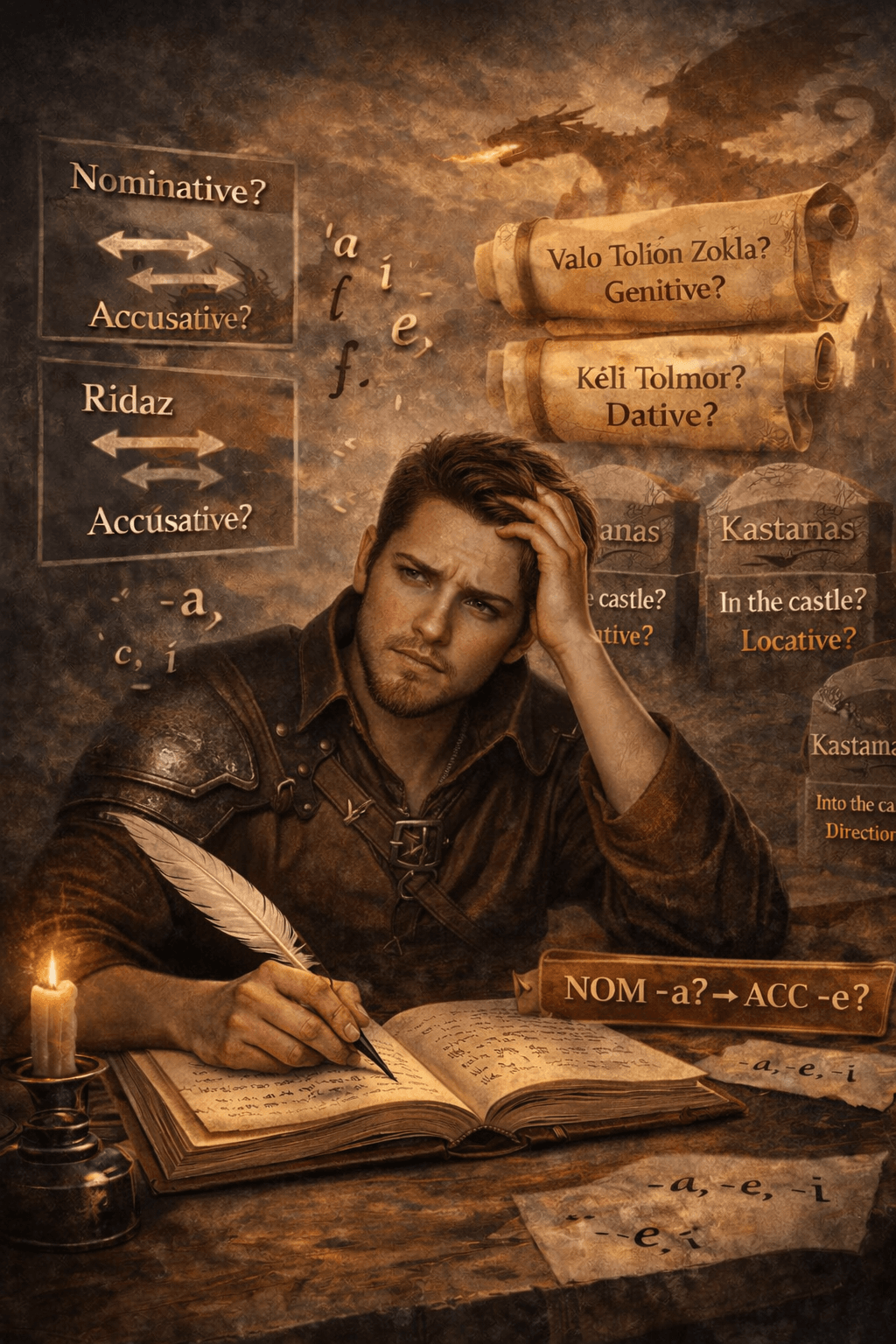
The most frequent error involves mixing up nominative and accusative forms. The nominative marks the subject of the sentence. The accusative marks the direct object.
This seems simple, yet learners struggle because they often identify the subject incorrectly. In English, we rely on word order. In High Valyrian, verb agreement and logic must guide us.
In community translation exercises, I have seen sentences like “The knight kills the dragon” written with both nouns in nominative form. The learner assumed the first noun automatically functions as subject. But if endings do not reflect that relationship, the sentence becomes ambiguous or incorrect.
Another common problem appears in longer sentences. When adjectives and relative clauses are added, learners lose track of which noun controls the verb. They then assign accusative to the wrong element.
To correct this, break sentences into a simple core first. Identify the verb. Then ask: Who is performing this action? That noun must be nominative. Who or what receives it? That noun must be accusative.
It helps to practice minimal pairs. Write two short sentences that reverse roles. For example, “The dragon sees the knight” and “The knight sees the dragon.” By switching endings deliberately, learners begin to see how meaning shifts independently of word order.
The deeper issue is not memory. It is analysis. Learners must train themselves to analyze sentence structure before choosing endings.
Genitive and Possession Misunderstandings
The genitive case often creates confusion because possession in English is expressed in multiple ways. We use apostrophe s, of-phrases, and sometimes simple noun compounds. High Valyrian marks possession directly through endings.
In long-term learner forums, I noticed repeated misuse of genitive in compound-like expressions. Learners would attempt to translate English patterns directly, producing constructions that do not align with Valyrian structure.
For example, instead of clearly marking possession, they would stack nouns without adjusting endings properly. The result resembles English noun phrases but violates Valyrian agreement rules.
Another difficulty is nested possession. Consider phrases equivalent to “the sword of the brother of the king.” Learners often apply genitive inconsistently across multiple nouns. In group study reviews, this pattern appears frequently when sentences become longer than two nouns.
The solution is systematic layering. Start from the core noun. Identify what is being possessed. Then attach each genitive modifier carefully, ensuring agreement and correct stem usage.
It is also important to understand semantic relationships. Not every English “of” phrase requires genitive in High Valyrian. Some relationships are descriptive rather than possessive. Distinguishing true possession from classification reduces overuse of genitive.
Mastery here comes from analyzing real examples and rewriting them. Repetition with awareness is far more effective than memorizing a single genitive chart. To structure that repetition properly, see how to review High Valyrian effectively without reinforcing mistakes.
Dative Case and Indirect Object Confusion
The dative case signals the indirect object, often translated as “to” or “for” someone. Learners typically understand this in theory. The confusion begins when verbs behave differently from English expectations.
In structured learning sessions, I observed that learners assume every verb of giving, telling, or showing will mirror English patterns exactly. That assumption leads to incorrect case assignment.
For instance, some verbs may require dative for the recipient but behave differently in certain constructions. Learners who rely on direct translation without checking verb behavior often misapply accusative instead.
Another issue is distinguishing between direction and recipient. A phrase indicating movement toward a location may not use the same case as giving something to a person. Conflating spatial meaning with indirect object meaning produces recurring errors.
One practical method is to build verb-based memory rather than preposition-based memory. When learning a verb, note which cases it governs. Treat the verb and its case pattern as a single unit.
In peer review settings, learners who kept personal verb-case notebooks improved much faster. They stopped guessing and began recognizing patterns tied to specific verbs.
Dative confusion decreases when learners shift from translating prepositions to understanding argument structure.
Locative and Spatial Meaning Errors
High Valyrian distinguishes location and motion more clearly than English. English uses prepositions for both. High Valyrian uses case endings to encode part of that meaning.
In classroom-style exercises, I repeatedly saw learners use the same form for “in the city” and “into the city.” This reflects English habits rather than Valyrian structure.
The locative case expresses static location. Motion toward or away from something may require different marking. When learners ignore this distinction, their sentences feel imprecise.
Another recurring issue involves abstract locations. Learners understand physical space but hesitate when expressing metaphorical space such as “in memory” or “in war.” They either avoid the construction or misuse a default form.
To correct this, practice contrasting pairs: standing in a place versus moving into it. Create short scenario drills. Describe where someone is, then describe where they go. Keep nouns consistent and change only the endings.
This type of focused contrast training, used in structured learning environments, dramatically reduces confusion because learners see the functional difference rather than memorizing isolated forms.
Plural and Collective Case Endings
Plural forms introduce additional complexity. If you need a structured breakdown of all declension patterns, see the complete High Valyrian noun declension guide with full paradigms and examples. Learners who are confident with singular cases often feel destabilized once plural endings enter.
In learner communities, I noticed a predictable pattern. Students master nominative and accusative singular forms. Then they apply singular logic to plural nouns, forgetting that endings change significantly.
Collective forms add another layer. These are not simply plural versions but carry distinct morphological patterns. Learners sometimes overgeneralize from one noun class to another, assuming uniform endings.
The key problem is pattern overextension. Human brains search for regularity. When High Valyrian presents variation, learners attempt to simplify it mentally.
To manage this, practice within noun classes. Group nouns by declension type and drill them together. Avoid mixing too many patterns early. Controlled exposure strengthens pattern recognition without overload.
In long-term study groups, learners who organized vocabulary by declension improved more steadily than those who memorized random word lists.
Plural case mastery requires structured repetition, not casual exposure.
Word Order Flexibility and False Confidence
One of the most subtle problems appears after learners gain partial confidence. Because High Valyrian allows flexible word order, students believe they can rearrange sentences freely. Technically, they can. Practically, many produce awkward or unclear constructions.
When endings are correct but sentence flow is unnatural, the issue is often information structure rather than grammar alone.
In translation workshops, learners sometimes moved nouns for stylistic reasons without understanding emphasis patterns. The result was grammatically valid but pragmatically odd.
Word order flexibility should be used intentionally. For a detailed explanation of how sentence patterns interact with case endings, consult the High Valyrian sentence structure guide. Case endings allow rearrangement, but discourse context determines what sounds natural.
A helpful strategy is to compare multiple versions of the same sentence and evaluate emphasis. Which element is highlighted? Which feels neutral? This level of awareness separates mechanical competence from fluency.
Case accuracy is foundational. Stylistic flexibility comes later. Rushing into free word order too early often increases confusion instead of improving expression.
FAQs
Summary and Action Plan
Case confusion in High Valyrian does not indicate lack of intelligence or effort. It reflects the shift from an English-based system to a morphology-based one.
To move forward:
First, analyze sentence roles before choosing endings.
Second, practice minimal sentence pairs that reverse subject and object.
Third, group nouns by declension and drill them systematically.
Fourth, attach case patterns to verbs rather than translating prepositions directly.
Fifth, contrast static location and motion regularly.
If you follow a structured and reflective approach, accuracy becomes predictable rather than accidental. Mastery of the case system transforms fragmented sentences into controlled, confident expression.